
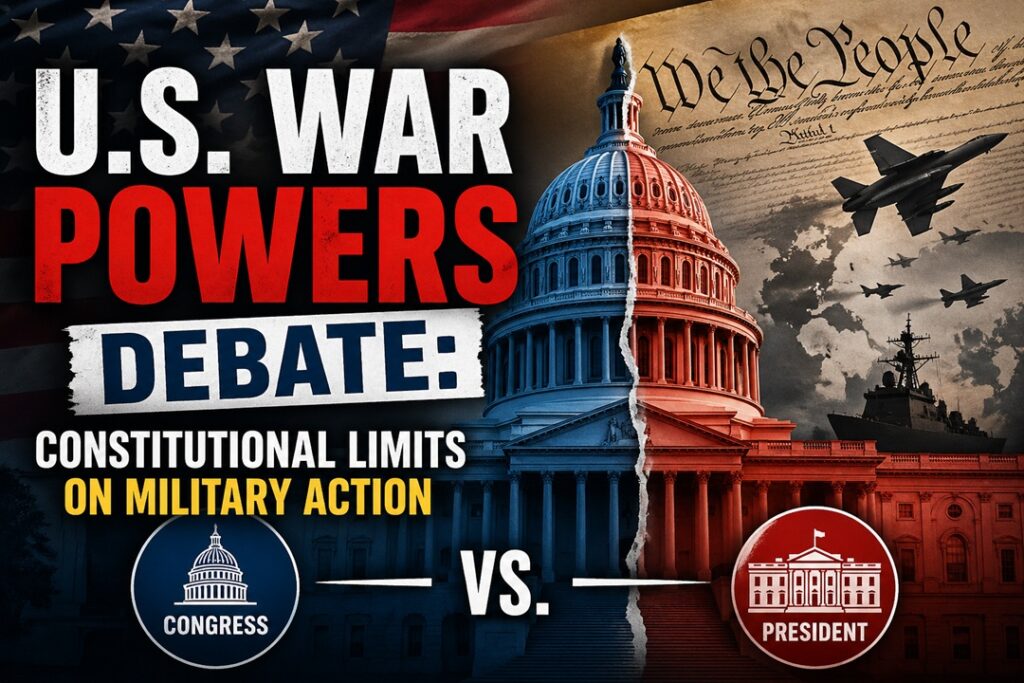
U.S. War Powers Debate: Constitutional Limits on Military Action
Context
The growing role of the United States in overseas conflicts has revived debates on the constitutional and legal boundaries governing its war-making powers.
Origin and Nature of the Debate
Institutional Contestation – The issue of who can authorize war in the U.S. has long been contested between political institutions.
Constitutional Allocation – The U.S. Constitution divides authority by empowering Congress to declare war, while the President acts as Commander-in-Chief.
Shift in Power Dynamics – Over decades, practical control has tilted toward the executive, raising concerns about unilateral military decisions.
Legislative Intervention – The War Powers Resolution (1973) was enacted to introduce checks on presidential military deployments without legislative approval.
Recent Developments – Military actions initiated under Donald Trump in West Asia have reignited scrutiny of this framework.
Historical Evolution of the Law
Post-Vietnam Response – The Resolution emerged after the Vietnam War, particularly due to secret expansions into Cambodia.
Executive Excesses – Actions taken by Richard Nixon without Congressional consent triggered constitutional concerns.
Congressional Assertion – In 1973, Congress overrode the presidential veto to reclaim its authority over war decisions.
Underlying Objective – The aim was to ensure that war-related decisions reflect collective institutional judgment.
Structure of War-Making Powers
Dual Authority Model –
- Congress: Declares war, funds military, raises armed forces
- President: Leads and directs military operations
Gradual Dilution of Legislative Role – Conflicts like Korea and Vietnam saw Presidents initiating wars without formal declarations.
Expansion of Executive Discretion – This trend marginalized Congress in critical security decisions.
Core Features of the 1973 Resolution
Consultative Requirement – The President must engage Congress before introducing troops into conflict zones wherever feasible.
48-Hour Disclosure Rule – A formal report must be submitted within 48 hours detailing justification, legality, and scope.
60-Day Operational Limit – Military engagement without approval must end within 60 days.
30-Day Exit Window – An extension is allowed for safe troop withdrawal.
Continuous Briefings – Periodic updates must be provided to Congress regarding ongoing operations.
Current Situation in West Asia
Rising Hostilities with Iran – U.S. military strikes, coordinated with Israeli operations, triggered retaliation.
Regional Spillover – Countries like United Arab Emirates, Qatar, and Saudi Arabia faced missile and drone threats.
Strategic Disruption – Iran’s blockade of the Strait of Hormuz disrupted global oil supply chains.
U.S. Countermeasures – Naval deployments and counter-blockade actions intensified American involvement.
Fragile Stability – Despite a ceasefire, tensions persist and legal compliance remains debated.
Interpretational and Legal Challenges
Ambiguity in Timeline – Disagreement exists on when the 60-day clock begins—initial action vs. formal notification.
Ceasefire Complications – Debate continues on whether ceasefire duration counts toward the deadline.
Legislative Hesitation – Congress has avoided authorizing new military actions since the Iraq War (2002), reflecting political caution.
Strategic Choices Before the Executive
Legislative Approval Route – Seeking Congress approval would reinforce constitutional legitimacy.
Phased Military Exit – Gradual withdrawal could ensure compliance with statutory limits.
Extension Mechanism – The 30-day buffer can be used for orderly disengagement.
Bypassing Constraints – Past instances show Presidents circumventing the Resolution, including actions in Yemen and Libya.
Trend of Executive Dominance
Historical Patterns –
- Richard Nixon – Cambodia operations
- Barack Obama – Libya intervention
- Donald Trump – Yemen involvement
Drivers of Overreach – Vague legal language, weak enforcement, and political reluctance of Congress.
Constraints on Congressional Authority
Political Divisions – Partisan dynamics weaken collective legislative action.
Limited Policy Initiatives – Efforts by leaders like Lisa Murkowski to formalize authorization have not progressed significantly.
Assessment of the War Powers Framework
Positive Aspects – Promotes transparency, accountability, and institutional balance.
Structural Weaknesses – Ambiguities (e.g., “hostilities”) and lack of enforcement reduce effectiveness.
Practical Outcome – Functions more as a guiding norm rather than a binding constraint.
Broader Strategic Consequences
Global Stability Risks – Unilateral actions can intensify regional conflicts.
Democratic Credibility – Repeated bypassing undermines institutional checks and balances.
International Legitimacy Issues – Military actions without approval raise concerns under global legal norms.
Way Forward
Revisiting the Law – Amendments are needed to clarify provisions and strengthen enforcement.
Strengthening Oversight – Ensure timely debate and voting in Congress.
Judicial Role – Courts can help define limits of executive power.
Bipartisan Cooperation – Essential to restore constitutional equilibrium.
Conclusion
The War Powers Resolution (1973) remains central to regulating U.S. military engagement. However, recurring executive dominance and legislative inaction have weakened its impact. The ongoing West Asia tensions underline the urgent need for reform to uphold accountability and prevent unchecked use of force.
Source : The Hindu