
India’s Orange Economy Push: Culture as the New Growth Engine
Context
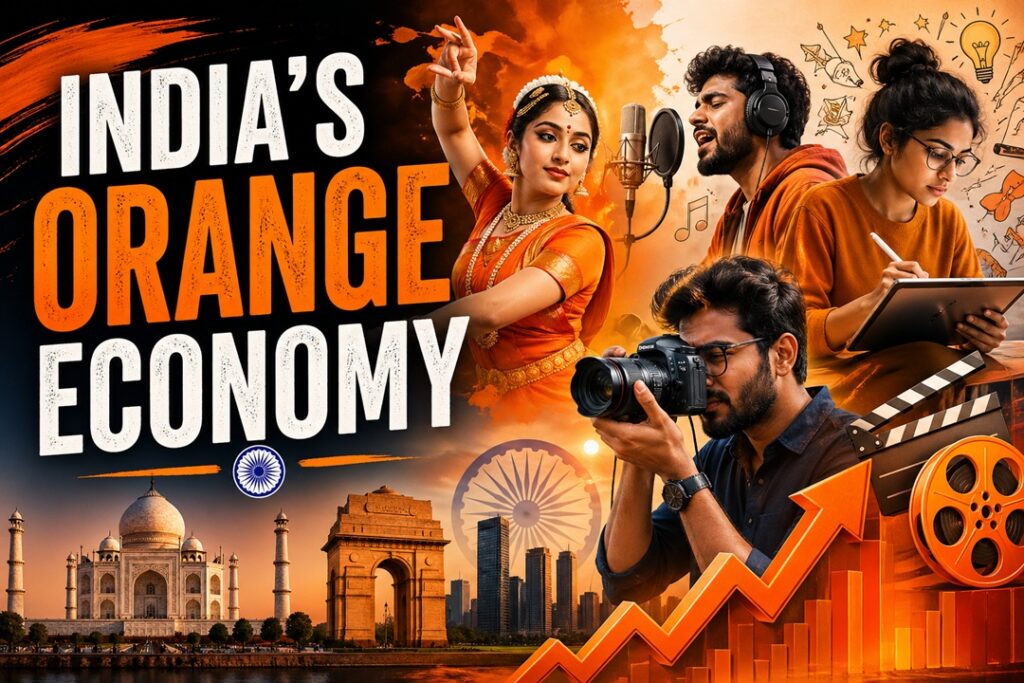
With rapid digital expansion and a young creator base, India is increasingly repositioning culture and creativity as core drivers of economic growth. The push toward the Orange Economy reflects a strategic shift to transform cultural capital into globally competitive Intellectual Property (IP), aligning with the broader vision of a knowledge-based and innovation-led economy.
Creative Economy Landscape in India
Conceptual Framework
The Orange Economy represents a growth model driven by imagination, cultural identity, and IP creation. It includes sectors like animation, films, gaming, fashion, digital media, and immersive storytelling—where cultural ideas are transformed into monetizable global assets.
Key Indicators and Trends
- Digital Expansion: India has crossed 1.028 billion internet users, with over one billion broadband connections, positioning it as a global hub for digital consumption.
- Gaming Boom: With nearly 42.5 crore gamers, India ranks among the top gaming markets globally; the sector touched ₹16,428 crore in FY23 with strong annual growth.
- Creator Economy: Around 2–2.5 million creators influence consumer spending worth $350–400 billion, expected to scale up to $1 trillion by 2030.
- GDP Contribution: Digital platforms like YouTube significantly boost the economy, contributing over ₹16,000 crore and generating lakhs of jobs.
Drivers of Growth in the Creative Sector
Cultural Commercialization
India can convert its myths, languages, folklore, and traditions into proprietary IP—ensuring long-term economic returns instead of one-time revenues.
Cross-Sector Innovation
Integration of film, design, and gaming enables creation of immersive, exportable content ecosystems with higher global adaptability.
Employment Potential
Initiatives like AVGC-XR are expected to generate nearly 20 lakh jobs, strengthening the creative workforce.
Rise of Creator Entrepreneurship
Individual creators are emerging as powerful distribution channels, taking Indian stories to global niche audiences.
Strategic Cultural Infrastructure
Viewing culture as infrastructure enables development of large-scale IP franchises spanning cinema, OTT platforms, and merchandising.
Key Constraints and Issues
Reliance on Global Platforms
Content visibility and monetization are largely controlled by foreign digital platforms and their algorithms.
Weak IP Retention
Despite high content production, India often lacks ownership of characters, stories, and formats, limiting long-term value capture.
Skill Fragmentation
Education systems remain siloed, lacking interdisciplinary training combining storytelling, technology, and business.
Unstable Revenue Models
Many creators depend on ad-based income, which is volatile and lacks sustainability.
Capital and Legal Gaps
Limited access to funding and poor awareness of IP laws hinder scaling and global commercialization.
Strategic Pathways Forward
Revamp Creative Education
Shift toward interdisciplinary learning that blends storytelling, design thinking, and entrepreneurship.
Focus on IP Creation
Encourage ownership-driven models such as licensing, franchises, and community-based monetization.
Adopt AI Integration
Incorporate AI tools in creative workflows, production, and distribution to enhance efficiency and scalability.
Expand Global Reach
Develop strong international distribution networks for Indian content as reusable and scalable IP assets.
Strengthen Policy Coordination
Promote cooperative federalism to align policies across central and state levels for a cohesive creative ecosystem.
Conclusion
India’s pivot toward the Orange Economy signals a structural shift—recognizing culture not merely as heritage but as a strategic economic driver. By prioritizing IP ownership, innovation, and global scalability, India can evolve from a content-rich nation into a dominant force in the global creative economy.
Source : The Hindu