
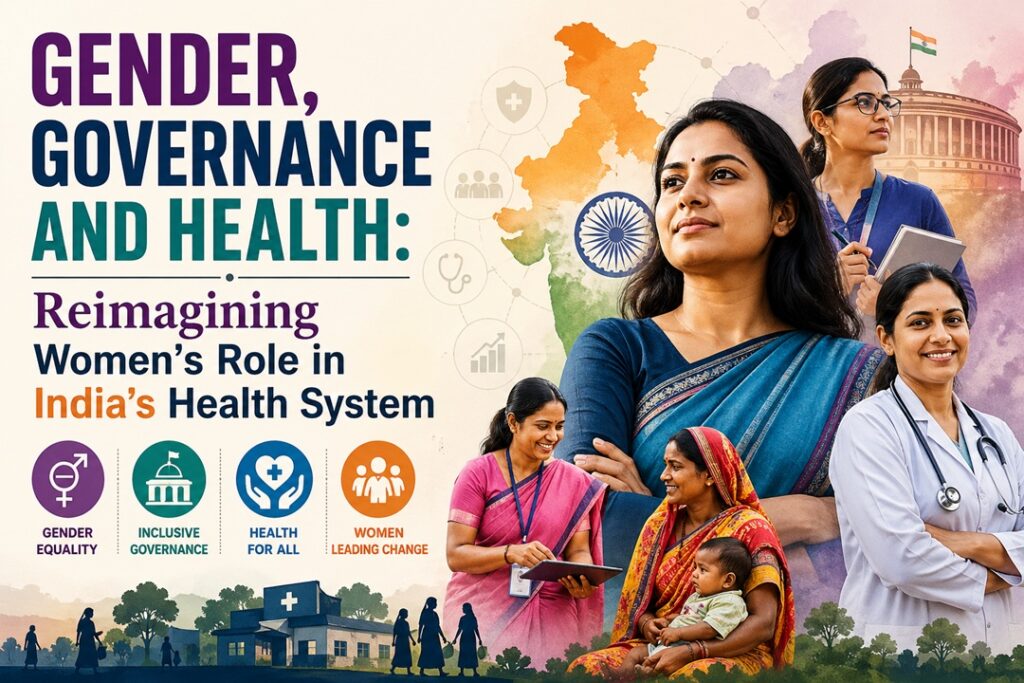
Gender, Governance and Health: Reimagining Women’s Role in India’s Health System
Context
A recent assessment of India’s health sector highlights that deep-rooted gender hierarchies continue to obstruct equitable outcomes, reflected in a low sex ratio at birth of 917 girls per 1,000 boys.
Understanding the Issue
This theme examines how gender-based power imbalances shape public health outcomes. It argues that entrenched male dominance influences policies, infrastructure, and service delivery, and that empowering women in decision-making is essential for achieving inclusive and effective healthcare.
Key Indicators on Women’s Health
- Imbalanced Birth Ratio: India’s sex ratio at birth remains at 917 girls per 1,000 boys, far below the biological norm (~950), pointing to continued gender bias and sex selection.
- Widespread Malnutrition: Nearly 60% of women in reproductive age are anaemic, while around 40% have inadequate BMI levels.
- Maternal Health Concerns: Maternal mortality has declined to 97 per 1 lakh live births (2018–20), yet early marriages (23% before 18) contribute to risky pregnancies.
- Regional Disparities: States like Gujarat show higher gender-based health inequality, whereas Kerala demonstrates better access and outcomes for women.
Gender Bias as a Structural Health Challenge
- Narrow Policy Lens: Women are often viewed only as mothers, ignoring their broader health needs across life stages.
- Son Preference Culture: Persistent societal bias weakens enforcement of laws against sex determination and distorts demographic balance.
- Neglect of Basic Dignity: Poor sanitation in healthcare settings (e.g., lack of toilets in most labor rooms) reflects systemic insensitivity.
- Proxy Governance: Practices like “Panch Pati” dilute women’s political authority in grassroots health planning.
- Top-down Governance: Centralized schemes often overlook local gender-specific needs, limiting effectiveness.
Barriers to Accessing Healthcare
- Service Gaps: Shortage of medicines and absence of female health professionals deter women from seeking care.
- Mobility Issues: Distance and lack of safe transport reduce timely access to health facilities.
- Economic Dependence: Limited financial autonomy restricts women’s ability to make independent health decisions.
- Care Burden: Household responsibilities and caregiving roles often take priority over personal health.
- Weak Welfare Design: Schemes like PMMVY exclude vulnerable groups and provide insufficient financial support.
Women as the Backbone of Healthcare Delivery
- Frontline Workforce: Around 10 lakh ASHA workers and 28 lakh Anganwadi workers form the base of rural healthcare.
- Undervalued Labour: These workers are treated as volunteers, lacking fair wages and job security.
- Nursing Majority: Women dominate nursing roles but face limited career progression and poor work environments.
- Leadership Gap: Senior positions in health governance remain largely male-dominated.
- Invisible Care Work: Women shoulder most informal healthcare responsibilities within families without recognition.
Way Forward
- Inclusive Leadership: Ensure greater representation of women in top health policy and administrative roles.
- Localized Planning: Strengthen community-level participation with active involvement of women in decision-making.
- Comprehensive Welfare: Expand maternity benefits to cover all women with adequate compensation.
- Improved Infrastructure: Build gender-sensitive facilities, including safe sanitation, in all healthcare institutions.
- Formal Recognition: Regularize ASHA and Anganwadi workers with proper salaries and social security benefits.
Conclusion
Health outcomes for women are deeply intertwined with societal power structures. As long as gender inequality shapes governance, disparities will persist. Transformative change requires shifting from symbolic inclusion to genuine leadership by women, ensuring that healthcare systems treat them as equal stakeholders rather than passive beneficiaries.
Source : FL