
Academic Freedom and Democratic Decline in India
Context
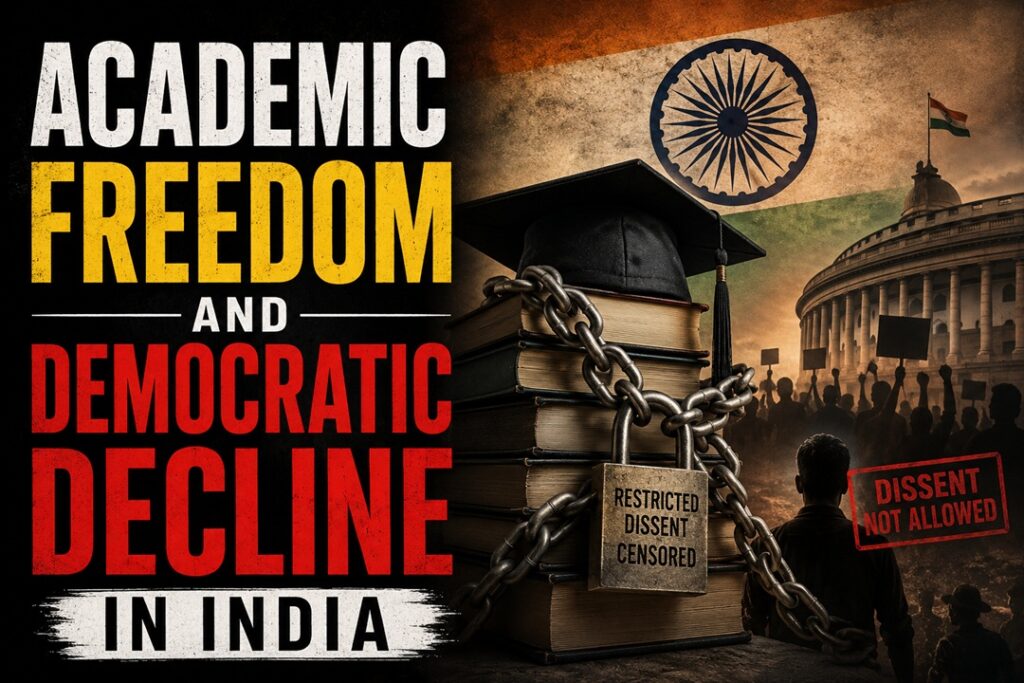
India’s declining academic autonomy is increasingly being linked to the shrinking democratic ecosystem, as universities witness intensified political oversight, censorship, and disciplinary action against critical voices.
What do recent global assessments indicate about democracy and academic autonomy in India?
Global Democracy Rankings
The 2026 report of the Varieties of Democracy Institute continues to classify India as an “electoral autocracy”, placing it in the lower tier globally for democratic performance.
Decline in Democratic Safeguards
The report highlights a continued weakening of democratic institutions, especially in areas such as press freedom, freedom of expression, and civil society participation, categorising India among rapidly autocratising nations.
Weakening Institutional Balance
The findings indicate an erosion of institutional checks and pluralistic norms that traditionally uphold democratic accountability and transparency.
Academic Freedom Under Pressure
The Scholars at Risk “Free to Think 2024” report states that academic freedom in India faces severe restrictions due to increasing governmental and political intervention in universities.
Ideological Influence in Higher Education
The report argues that higher education institutions are witnessing intensified ideological intervention through curriculum restructuring, restricted research spaces, and reduced tolerance for dissent.
Convergence with Other Global Indices
These observations align with broader concerns raised by indices such as Freedom House, which have also documented democratic backsliding in India.
Role of Universities in Democracy
A robust democracy depends not only on elections but also on
- Vibrant civil society,
- Independent research and evidence-based discourse, and
- Open public deliberation.
Universities serve as crucial spaces for these democratic functions.
Growing Institutional Constraints
Higher education institutions increasingly face budgetary constraints, administrative pressure, surveillance, and self-censorship, weakening independent scholarship.
Trend Toward Centralised Governance
Proposals such as the Viksit Bharat Shiksha Adhishthan Bill are viewed by critics as attempts to centralise educational governance, potentially reducing institutional autonomy.
What concerning trends are emerging within academia?
Disciplinary Action Against Scholars
Reports suggest that from 2014–2026, dozens of academics faced suspension, investigation, or punitive action over public statements or political opinions.
Restriction of Campus Expression
Service rules and administrative regulations are increasingly being used to restrict freedom of speech among faculty members and researchers.
Findings of Academic Freedom Networks
The India Academic Freedom Network documented disrupted seminars, arrests of students and faculty, and visa-related barriers for foreign researchers.
Shrinking Space for Intellectual Dissent
The contrast with figures like J. B. S. Haldane, who openly criticised governments while working in India decades ago, reflects the narrowing space for dissent today.
Wider Crackdown on Independent Inquiry
Recent years have seen increased pressure on students, researchers, journalists, and faculty members working on politically sensitive issues.
Political and Social Pressures
Certain themes are increasingly viewed as controversial or “unsafe”, limiting independent inquiry due to political influence, institutional caution, and social polarisation.
Institutional Accountability Concerns
Critics argue that many institutional mechanisms, including internal committees, often function symbolically rather than ensuring meaningful accountability.
Climate of Fear
When oversight bodies fail to protect academic freedom, mistrust deepens and self-censorship expands across campuses.
How does weakening academia affect democratic freedoms?
Damage to the Knowledge Ecosystem
The weakening of universities and civil society reduces the ability of institutions to critically evaluate policies and hold power accountable.
Democratic Oversight Weakens
Unchecked violence, discrimination, suppression of dissent, and intimidation collectively reduce the autonomy of civil society and educational institutions.
India and International Rights Frameworks
India has been a signatory to the International Covenant on Civil and Political Rights since 1979 but has not adopted the First Optional Protocol enabling individual complaints before the UN mechanism.
Constitutional Safeguards
Articles 14, 19, and 21 of the Indian Constitution guarantee equality, liberty, and freedom of expression, often interpreted expansively by the Supreme Court of India.
Debate on International Accountability
Critics argue that reluctance to adopt international complaint mechanisms limits avenues for justice once domestic remedies are exhausted.
Case Illustration
The prolonged incarceration and bail debates involving academics such as Umar Khalid and Sharjeel Imam have intensified debates over civil liberties and due process.
Perception of Unequal Justice
Comparisons between the treatment of activists and influential religious or political figures have triggered discussions regarding asymmetry in the justice system.
What are the consequences of homogenisation in universities and society?
Uniformity Over Intellectual Diversity
Critics argue that increasing emphasis on ideological conformity undermines diversity of thought within educational institutions.
Universities as Spaces of Debate
Historically, universities have functioned as centres for critical inquiry, innovation, and challenges to prevailing orthodoxies.
Importance of Dissent in Democracies
Healthy democracies evolve through disagreement, debate, and questioning of dominant narratives.
Gradual Democratic Backsliding
Authoritarian tendencies often emerge gradually through
- Fear-based narratives,
- Manufactured insecurities, and
- Incremental weakening of democratic norms.
Academic Freedom as a Democratic Indicator
The Academic Freedom Index increasingly serves as a measure of democratic health by assessing the independence of educational institutions.
Changing Institutional Culture
Many observers note that campuses once associated with vibrant debate now operate under heightened caution and regulatory scrutiny.
Concerns Over Judicial and Social Climate
Questions are increasingly being raised about whether public institutions, including courts and universities, remain equally accessible and protective of dissenting voices.
Conclusion
The central challenge is whether democratic institutions, universities, and civil society can preserve spaces for independent thought, critical inquiry, and public accountability. The future trajectory of Indian democracy may depend significantly on the ability of institutions to protect intellectual freedom, encourage debate, and uphold constitutional values in both campuses and public life.
Source : The Hindu