
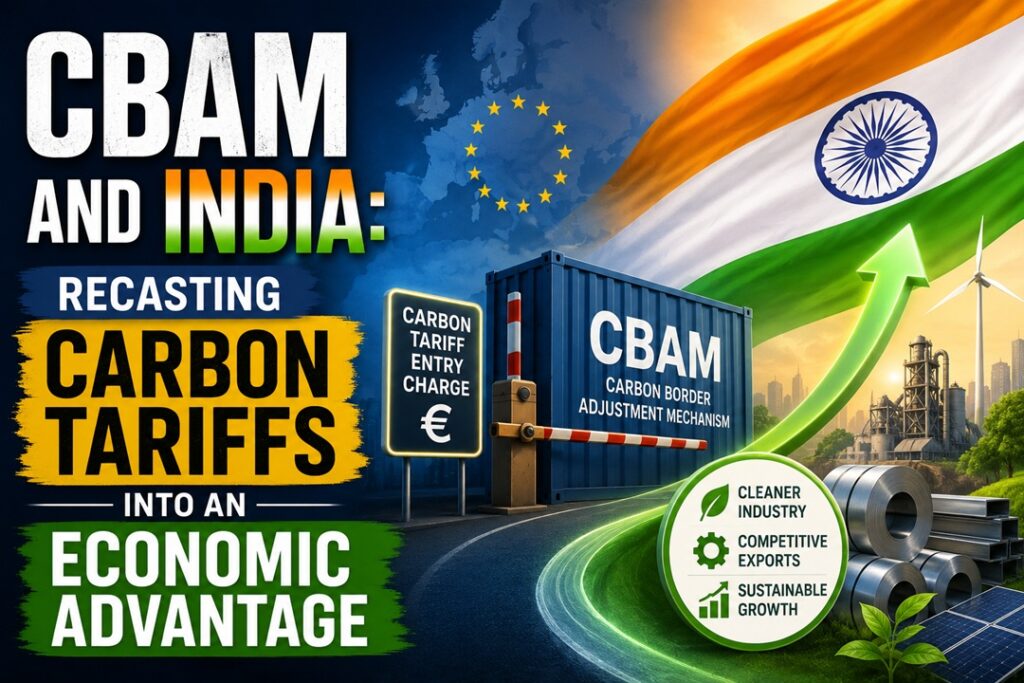
CBAM and India: Recasting Carbon Tariffs into an Economic Advantage
Context
With the European Union’s Carbon Border Adjustment Mechanism (CBAM) set to become fully operational from January 1, 2026, India is evaluating policy alternatives such as a proposed India Carbon Equalisation Mechanism (ICEM) to safeguard exports and retain carbon-linked revenues domestically.
CBAM and India: Recasting Carbon Tariffs into an Economic Advantage
About CBAM and India: Recasting Carbon Tariffs into an Economic Advantage
What is CBAM?
The Carbon Border Adjustment Mechanism (CBAM) is a climate-linked trade instrument introduced by the European Union to align the carbon costs borne by domestic EU industries with those imposed on imported products. The mechanism seeks to curb carbon leakage, wherein industries relocate production to countries with weaker climate regulations, by charging imports based on their embedded emissions.
Core Components of CBAM
Coverage of High-Emission Industries:
The mechanism initially covers sectors with intensive carbon footprints such as Iron & Steel, Cement, Aluminium, Fertilisers, Hydrogen, and Electricity generation.
Gradual Rollout Structure:
CBAM will function in parallel with the phased withdrawal of free emission allowances granted to EU industries between 2026 and 2034.
Recognition of Domestic Carbon Pricing:
Under Article 9, importers can claim deductions if a comparable carbon price has already been paid in the exporting country.
Emission Reporting Framework:
Exporters must comply with stringent MRV (Monitoring, Reporting and Verification) norms, often validated through accredited third-party agencies.
Carbon Certificate Purchase Requirement:
Importers are required to buy CBAM certificates linked to the prevailing prices under the EU Emissions Trading System (ETS).
Operational Mechanism
When an Indian aluminium exporter ships goods to the EU, the importer must disclose the emissions generated during manufacturing.
If the EU carbon benchmark stands at €90 per tonne and India has no equivalent domestic carbon levy, the importer bears the entire cost at the border.
However, if India imposes a domestic carbon pricing mechanism worth €40 per tonne equivalent, only the remaining €50 becomes payable within the EU framework.
Potential Gains for India
Domestic Retention of Carbon Revenues:
A national adjustment mechanism would allow India to retain revenues that would otherwise flow to European authorities.
Example: Carbon-related duties collected from Indian engineering exports could remain within India’s fiscal system instead of being transferred abroad.
Accelerating Industrial Green Transition:
Funds mobilized through domestic carbon pricing can support cleaner industrial technologies.
Example: Revenue generated can finance electric arc furnaces, renewable-powered manufacturing clusters, and green hydrogen adoption.
Expansion of Carbon Markets:
CBAM could accelerate the strengthening of India’s Carbon Credit Trading Scheme (CCTS) into a credible compliance-based market.
Example: Indian industries participating in domestic carbon trading could use certified credits as evidence for reduced EU liabilities.
Enhanced Bargaining Power in Trade Negotiations:
Climate-linked trade discussions under the India–EU FTA framework can provide India leverage in carbon accounting and equivalence standards.
Example: India can negotiate fair treatment for rupee-based carbon pricing systems during technical consultations.
Market Edge for Sustainable Manufacturers:
Indian firms with lower carbon intensity may gain competitiveness in premium global markets.
Example: Renewable energy-powered steel plants may attract lower border levies compared to coal-dependent global producers.
Major Concerns
Unequal Green Subsidy Ecosystem:
European industries often receive substantial public financial assistance for decarbonisation, unlike many Indian firms.
Example: EU manufacturers may access multi-billion-euro transition packages, while Indian industries face higher financing burdens.
Compliance Burden on Small Enterprises:
MSMEs may struggle with costly emission audits and technical reporting obligations.
Example: Smaller engineering exporters could face disproportionately high certification expenses relative to export value.
Risk to Export Competitiveness:
Failure to establish a domestic offset mechanism may increase the effective cost of Indian exports.
Example: Indian cement or metal exports may lose price competitiveness in European markets.
Regulatory Dependence:
Alignment with externally designed carbon standards may reduce India’s policy autonomy.
Example: Domestic firms may be compelled to adopt foreign methodologies for emissions accounting and verification.
Industrial Data Vulnerability:
Detailed disclosure of industrial production and energy-use patterns could create strategic concerns.
Example: Sensitive operational data from critical manufacturing sectors may become accessible to external verification agencies.
Way Forward
Launch an Indian Carbon Equalisation Framework:
India should establish an export-linked carbon adjustment mechanism to capture carbon revenues domestically.
Dedicated Green Transition Fund:
Carbon revenues should be channelled into a transparent fund supporting low-carbon industrial modernisation.
Recognition of Indian Carbon Credits:
India must pursue mutual recognition arrangements for CCTS certificates under EU carbon regulations.
MSME Support Infrastructure:
The government should provide subsidised carbon accounting tools, digital calculators, and audit support for smaller exporters.
Building a Developing Country Coalition:
India can lead emerging economies in advocating fair carbon trade rules and equitable redistribution of carbon revenues.
Conclusion
India should view CBAM not merely as a trade barrier, but as an opportunity to strengthen domestic carbon governance and industrial competitiveness. A well-designed Indian carbon adjustment mechanism can help retain financial resources, support green industrialisation, and preserve strategic autonomy in the evolving global climate economy. By proactively adapting to carbon-linked trade measures, India can transform climate compliance into long-term economic leverage.
Source : The Hindu