
Jharkhand Treasury Fraud Raises Questions Over Digital Governance Safeguards
Context
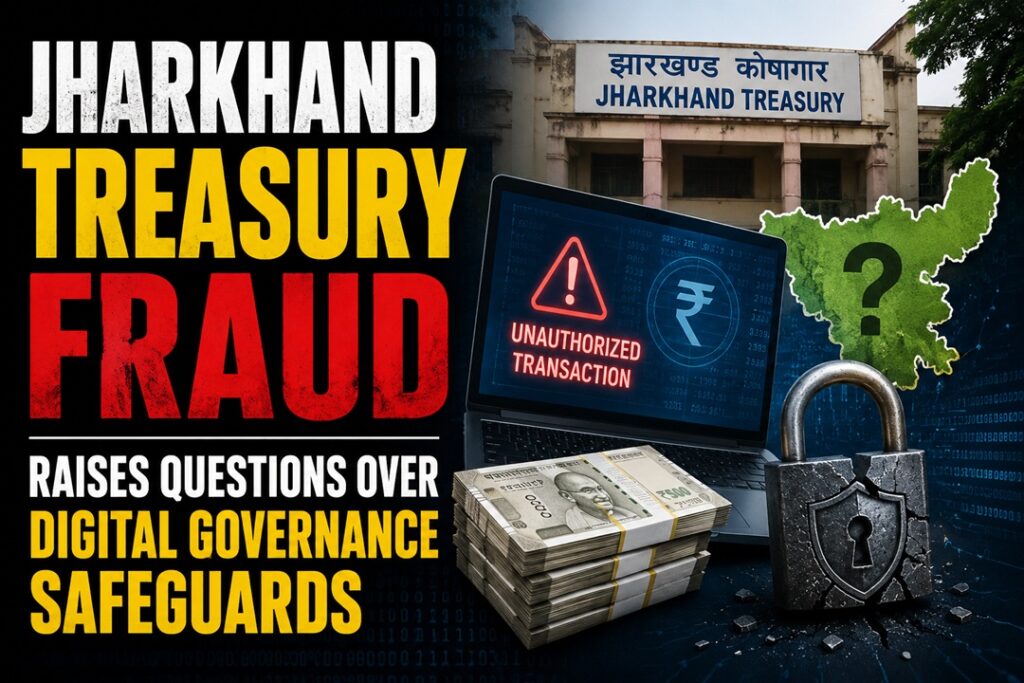
Jharkhand is facing allegations of a major financial irregularity involving the diversion of nearly ₹50 crore from government treasuries in several districts through manipulation of digital financial systems.
Understanding the Issue
The Integrated Financial Management System (IFMS) is a digital platform used by the state government for handling budgeting, treasury functions, salary payments, and financial administration.
Within IFMS, the Kuber portal facilitates direct electronic transfer of salaries, pensions, and other payments into beneficiaries’ bank accounts.
Methods Allegedly Used in the Fraud
Fake Employee Entries
Officials allegedly generated records of non-existent or inactive employees, including retired or deceased individuals, to divert government salary payments.
Misuse of Official Access
The manipulation reportedly occurred through authorized internal credentials rather than external cyberattacks, highlighting insider misuse of administrative privileges.
Inflation of Salary Components
Certain staff members allegedly altered salary details on the Kuber portal, increasing payment amounts and redirecting surplus funds into linked private accounts.
Weak Verification Procedures
The system depended heavily on approvals by Drawing and Disbursing Officers (DDOs), while detailed scrutiny of bulk payment entries remained limited.
Alteration of Records
Investigators reportedly found inconsistencies between physical treasury documents and digital database entries, suggesting post-payment data modifications to conceal evidence.
Reasons Behind Administrative Leakages
Delayed Audit Mechanisms
Financial discrepancies often surface only after long gaps, allowing irregularities to continue unchecked for years.
Illustration: In one district, alleged fund diversion reportedly continued for nearly a decade before being detected during routine scrutiny.
Declining Ethical Standards
Corruption within administrative machinery weakens institutional integrity when officials prioritize private enrichment over public accountability.
Excessive Dependence on Hierarchical Approval
Treasury systems frequently rely on senior officers’ certifications without parallel digital authentication or cross-verification mechanisms.
Inadequate Digital Safeguards
Weak IT monitoring systems failed to generate alerts regarding unusual salary spikes or suspicious account modifications.
Poor Deterrence Structure
Slow investigations and prolonged judicial processes reduce fear of punishment among corrupt officials.
Major Concerns Emerging from the Scam
Erosion of Public Confidence
Such incidents weaken trust in e-governance systems and digital financial reforms meant to improve transparency.
Questions Over Probe Independence
Since senior officials themselves act as approving authorities, concerns arise regarding impartiality in internal investigations.
Difficulty in Recovering Funds
Money transferred through layered bank accounts and fake identities becomes difficult to trace and retrieve.
High Transaction Complexity
Large volumes of daily treasury transactions make manual scrutiny impractical without advanced technological tools.
Challenges in Digital Forensics
Tampered electronic records complicate efforts to establish reliable evidence chains for prosecution.
Reform Measures Suggested
AI-Based Monitoring Systems
Deploy machine learning tools within treasury portals to identify abnormal salary changes and suspicious transaction patterns in real time.
Regular Employee Verification
Conduct periodic reconciliation between departmental employee records and actual bank disbursement data.
Continuous Digital Auditing
Shift from delayed traditional audits toward ongoing automated scrutiny of treasury operations.
Greater Responsibility for DDOs
Introduce stricter legal accountability standards for officers certifying financial transactions.
Protection for Informants
Strengthen whistleblower safeguards so employees can report irregularities without fear of retaliation.
Conclusion
The Jharkhand treasury controversy highlights that digital governance systems alone cannot eliminate corruption unless accompanied by strong oversight, ethical administration, and effective accountability frameworks. Technology can improve efficiency, but institutional integrity remains central to safeguarding public finances.
Source : The Indian Express