
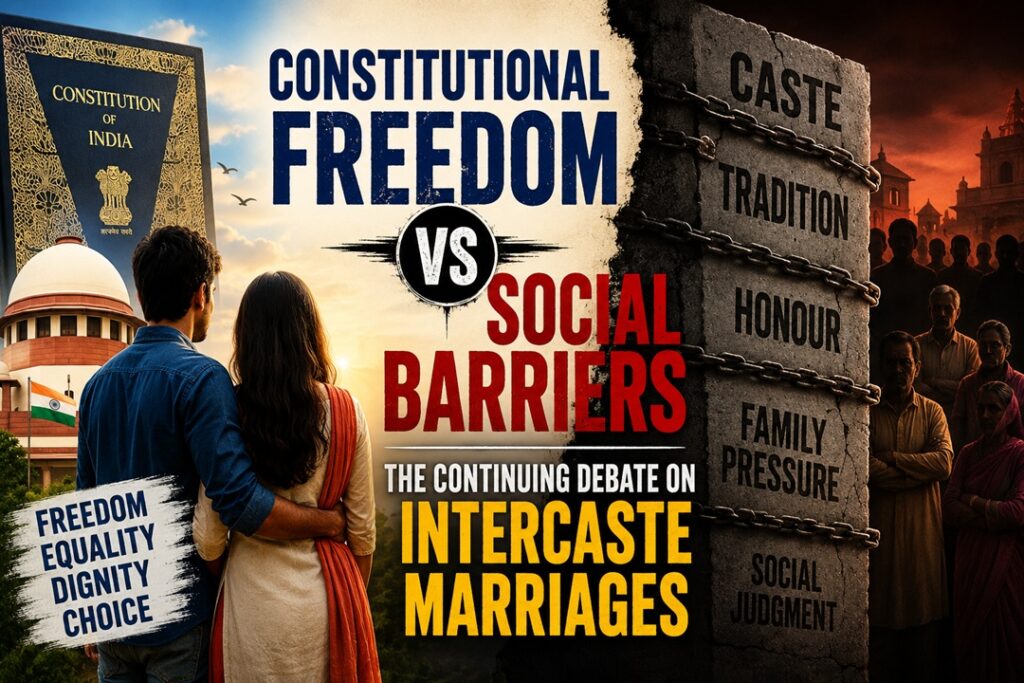
Constitutional Freedom vs Social Barriers: The Continuing Debate on Intercaste Marriages
Context
Coinciding with Dalit History Month, recent incidents from Gujarat involving coercion, honour-based violence, and forced separation of intercaste couples have once again exposed the disconnect between constitutional rights and entrenched caste practices.
Intercaste Marriages and the Continuing Social Challenge
About Intercaste Marriages and the Continuing Social Challenge
Meaning and Significance
An intercaste marriage refers to a marital union between individuals belonging to different caste groups. Although the Indian Constitution and the Special Marriage Act, 1954 legally recognize such marriages, social acceptance remains weak in many regions. Informal caste institutions, local networks, and conservative social norms frequently undermine constitutional freedoms, resulting in social exclusion, threats, and honour-based crimes.
Key Facts & Trends
- Limited Acceptance: Even after decades of constitutional governance, surveys show that intercaste marriages account for only around 5–6% of total marriages in India.
- Supreme Court Intervention (2018): In the Shakti Vahini vs Union of India judgment, the Supreme Court declared any interference by Khap Panchayats or community groups in adult consensual marriages to be unlawful.
- Rising Incidents of Coercion: During 2025–26, states such as Gujarat witnessed several cases involving honour killings, forced confinement, and intimidation of intercaste couples.
- Criticism of the Special Marriage Act: The mandatory 30-day public notice requirement under the SMA is often criticized for exposing couples to family pressure and vigilante violence.
Legal Safeguards Related to Intercaste Marriage
- Article 21: The Right to Marry is recognized by the Supreme Court as part of the Right to Life and Personal Liberty.
- Special Marriage Act, 1954: Provides a secular legal framework enabling marriage irrespective of caste or religion.
- Hindu Marriage Act, 1955: Does not prohibit marriages between Hindus of different castes, including Sikhs, Jains, and Buddhists.
- SC/ST (Prevention of Atrocities) Act, 1989: Offers protection where caste-based violence or harassment targets couples involving Dalit or Tribal partners.
- Government Incentive Schemes: Both the Centre and states provide financial assistance for intercaste marriages involving Scheduled Caste partners under schemes such as the Dr. Ambedkar Scheme.
Factors Encouraging Intercaste Marriages
Expansion of Higher Education
Universities and professional institutions provide spaces where young people interact beyond caste boundaries.
Example: NEET-qualified student Chandrika Chaudhary prioritized compatibility and shared ambitions over caste identity.
Urbanisation and Financial Independence
Migration for jobs and economic self-reliance reduce dependence on traditional caste structures.
Example: Artist Aarti Sangani built social and professional relationships across communities through her work in the music industry.
Growth of Social Media Networks
Digital platforms enable communication outside conventional matchmaking systems.
Example: Kinjal Rabari publicly asserted her marital choice online, challenging traditional customs such as Sata Pratha.
Judicial Awareness and Legal Assertion
Increased awareness of constitutional rights has encouraged couples to seek legal remedies.
Example: Haresh approached the High Court through a habeas corpus petition to safeguard his partner’s liberty.
Influence of Social Reform Movements
Ideas propagated by social reformers like B.R. Ambedkar and Jyotiba Phule continue to inspire resistance against caste hierarchy.
Example: Activists in Ahmedabad organized demonstrations asserting that intercaste marriage is central to dismantling caste discrimination.
Major Challenges
Persistence of Caste Endogamy
Customs such as Sata Pratha link marriages between families, making intercaste unions socially unacceptable.
Example: Community leaders often attempt to forcibly reverse such marriages to maintain reciprocal arrangements.
Institutional Indifference
Law enforcement agencies are frequently accused of siding with families or caste groups rather than protecting adult autonomy.
Example: Despite appeals for safety, Kinjal Rabari reportedly faced organized social pressure that weakened legal protection.
Patriarchal Notions of Honour
Women are often viewed as carriers of caste identity, making their marital choices a matter of “community prestige.”
Example: In some cases, women are treated as exchangeable assets within patriarchal negotiations.
Collective Moral Surveillance
Certain organizations actively monitor and intervene in relationships outside caste or religious boundaries.
Example: Reports indicate that networks linked to extremist elements have pressured couples into separation.
Gaps in Emerging Legal Proposals
Provisions requiring prior notification to parents may unintentionally endanger couples.
Example: Critics argue that notice requirements in proposed UCC-related provisions could trigger immediate retaliation from hostile families.
Measures Needed
- Impartial Policing: Police authorities must strictly implement Supreme Court directives protecting consenting adults.
- Educational Reforms: School and college curricula should promote constitutional morality and social equality.
- Promoting Social Integration: Public campaigns should normalize intercaste marriages as instruments of social harmony and equality.
- Proactive Judicial Intervention: Courts should take suo motu cognizance in cases involving honour violence and unlawful confinement.
- Reforming Marriage Laws: Privacy-compromising provisions such as mandatory public notices under the SMA should be reconsidered.
Conclusion
The issue of intercaste marriage reflects the broader struggle between constitutional democracy and deeply rooted caste structures. While India’s legal system formally protects the freedom to choose one’s partner, social realities continue to obstruct that freedom in many regions. Meaningful change requires not only legal enforcement but also a sustained transformation in societal attitudes toward caste and individual liberty.
Source : FL