
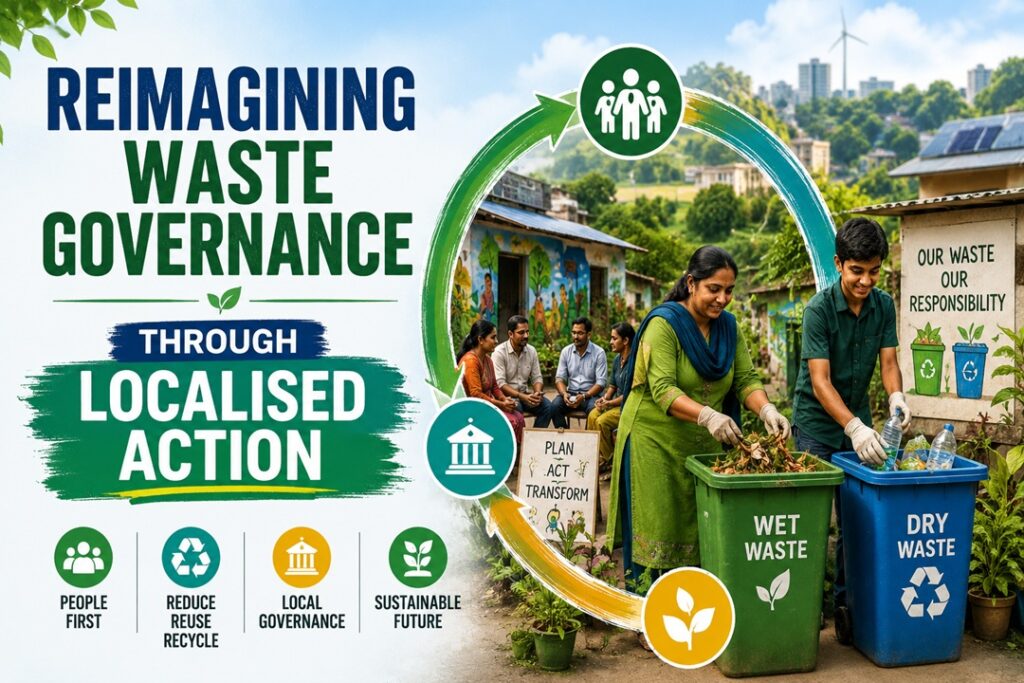
Reimagining Waste Governance Through Localised Action
Context
The Solid Waste Management Rules, 2026, enforced from April 1, 2026, have triggered debate over their highly centralised and compliance-heavy framework. Critics contend that the rules weaken cooperative federalism and ignore ground realities, risking administrative paperwork instead of meaningful environmental outcomes.
Localised Governance as a Remedy to India’s Waste Emergency
About Localised Governance for Waste Management:
Meaning:
A localised waste governance model transfers greater planning and operational powers to Urban Local Bodies (ULBs) and Gram Panchayats, enabling community-specific waste solutions.
It is rooted in the principle of subsidiarity, where governance functions are carried out by the lowest competent authority using local knowledge, citizen participation, and informal recycling networks.
Key Indicators of India’s Waste Challenge:
Financial Inefficiency:
Weak waste accounting systems and centrally imposed models force municipalities to divert nearly 40–50% of sanitation budgets toward transportation instead of scientific processing.
Landfill Disaster Risks:
Large dumping sites have become hotspots of methane emissions and recurring fires, highlighted by incidents such as the Kochi and Delhi landfill fires of 2024.
Urban Flooding:
Improper disposal of plastics blocks drainage systems, aggravating monsoon flooding in metropolitan regions such as Bengaluru and Mumbai.
Administrative Burden:
Overdependence on paperwork and digital reporting creates cosmetic compliance while masking actual deficiencies in waste handling systems.
Ecological Consequences of India’s Waste Mismanagement
Plastic and E-Waste Expansion:
Both cities and villages are witnessing rising plastic and electronic waste accumulation beyond existing treatment capacity.
Example: Rural regions increasingly face disposal issues relating to pesticide packaging and sanitary waste despite lacking basic collection infrastructure.
Toxic Leachate Pollution:
Dumping grounds near lakes and rivers generate contaminated runoff that damages aquatic ecosystems.
Example: Landfills around Bengaluru are situated close to water bodies heavily covered with water hyacinth, indicating nutrient and toxin overload.
Open Waste Burning:
Scientific waste processing gaps often lead to open-air burning, worsening air quality in smaller towns and peri-urban areas.
Example: Northern Indian towns experience severe winter air deterioration due to recurring garbage fires.
Climate and Flood Vulnerability:
Blocked drains convert moderate rainfall into severe urban flooding events.
Example: Plastic-choked stormwater drains were identified as a major contributor to Bengaluru’s 2025 flood crisis.
Legacy Dumping Sites:
Old dumpsites continue to release pollutants into soil and atmosphere despite remediation attempts.
Example: Delhi’s Ghazipur landfill remains a prominent symbol of chronic urban waste neglect.
Factors Driving Excessive Centralisation
Perceived Weakness of Local Bodies:
A common assumption exists that local governments lack adequate technical and managerial capacity.
Example: The 2026 framework applies nearly identical operational standards to both Gram Panchayats and megacities.
Centralised Monitoring Culture:
The Union government often prioritises uniform control mechanisms over State-level flexibility.
Example: CPCB-managed reporting portals reduce local institutions to data-uploading agencies.
Uniform Policy Approach:
Technocratic governance tends to impose standardised solutions across geographically diverse regions.
Example: Imposing Material Recovery Facility-based systems in fragile Himalayan settlements disregards terrain constraints.
Litigation-Oriented Administration:
Rules are often drafted to satisfy judicial scrutiny through rigid uniformity.
Example: Compliance timelines frequently overlook the actual implementation capacity of rural local bodies.
Weakening of Grassroots Innovation:
Over-centralisation discourages experimentation and local problem-solving.
Example: Indigenous composting or community-led recycling models receive limited policy space under standardised frameworks.
Consequences of a Top-Down Waste Framework
Diffused Responsibility:
Shared control between Centre, States, and local bodies creates ambiguity regarding accountability.
Example: Municipalities blame inadequate funding while higher authorities cite implementation failures.
Administrative Overload:
Officials devote excessive time to compliance documentation instead of field-level sanitation management.
Example: Workers in smaller municipalities are increasingly assigned reporting tasks rather than waste collection duties.
Financial Pressure on Local Governments:
Additional responsibilities are imposed without assured fiscal support.
Example: Panchayats are expected to procure costly waste vehicles despite limited maintenance capacity.
Weakening of Federal Principles:
Central rules increasingly dominate subjects constitutionally linked to States and local governance.
Example: Public sanitation policies are effectively shaped through centralised regulatory mechanisms.
Reduced Policy Innovation:
States lose the flexibility to test alternative waste management strategies.
Example: Self-Help Group-led decentralised composting initiatives may conflict with rigid national templates.
Reform Priorities
Strengthen Subsidiarity:
Waste governance responsibilities should be assigned to the lowest viable administrative unit such as wards and Gram Sabhas.
Encourage State-Level Experimentation:
States should receive flexibility to design context-specific waste systems for a fixed policy period.
Phased Compliance Mechanism:
Large metropolitan regions may adopt stricter standards first, while rural and small-town systems follow simplified models.
Assured Fiscal Transfers:
Every additional responsibility imposed under the Rules should be matched with predictable statutory funding support.
Collaborative Data Systems:
Digital portals should function as shared governance platforms enabling local customisation instead of merely monitoring compliance.
Conclusion
The Solid Waste Management Rules, 2026, highlight the tension between technocratic centralisation and grassroots governance in India’s environmental policy landscape. A sustainable response to the waste crisis requires empowering local institutions, strengthening fiscal federalism, and enabling region-specific innovation. Cleaner cities and villages are unlikely to emerge through paperwork alone; they depend on locally driven governance ecosystems.
Source : The Hindu