
Water Governance Challenges in India
Context
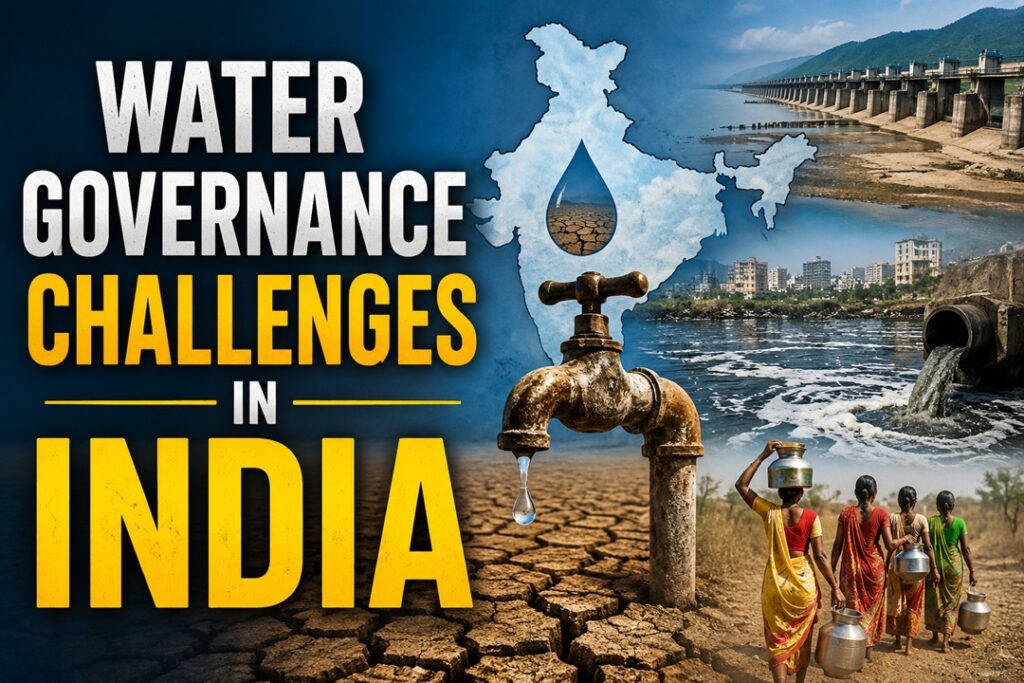
Despite receiving abundant monsoon rainfall annually, India continues to face severe water stress due to inadequate storage infrastructure, fragmented governance mechanisms and inefficient utilisation of water resources.
What are the major paradoxes in India’s water management system?
Population Pressure vs Limited Resources
India sustains almost 18% of the global population while possessing barely 4% of the world’s freshwater availability.
High Rainfall but Low Storage Capacity
The country receives close to 4,000 billion cubic metres (bcm) of rainfall annually, yet only around 1,100 bcm is effectively utilisable because of uneven spatial distribution, poor storage infrastructure and ecological limitations.
Water Stress Amid Heavy Precipitation
According to the NITI Aayog’s Composite Water Management Index, nearly 600 million Indians experience severe to extreme water stress despite substantial annual rainfall.
Shrinking Per-Capita Availability
Per-capita water availability has sharply declined from nearly 5,000 cubic metres after Independence to around 1,400 cubic metres today due to population growth and overexploitation.
Excessive Dependence on Groundwater
India has emerged as the largest extractor of groundwater globally, accounting for nearly 25% of total worldwide extraction.
While this supported agricultural growth and rural livelihoods, it has accelerated groundwater depletion across many regions.
How is India’s water governance framework structured?
Multi-Tier Governance Mechanism
Water governance in India functions through coordination among the Union Government, States and local institutions.
Central-Level Institutions
Ministry of Jal Shakti
Acts as the principal ministry dealing with water resources, drinking water and sanitation.
Central Water Commission (CWC)
Responsible for river basin planning, surface water management and flood moderation.
Central Ground Water Board (CGWB)
Monitors groundwater reserves and provides scientific assessment for aquifer sustainability.
NITI Aayog
Assesses State-level performance in water governance through tools like the Composite Water Management Index, promoting data-driven governance and accountability.
Constitutional Distribution of Powers
Water falls under Entry 17 of the State List, giving States primary responsibility over irrigation, water supply and groundwater regulation.
However, the Union Government exercises authority over inter-State rivers under Entry 56 of the Union List and environmental regulation.
State-Level Implementation
State irrigation departments, municipal water agencies and Panchayati Raj Institutions play a major role in executing water policies and service delivery.
Institutional Coordination Challenges
The federal structure often creates overlapping responsibilities and coordination gaps between Union, State and local authorities, making water governance increasingly complex.
Which legal and policy frameworks regulate water governance in India?
Article 21 – Right to Water
The Supreme Court has interpreted the Right to Life under Article 21 to include access to safe and clean drinking water.
Water (Prevention and Control of Pollution) Act, 1974
Provides the primary legal framework to prevent water pollution and established the CPCB and SPCBs.
Water Cess Act, 1977
Introduced a cess on industrial and local authority water consumption to encourage conservation and support pollution-control mechanisms.
Environment (Protection) Act, 1986
Empowers the Central Government to take measures for environmental protection, including safeguarding water bodies.
Central Ground Water Authority (CGWA)
Regulates groundwater extraction through the issuance of No Objection Certificates (NOCs) for industries and infrastructure projects.
River Boards Act, 1956
Allows the Centre to create river boards for inter-State river development and coordination.
Indian Easements Act, 1882
Defines certain water-use rights and recognises State authority over natural water resources.
National Water Policy, 2012
Provides a strategic policy framework encouraging integrated water resource management, conservation and efficient utilisation.
Which national initiatives aim to improve water governance?
Tackling Institutional Fragmentation
The Centre increasingly uses centrally sponsored missions to combine financial support with State-level implementation.
Jal Jeevan Mission (2019)
Targets universal functional household tap connections in rural areas and has been extended till 2028 to ensure broader coverage.
Atal Bhujal Yojana
Encourages community-led groundwater management and aquifer budgeting in water-stressed regions.
Pradhan Mantri Krishi Sinchayee Yojana (PMKSY)
Promotes micro-irrigation and efficient irrigation practices to reduce agricultural water consumption.
AMRUT Mission
Focuses on strengthening urban water supply systems, sewage treatment and wastewater reuse infrastructure.
Namami Gange Programme
Integrates pollution control, river rejuvenation, sewage treatment and ecological restoration within the Ganga basin.
What reforms can strengthen water governance in India?
Learning from Global Models
International practices such as circular water economies, precision irrigation and wastewater reuse offer useful lessons for India.
Enhancing Wastewater Reuse
Expanding urban wastewater recycling can significantly reduce pressure on freshwater resources.
Agricultural Water Efficiency
Improved crop diversification and modern irrigation technologies can increase water productivity in agriculture.
Strengthening Governance Architecture
Greater integration of scientific research, technological innovation and institutional coordination is essential for sustainable water management.
Way Forward
India’s water future will depend not merely on the quantity of rainfall received, but on the efficiency of governance, storage and distribution systems.
A shift toward integrated and participatory water management can help transform India’s water economy from chronic scarcity toward long-term sustainability.
Achieving the targets of United Nations Sustainable Development Goal-6 on clean water and sanitation will remain critical for India’s aspiration of becoming a developed nation by 2047.
Source : The Hindu