
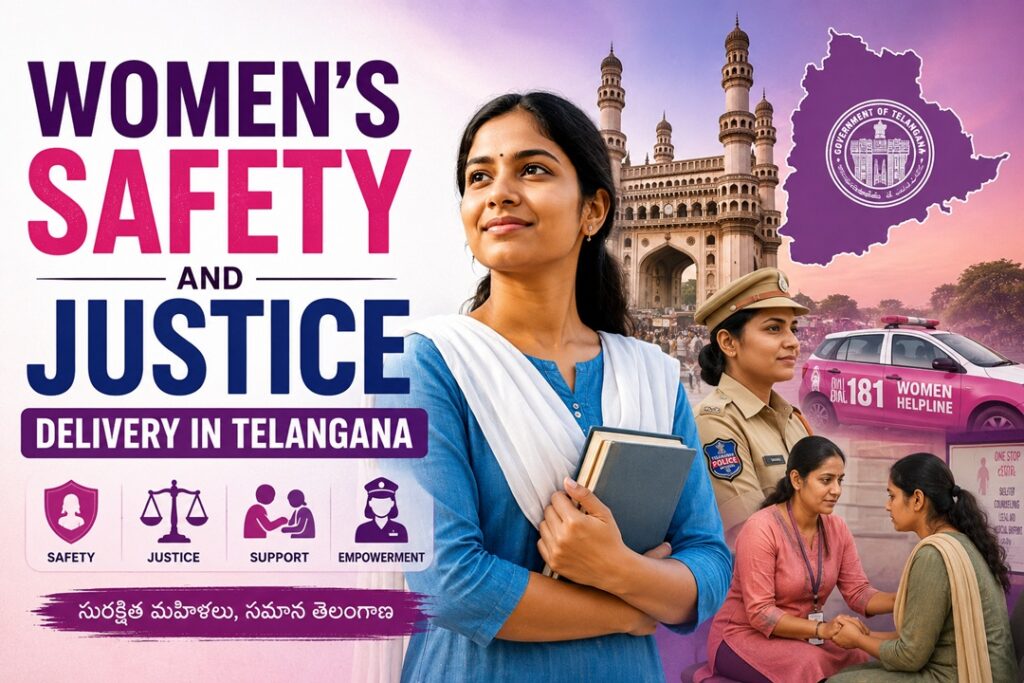
Women’s Safety and Justice Delivery in Telangana
Context
A recent high-profile POCSO case involving a politically influential family reignited debates on whether justice delivery systems can remain impartial when power and influence intersect with crimes against women and minors.
AboutWomen’s Safety and Justice Delivery Framework
What does it imply?
Women’s safety today goes beyond protection from physical violence and includes ensuring dignity, freedom, and security in both public and digital spaces.
It reflects a shift from incident-based policing to a rights-based governance approach that emphasizes accountability, survivor-centric justice, and institutional neutrality irrespective of the accused’s political or social standing.
The framework also focuses on enabling women to participate confidently in workplaces, educational institutions, politics, and online platforms without fear of intimidation, harassment, or reputational attacks.
Key Trends and Indicators
Increasing Cases of Crimes Against Women:
According to recent NCRB trends, crimes against women in Telangana have continued to show an upward trajectory, reflecting growing concerns over harassment, assault, and cyber abuse.
Public Space Vulnerability:
Surprise field-level safety assessments conducted by officials in urban areas revealed persistent harassment in crowded junctions and transport zones, especially during night hours.
Expansion of Digital Harassment:
Cybercrime units have reported a sharp rise in coordinated trolling, morphed content circulation, and anonymous online intimidation campaigns targeting women in public life.
Vulnerability of Minors:
Recent POCSO-related investigations indicate that children and adolescents remain particularly exposed to abuse, especially where the accused possess economic or political influence.
Challenges Affecting Women’s Safety
In the Digital Sphere:
Coordinated Cyber Abuse:
Women increasingly face organized online attacks involving fake accounts, misinformation, and character assassination campaigns.
AI-Generated Manipulation:
Artificial intelligence tools are being misused to create morphed visuals, deepfakes, and misleading narratives targeting women.
Anonymous Online Ecosystem:
Fake profiles and encrypted communication channels complicate efforts by cybercrime authorities to identify offenders quickly.
Psychological Impact:
Sustained online harassment often results in emotional distress, reputational damage, and professional setbacks for victims.
In the Physical Sphere:
Everyday Harassment:
Incidents such as stalking, verbal abuse, inappropriate gestures, and public intimidation continue to remain widespread.
Gender-Based Violence:
Threats of assault, domestic abuse, and workplace exploitation persist despite increased policing initiatives.
Institutional Bias and Delay:
Victims often face procedural delays and pressure when influential individuals are involved in criminal investigations.
Unequal Access to Justice:
Socio-political influence can discourage survivors from pursuing complaints due to fear of retaliation or social stigma.
Measures Undertaken by Telangana
Gender Awareness Campaigns:
The state government has initiated awareness drives encouraging public participation in challenging sexism and promoting respect toward women.
Dedicated Investigation Mechanisms:
Specialized investigative teams have been formed to probe cyber harassment, online abuse, and targeted misinformation campaigns.
Strengthening Cyber Policing:
Police authorities have increased collaboration with digital platforms and enhanced cyber-monitoring mechanisms to track anonymous offenders.
Expansion of SHE Teams:
Dedicated SHE Teams continue to conduct surveillance, decoy operations, and rapid-response interventions in vulnerable public areas.
Technology-Driven Surveillance:
Use of CCTV networks, AI-enabled monitoring, and digital evidence collection has been expanded to improve conviction rates.
The Way Forward
Equal Application of Law:
Justice mechanisms must function independently of political or social influence to strengthen public trust in the rule of law.
Stronger Cyber Laws:
Clear legal definitions and penalties for deepfakes, digital defamation, and coordinated online abuse should be introduced.
Gender Sensitization of Institutions:
Regular training programs for police personnel, prosecutors, and judicial officers are essential to ensure survivor-sensitive handling of cases.
Community and Youth Engagement:
Educational institutions should integrate gender-awareness and respectful online conduct programs to address misogyny at an early stage.
Advanced Cyber Forensics:
Investment in AI-assisted cyber forensic tools and faster digital tracing systems can improve the detection of coordinated harassment networks.
Conclusion
Ensuring women’s safety requires more than visible policing; it demands consistent and impartial justice delivery across both physical and digital spaces. Telangana’s experience highlights the importance of institutional accountability, technological preparedness, and social transformation in building a secure environment for women and children. Ultimately, the credibility of governance depends on whether justice remains accessible to every survivor, regardless of the accused’s influence or status.
Source : The Hindu