
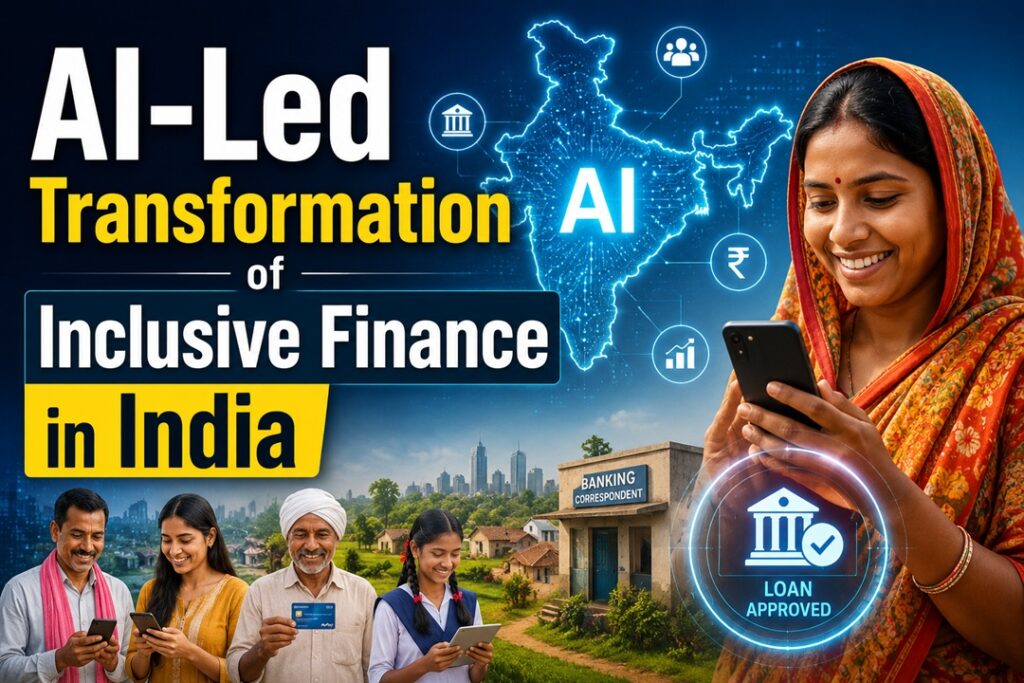
AI-Led Transformation of Inclusive Finance in India
Context
Recent assessments have underlined India’s rapid evolution toward digitally enabled and AI-driven financial empowerment, supported by the integration of Digital Public Infrastructure (DPI), fintech innovation, and data analytics.
Intelligent Digital Finance and Inclusive Growth in India
About Intelligent Digital Finance and Inclusive Growth
What is Inclusive Finance?
Inclusive finance refers to ensuring affordable, timely, and accessible financial services for all sections of society, especially economically weaker and excluded groups. It covers banking, savings, digital payments, insurance, pensions, and credit facilities delivered in a secure and sustainable manner.
Major Indicators of Financial Inclusion in India
- Digital Identity Expansion: By March 2026, more than 144 crore Aadhaar IDs had been issued, strengthening biometric authentication and secure service delivery.
- Banking Penetration: Jan Dhan Yojana accounts crossed 58 crore by April 2026, with deposits exceeding ₹3 lakh crore.
- Digital Transactions Boom: UPI transactions in March 2026 alone crossed nearly ₹29 lakh crore, forming over 80% of India’s retail digital payment ecosystem.
- MSME Credit Opportunity: AI-enabled lending systems are projected to unlock nearly USD 130–170 billion worth of credit access for underserved MSMEs.
Role of Artificial Intelligence in Advancing Financial Access
Smart Credit Assessment
AI systems evaluate digital transaction behaviour, utility payments, and alternative datasets instead of relying solely on conventional credit histories.
Example: The Unified Lending Interface (ULI) leverages land records, satellite imagery, and digital data trails to estimate the repayment capacity of rural borrowers.
Multilingual Banking Access
AI-powered language tools are helping citizens interact with financial platforms in regional languages through voice-based systems.
Example: Banking BHASHINI enables conversational banking support across all 22 scheduled Indian languages.
AI-Based Fraud Surveillance
Advanced machine-learning systems monitor unusual transaction patterns to prevent cyber fraud and money laundering.
Example: MuleHunter.AI identifies suspicious transaction networks and flags mule accounts in real time.
Customized Financial Products
AI helps institutions design need-based products for informal workers and low-income households.
Example: Mission Digital ShramSetu integrates informal labourers into formal financial systems through AI-enabled skill and identity verification.
Faster Service Delivery
AI-assisted automation simplifies KYC verification, documentation, and consent-based data sharing, reducing operational costs.
Example: The Account Aggregator framework enables paperless and instant loan processing through interoperable digital APIs.
Key Measures Undertaken by India
JAM Architecture
The Jan Dhan–Aadhaar–Mobile ecosystem created a robust digital backbone connecting banking access, identity verification, and mobile services at scale.
Unified Lending Interface (ULI)
ULI acts as a digital public infrastructure platform integrating multiple databases for frictionless credit delivery.
RBI Innovation Sandbox
The Reserve Bank of India provides a controlled testing environment for AI-driven fintech products, including cybersecurity tools and digital KYC solutions.
Direct Benefit Transfer (DBT)
DBT systems have transferred over ₹49 lakh crore directly into beneficiary accounts while reducing duplication and leakages through technology-driven authentication.
Concerns Linked to AI-Driven Finance
Bias in AI Algorithms
Improper or skewed training data may produce discriminatory lending outcomes against specific communities or regions.
Example: Women-led enterprises in rural areas may receive lower credit scores because of historically limited financial records.
Privacy and Data Security Risks
Large-scale consent-based data sharing increases the importance of strong safeguards against unauthorized data usage.
Example: Expanding Account Aggregator systems require strict oversight to prevent misuse of personal financial information.
Digital Awareness Deficit
Limited digital literacy makes first-time users vulnerable to scams and manipulation despite AI-enabled protections.
Example: Fraudsters may exploit users through OTP scams or fake biometric verification requests.
Emerging Cyber Threats
AI-generated phishing attacks, deepfakes, and voice scams are becoming more sophisticated and difficult to detect.
Example: AI-powered voice cloning may compromise voice-authentication mechanisms used in banking services.
Technology Accessibility Issues
Advanced AI applications often require modern smartphones and high-speed internet connectivity, which remain unevenly distributed.
Example: Despite widespread 5G rollout, device affordability continues to be a challenge in remote rural regions.
Future Priorities
Expanding Voice-Based Banking
Strengthening Banking BHASHINI can help new users access financial services through simple speech-based interfaces.
Deepening Rural Credit Networks
Greater integration of Regional Rural Banks and cooperative institutions into ULI can improve credit penetration in underserved areas.
Developing Responsible AI Standards
India needs transparent and explainable AI governance frameworks to ensure fairness and accountability in financial decision-making.
Encouraging Fintech Partnerships
Regulatory support can foster collaboration between traditional banks and AI-focused fintech startups for innovative lending models.
Enhancing Financial Literacy
AI-enabled awareness programmes and gamified learning platforms can improve cybersecurity awareness and responsible digital finance usage.
Conclusion
India’s financial inclusion journey is rapidly moving beyond basic account ownership toward AI-enabled financial empowerment. By combining Digital Public Infrastructure with artificial intelligence, the country is creating scalable, low-cost, and inclusive financial solutions for millions. Sustained focus on ethical AI, digital literacy, and cybersecurity will be essential for ensuring that technological progress translates into equitable economic participation and supports the vision of Viksit Bharat 2047.
Source : PIB