
India–UAE Relations Enter a New Strategic Phase
Context
Prime Minister of India concluded a high-profile strategic visit to Abu Dhabi, engaging in comprehensive bilateral discussions with UAE President Sheikh Mohamed bin Zayed Al Nahyan on regional security, energy resilience, and emerging technologies.
India–UAE Deepen Comprehensive Strategic Cooperation
What is it?
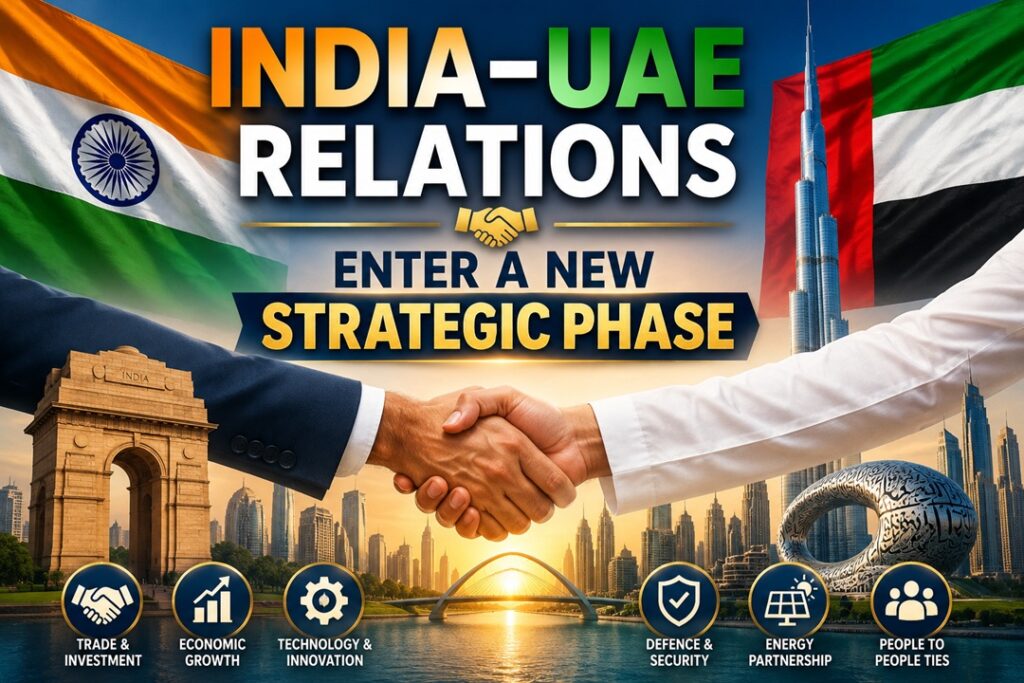
The latest bilateral engagement marks a major expansion of the India-UAE strategic relationship into advanced defense production, digital trade connectivity, energy security, and financial integration. Instead of a conventional trade-centric partnership, both nations are shaping a long-term geo-economic and security architecture connecting South Asia with the Gulf region.
Major Highlights of the Bilateral Agreements
Integrated Defence Cooperation Mechanism
A formal framework was established for joint military manufacturing, defense technology collaboration, and elite forces training exercises.
Strategic Energy Reserve Collaboration
ADNOC and Indian Strategic Petroleum Reserves Limited finalized a new arrangement to increase UAE crude storage participation in India’s strategic reserves up to 30 million barrels.
$5 Billion Investment Commitments
Banking Sector: Emirates NBD announced a $3 billion investment in India’s RBL Bank.
Infrastructure Development: Abu Dhabi Investment Authority (ADIA) partnered with India’s NIIF to invest $1 billion in major infrastructure assets.
Financial Services: International Holding Company (IHC) committed $1 billion into Sammaan Capital.
Next-Generation Supercomputing Alliance
India’s C-DAC and UAE-based G42 signed a technology cooperation agreement to jointly develop an 8 Exaflop ultra-performance computing ecosystem.
Maritime Industrial Corridor
Cochin Shipyard Limited and Dubai’s Drydocks World agreed to establish offshore fabrication and ship maintenance facilities at Vadinar in Gujarat, accompanied by a maritime skilling institute.
Digital Logistics Connectivity (MAITRI)
Launch of a virtual trade integration system connecting customs authorities and ports to minimize cargo delays and logistics costs.
Evolution of India-UAE Relations
Civilizational Maritime Linkages
Trade and cultural exchanges between the Indian subcontinent and the Gulf region date back to the Indus Valley maritime networks.
Establishment of Diplomatic Relations (1972)
India formally established diplomatic ties with the UAE soon after the federation’s formation in 1971.
Transformational Visit of 2015
PM Modi’s UAE visit in 2015, the first by an Indian Prime Minister in over three decades, fundamentally redefined ties into a strategic partnership.
Comprehensive Strategic Partnership (2017)
Bilateral relations received a strategic upgrade during the 2017 Republic Day celebrations when Sheikh Mohamed bin Zayed Al Nahyan attended as Chief Guest.
Economic Integration through CEPA (2022)
The Comprehensive Economic Partnership Agreement significantly reduced tariff barriers, pushing bilateral trade beyond $85 billion and strengthening the UAE’s role as one of India’s largest trading partners.
Major Challenges in India-UAE Ties
Regional Geopolitical Instability
The continuing volatility arising from the 2026 Iran conflict places India’s balancing strategy in West Asia under growing pressure.
Example: India’s criticism of attacks targeting the UAE complicates New Delhi’s diplomatic engagement with Tehran.
Emerging Strategic Alignments
New defense partnerships in West Asia are reshaping the regional security equilibrium.
Example: The evolving Pakistan-Saudi security understanding has encouraged India and the UAE to intensify their own defense cooperation.
Critical Maritime Vulnerabilities
Any disruption in the Strait of Hormuz threatens India’s energy supply chains and trade routes.
Example: Increased UAE oil production becomes strategically ineffective if Gulf shipping corridors remain insecure.
Indian Diaspora Vulnerabilities
Conflict-driven economic disruptions in the Gulf directly impact the livelihoods of over 4 million Indians residing in the UAE.
Example: Regional instability may reduce remittance flows and trigger reverse migration pressures.
Technology and Data Governance Risks
Cooperation in sensitive sectors such as supercomputing and AI requires compliance with evolving global technology regulations.
Example: India’s partnership with UAE’s G42 necessitates safeguards regarding sensitive data sharing and export control restrictions.
Way Forward
Strengthening the Fujairah Energy Corridor
India should accelerate development of oil storage facilities in Fujairah to reduce dependence on the Strait of Hormuz route.
Coordinated Maritime Patrols
Both nations should operationalize joint naval surveillance missions to protect critical commercial shipping lanes.
Expanding Local Currency Trade
Institutionalizing rupee-dirham settlements can reduce exposure to dollar volatility and sanctions-related disruptions.
Joint Defence Manufacturing
India and the UAE should establish co-production facilities for drones, cybersecurity systems, and secure communication technologies.
Expanding the MAITRI Trade Network
The digital logistics corridor can be integrated with BIMSTEC and East African ports to strengthen India-UAE leadership in Global South connectivity.
Conclusion
The Abu Dhabi summit has elevated India-UAE relations into a multidimensional strategic alliance encompassing energy security, defense modernization, financial investment, and technological collaboration. By mobilizing billions in investments and strengthening strategic petroleum reserves, both countries have laid the foundation for a resilient partnership capable of withstanding future geopolitical disruptions.
Source : NDTV