
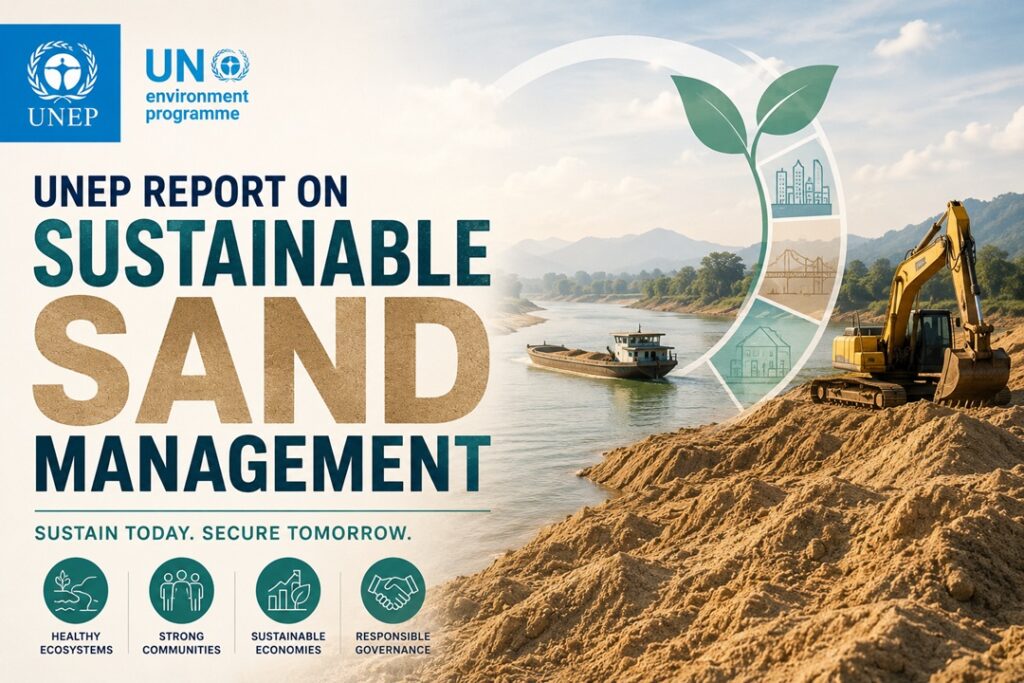
UNEP Report on Sustainable Sand Management
Context
The United Nations Environment Programme released a major report titled “Sand and Sustainability: An Essential Resource for Nature and Development”, highlighting the alarming rise in global sand extraction and its ecological consequences. The report stresses that sand, a critical resource for construction and industrial development, is being exploited at unsustainable levels, threatening river systems, coastal ecosystems, biodiversity, and climate resilience.
Sand Governance and Ecological Security
About “Sand and Sustainability: An Essential Resource for Nature and Development” Report
What is Sand Extraction?
Sand extraction refers to the removal of sand and gravel from rivers, coastlines, floodplains, and marine ecosystems for use in infrastructure, industrial production, and urban expansion. The UNEP report highlights that sand is now among the most exploited natural resources globally due to rapid construction-led growth.
Major Facts & Figures on Global Sand Use
Escalating Consumption
Worldwide demand crossed nearly 50 billion tonnes annually, making sand the backbone of construction and infrastructure economies.
Expansion of Urban Landscapes
Per capita built-up space has increased sharply over the last five decades due to growing urban settlements and real-estate expansion.
Rising Market Size
The international construction aggregates market continues to expand rapidly alongside smart cities, transport corridors, and industrialization.
Dependence of Coastal Communities
Millions dependent on fisheries and coastal livelihoods are vulnerable because healthy sandy ecosystems sustain breeding grounds and marine biodiversity.
Drivers Behind Increased Sand Extraction
Accelerated Urban Growth
Rapid migration toward cities has increased demand for cement, concrete, roads, and glass.
Example: Coastal reclamation projects in Southeast Asia require extensive marine dredging operations.
Infrastructure Push
Large transport and housing projects consume massive quantities of aggregates and river sand.
Example: Expressways, industrial corridors, and affordable housing missions have intensified pressure on river ecosystems.
Population Expansion
Growing populations require additional residential spaces, healthcare facilities, and educational infrastructure.
Example: Developing economies are witnessing a continuous rise in urban construction activities.
Climate Resilience Projects
Sand is increasingly used in embankments, artificial islands, and coastal protection measures.
Example: Several island nations are using dredged material to create elevated climate-resilient settlements.
Industrial and Technological Demand
High-grade silica sand is essential for semiconductors, solar panels, and electronics manufacturing.
Example: Renewable energy expansion and digital infrastructure are increasing industrial-grade sand requirements.
Ecological Consequences of Unsustainable Sand Mining
River Ecosystem Disturbance
Over-extraction deepens river channels, weakens banks, and disrupts sediment flow.
Example: Excessive mining in Indian river systems has increased erosion and flash flood vulnerability.
Declining Groundwater Levels
River sand acts as a natural aquifer recharge medium; its removal lowers groundwater retention.
Example: Rural wells near intensive mining regions frequently experience seasonal drying.
Destruction of Aquatic Biodiversity
Dredging damages benthic habitats and affects fish spawning zones.
Example: Coral reef systems and coastal ecosystems face severe degradation due to marine extraction.
Salinity Intrusion
Coastal mining permits seawater intrusion into freshwater aquifers.
Example: Several coastal communities in Asia have reported salinized drinking water sources.
Public Health Concerns
Mining operations expose workers to silica dust and create stagnant water pits that spread diseases.
Example: Silicosis and vector-borne diseases are increasingly linked to poorly regulated mining zones.
Measures and Policy Responses
International Initiatives
UNEP 10-Point Framework
Encourages sustainable extraction standards, resource efficiency, and circular construction practices.
Marine Sand Watch
A satellite and AIS-based monitoring platform tracking global dredging activities in marine regions.
Indian Initiatives
Sustainable Sand Mining Management Guidelines, 2016
Requires District Survey Reports (DSRs) and scientific assessment before granting mining approvals.
Enforcement and Monitoring Guidelines, 2020
Promotes remote sensing, digital monitoring, and transport tracking systems to check illegal mining.
Judicial Interventions by NGT
The National Green Tribunal has imposed restrictions on mining activities lacking environmental clearances.
Recommendations and Future Strategy
Recognizing Sand as a Strategic Resource
Governments should treat sand as a finite ecological asset rather than an unlimited construction material.
Promoting Alternatives
Encourage Manufactured Sand (M-Sand), recycled debris, and circular construction technologies.
Strengthening Environmental Regulation
Mandatory cumulative impact assessments should be adopted for large-scale dredging and extraction projects.
Declaring Ecologically Sensitive No-Mining Zones
Critical river stretches, wetlands, and marine protected areas should be legally safeguarded.
Enhancing International Cooperation
Shared river basins and coastal ecosystems require coordinated global governance frameworks.
Conclusion
The UNEP report highlights that unchecked sand extraction threatens rivers, coastlines, biodiversity, and climate resilience worldwide. Sustainable development now requires a transition toward circular construction practices, scientific regulation, and eco-friendly substitutes like M-Sand. Without urgent reforms, excessive exploitation of sand resources could destabilize both ecosystems and long-term economic security.
Source : Down To Earth