
3rd India-Nordic Leaders’ Summit Held in Oslo
Context:
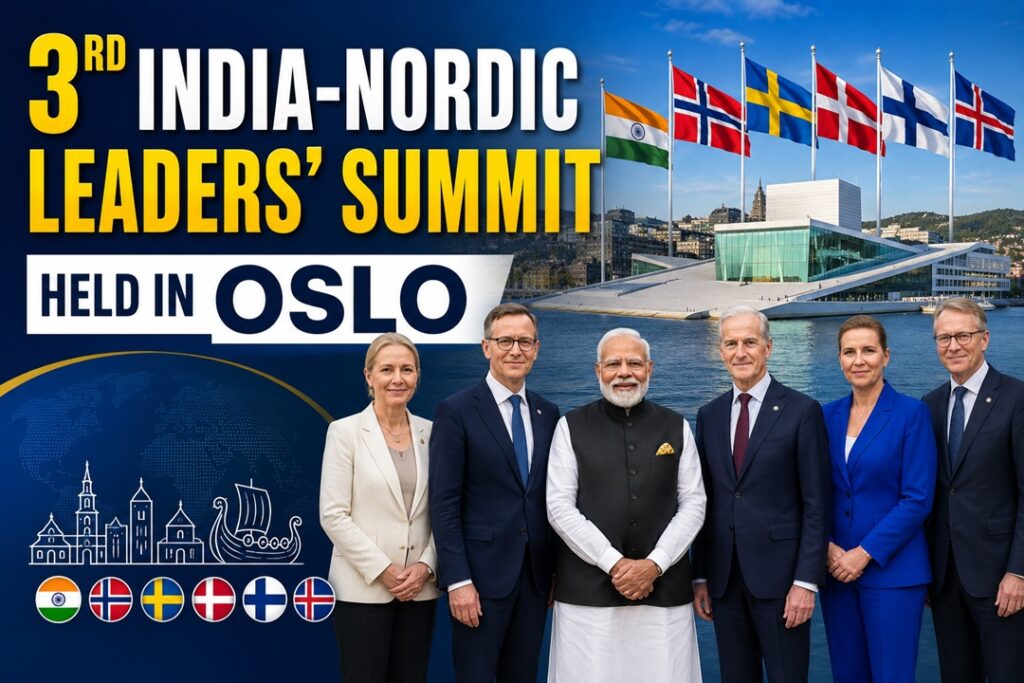
Prime Minister of India jointly presided over the 3rd India-Nordic Leaders’ Summit held in Oslo, Norway, along with the Prime Ministers of Denmark, Finland, Iceland, Norway, and Sweden.
India-Nordic Leaders’ Summit 2026
About India-Nordic Leaders’ Summit:
What is the Summit?
The India-Nordic Leaders’ Summit is a high-level multilateral cooperation mechanism connecting India with the five Nordic countries—Denmark, Finland, Iceland, Norway, and Sweden.
Since its earlier editions in Stockholm (2018) and Copenhagen (2022), the platform has evolved into a strategic engagement framework combining India’s industrial and digital strengths with Nordic leadership in sustainability, clean technologies, shipping, and advanced innovation ecosystems.
Major Highlights of the 2026 Summit:
Strategic Partnership Expansion:
The participating nations agreed to strengthen cooperation under a new Sustainable Innovation and Technology Partnership framework.
Trade and Investment Cooperation:
Leaders welcomed the implementation of the India-EFTA Trade and Economic Partnership Agreement (TEPA), expected to facilitate nearly $100 billion worth of investments and generate substantial employment opportunities in India, while also accelerating discussions on the India-EU Free Trade Agreement.
Diplomatic and Multilateral Support:
Nordic nations reaffirmed support for India’s aspiration for permanent membership in a restructured UN Security Council and expressed backing for India’s entry into the Nuclear Suppliers Group (NSG).
Space Technology Collaboration:
The summit emphasized operational cooperation between ISRO and Nordic space agencies, including plans for integrating Nordic scientific instruments in India’s future planetary exploration missions.
Maritime and Blue Economy Cooperation:
India, Norway, and Denmark initiated dedicated maritime security consultations to strengthen cooperation against illegal maritime activities under the Indo-Pacific Oceans Initiative (IPOI) and India’s MAHASAGAR vision.
Industrial Decarbonization:
The LeadIT 2.0 platform for green industrial transition was expanded with Iceland formally joining the initiative aimed at reducing carbon emissions from heavy industries.
Ethical AI and Digital Governance:
Member nations endorsed collaboration on transparent and human-centric artificial intelligence systems, emphasizing open and responsible digital innovation.
Future Engagement:
Finland was confirmed as the host country for the next India-Nordic Summit.
Significance for India
Strengthening Semiconductor and Next-Generation Telecom Capacity:
Partnerships with Nordic technology leaders can help India access advanced semiconductor design systems and emerging 6G communication technologies.
Example: Cooperation with Sweden and Finland in trusted telecom infrastructure can reduce India’s dependence on external supply chains.
Boosting Foreign Investment Through EFTA:
The TEPA agreement can channel major investments into domestic manufacturing and industrial expansion.
Example: EFTA-linked investments can accelerate semiconductor fabrication projects under the India Semiconductor Mission.
Expanding Arctic Research Cooperation:
Nordic scientific partnerships provide India valuable support in climate and Arctic studies.
Example: Joint polar research initiatives can improve India’s understanding of monsoon variability and climate change patterns.
Modernizing Maritime Infrastructure:
Nordic expertise in green shipping and ship-recycling technologies can strengthen India’s maritime economy.
Example: Sustainable ship-recycling standards can help transform Indian ports and shipyards into globally competitive eco-friendly hubs.
Advancing Defence Manufacturing:
Nordic defence companies can collaborate with Indian industries under the “Make in India” framework.
Example: Liberalized investment rules may encourage Nordic firms to establish local production facilities for advanced defence systems and UAV technologies.
Concerns and Constraints
Differences in Foreign Policy Approaches:
Divergent perspectives on ongoing geopolitical conflicts may create coordination challenges during joint diplomatic engagements.
Example: India’s strategic balancing approach toward Russia may occasionally differ from Nordic positions on European security matters.
Non-Tariff Trade Restrictions:
Strict European sustainability regulations may impact Indian exports entering Nordic markets.
Example: Carbon border taxes and environmental compliance standards could affect Indian steel, textile, and industrial exports.
Intellectual Property and Technology Sharing Issues:
Concerns regarding protection of advanced technologies may slow collaborative innovation.
Example: Nordic firms may remain cautious in sharing sensitive AI, quantum computing, or dual-use technological data.
Vulnerability of Maritime Supply Chains:
Trade routes connecting Europe and the Indo-Pacific remain exposed to geopolitical disruptions.
Example: Tensions in the Strait of Hormuz can affect the progress of connectivity initiatives such as the India-Middle East-Europe Economic Corridor (IMEC).
Skilled Mobility Challenges:
Movement of highly skilled Indian professionals may face immigration and regulatory barriers in Nordic countries.
Future Course of Action
Enhancing Polar Satellite Cooperation:
India can utilize Nordic Arctic infrastructure for real-time environmental monitoring and polar satellite communication.
Developing Green Shipping Corridors:
India and Nordic nations can jointly establish zero-emission maritime transport routes using green hydrogen and ammonia-based fuel technologies.
Accelerating Defence Industrial Collaboration:
Dedicated Nordic manufacturing clusters can be integrated into India’s defence corridors for co-production of advanced systems.
Creating Common AI Governance Standards:
A unified framework for secure AI data exchange can support collaboration in healthcare, climate science, and digital governance.
Monitoring EFTA Investment Commitments:
A dedicated institutional mechanism can ensure efficient implementation and tracking of promised foreign investments.
Conclusion:
The 3rd India-Nordic Leaders’ Summit marked a major step in transforming India’s engagement with Northern Europe into a comprehensive strategic partnership. By combining India’s manufacturing capacity, digital infrastructure, and market scale with Nordic expertise in sustainability, innovation, and advanced technologies, the summit has laid the foundation for a resilient and future-oriented economic and technological partnership.
Source : MEA