
Bhojshala–Kamal Maula Verdict and Historical Significance
Context
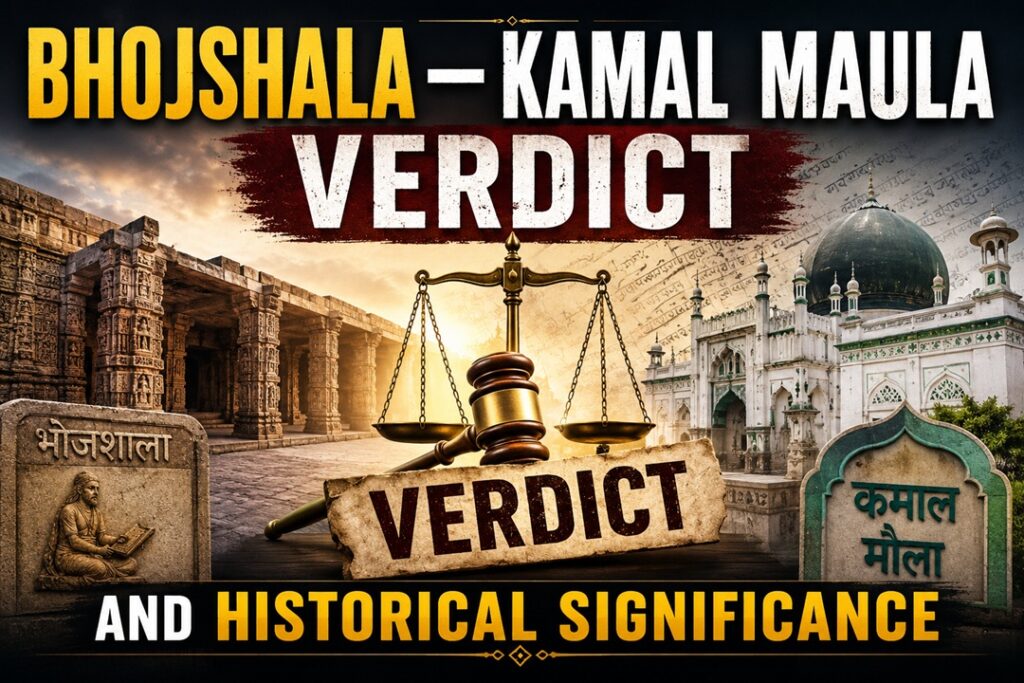
In a landmark ruling with major cultural and legal implications, the Indore Bench of the Madhya Pradesh High Court issued a detailed 242-page judgment recognizing the disputed Bhojshala–Kamal Maula structure in Dhar as an ancient Hindu temple devoted to Goddess Saraswati (Vagdevi).
About the Bhojshala–Kamal Maula Heritage Site:
Nature of the Monument:
The Bhojshala complex is a protected medieval-era monument dating back to the 11th century, historically regarded as a renowned institution of Sanskrit education and a sacred site dedicated to Goddess Saraswati. Over time, sections of the original temple architecture were incorporated into the construction of the Kamal Maula Mosque, resulting in a long-standing religious and historical dispute.
Geographical Setting:
- State: Madhya Pradesh, India.
- Region: Malwa plateau.
- Specific Location: Situated in Dhar city, once the political and cultural capital of the Paramara rulers.
Historical Evolution:
- Establishment under Raja Bhoja (11th Century): The complex was established during the reign of Raja Bhoja, the illustrious Paramara king celebrated for his patronage of literature, philosophy, and education. The institution functioned as an important scholarly center attracting intellectuals from different parts of India.
- Expansion by Later Paramara Kings: Subsequent rulers such as Udayaditya, Naravarman, and Arjunavarma supported the institution and contributed to its growth as a center of classical learning and temple activity.
- Transformation during Sultanate Rule: During the expansion of the Malwa Sultanate in the 14th century, portions of the original temple complex were converted into a mosque structure linked to the Sufi saint Kamal Maula, leading to the site’s composite identity.
- Colonial-Era Protection: The monument received protected status under the Ancient Monuments Preservation framework in 1904. Later, an Archaeological Survey of India (ASI) arrangement issued in 2003 allowed Hindu worship on Tuesdays and Basant Panchami, while Friday namaz was permitted for Muslims.
Architectural and Epigraphic Significance:
- Temple-Style Structural Elements: The site contains intricately carved pillars, ornamental ceilings, colonnades, and a spacious courtyard reflecting classical Hindu temple architecture despite later modifications.
- Sarpabandha Educational Inscriptions: Two rare Sarpabandha inscriptions survive at the site. One records Sanskrit alphabets with grammatical forms, while another presents conjugational patterns linked to Sanskrit grammar and linguistic instruction.
- Prakrit Literary Records: Stone inscriptions featuring devotional compositions dedicated to the Kurma incarnation of Lord Vishnu are embedded within the structure.
- Dramatic Sanskrit Composition: Several stone slabs contain portions of a classical theatrical text attributed to Madana, a royal preceptor associated with the Paramara court during Arjunavarma’s reign.
- Recovered Sculptural Evidence: Recent ASI investigations documented numerous fragmented idols and sculptural remains, including depictions of Hindu deities such as Ganesha, Vishnu, and Narasimha, along with damaged carvings integrated into the monument’s pillars and walls.
Source : NDTV