
Road Dust and the Growing Urban Air Pollution Crisis
Context
Recent reports by the Commission for Air Quality Management (CAQM), along with studies conducted by CSIR-NEERI and CRRI, have identified road dust as one of the most persistent and dominant sources of air pollution in Delhi. It contributes significantly to particulate matter pollution, especially during dry seasons, thereby posing serious environmental and public health challenges.
Introduction
Road dust has emerged as a critical component of urban air pollution, particularly in metropolitan cities like Delhi. Unlike construction dust, which originates from specific locations, road dust acts as a continuous pollution source spread across transport corridors. It contains fine soil particles, tyre and brake wear residues, loose dirt, and debris from construction transport vehicles. The growing intensity of vehicular movement and poor urban infrastructure have aggravated the issue, making it a major governance and public health concern.
Meaning of Road Dust
Definition: Road dust refers to fine particulate matter generated from unpaved shoulders, loose soil, tyre-rubber particles, brake-lining wear, and spilled construction debris along roads.
Nature of Pollution: It acts as a continuous line-source pollutant, unlike localized point-source pollution such as construction activities.
Major Findings and Data
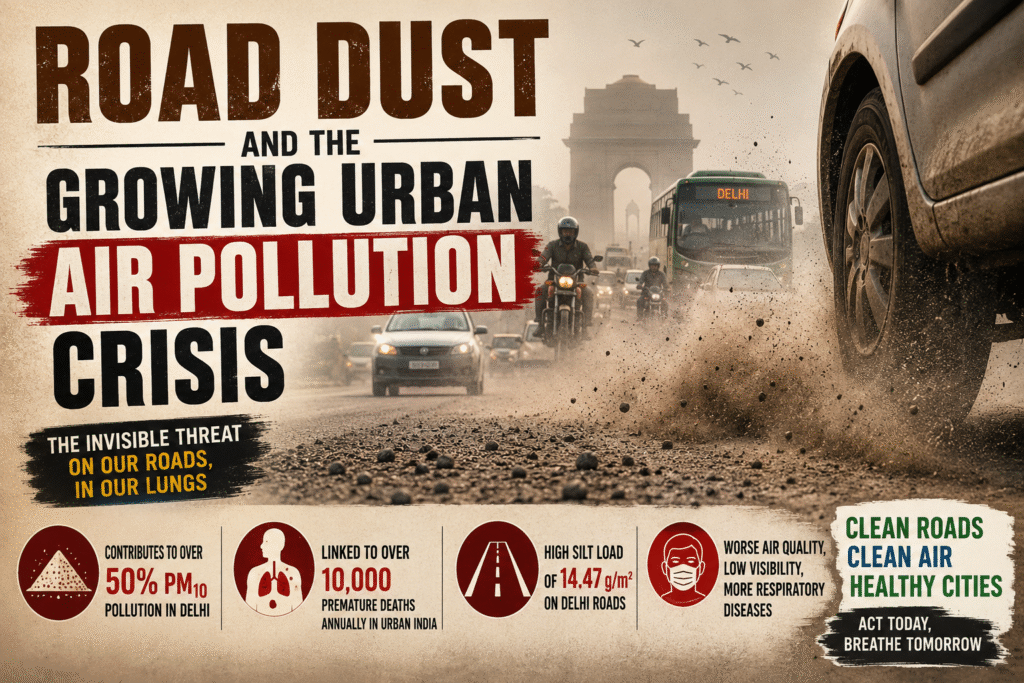
Contribution to Air Pollution: Road dust, construction activities, and wind-blown soil contribute more than 50 percent of PM10 and nearly 30 percent of PM2.5 pollution in Delhi during dry periods.
Extremely High PM10 Levels: Studies recorded PM10 concentrations reaching nearly 1,700 micrograms per cubic metre near major roads, far exceeding the safe limit of 100 micrograms per cubic metre.
High Surface Silt Load: Delhi’s roads carry an average silt load of around 14.47 grams per square metre, significantly higher than cleaner Indian cities.
Public Health Burden: Long-term exposure to road dust and non-exhaust vehicular emissions contributes to thousands of premature deaths annually in urban India.
Causes of Road Dust Pollution
Unpaved Road Shoulders: Large stretches of roads and highways remain unpaved, exposing loose soil to vehicular movement and wind action.
Defective Median Design: Soil from unpaved medians frequently spills onto roads, increasing dust accumulation.
Improper Irrigation Practices: Use of high-pressure water hoses for watering roadside plants creates muddy deposits that dry into airborne dust.
Poor Road Maintenance: Delayed repair of potholes and damaged road edges leads to continuous generation of fine mineral dust.
Environmental Degradation of Aravallis: Mining activities and ecological degradation in the Aravalli range have weakened Delhi’s natural barrier against desert dust from Rajasthan.
Implications of Road Dust Pollution
Impact on Child Health: Fine dust particles adversely affect respiratory development in children and increase cases of asthma and chronic wheezing.
Heavy Metal Exposure: Road dust contains toxic metals such as lead, cadmium, and nickel released from brake pads and engine wear, increasing risks of cancer and organ damage.
Rise in Respiratory Diseases: Fine mineral particles aggravate Chronic Obstructive Pulmonary Disease (COPD) and other respiratory illnesses among vulnerable populations.
Persistent Smog Formation: Suspended fine particles trap industrial emissions and contribute to dense smog formation, reducing visibility and affecting transportation systems.
Challenges in Addressing Road Dust
Limited Effectiveness of Water Sprinkling: Temporary water spraying and anti-smog guns provide only short-term relief without addressing the root causes.
Unscientific Mechanical Sweeping: Inadequate sweeping methods can re-suspend fine particles into the atmosphere instead of removing them effectively.
Encroachment and Illegal Parking: Unauthorized parking along roads obstructs municipal cleaning operations and leads to silt accumulation.
Geographical and Climatic Constraints: Delhi’s dry climate, low rainfall, and frequent dust storms make dust management more difficult.
Measures Required
Development of Vegetative Barriers: Dense plantation along roads and medians can help trap airborne dust naturally.
Scientific Road Engineering: Construction of proper retaining kerbs and paved shoulders can prevent soil movement onto roads.
Adoption of Drip Irrigation: Replacing open water hoses with drip irrigation systems can reduce mud formation and dust generation.
Technology-Based Monitoring: Real-time GPS monitoring of mechanical sweepers can improve accountability and efficiency in road cleaning operations.
Integrated Urban Planning: Coordination among municipal bodies, pollution control authorities, and transport agencies is essential for sustainable dust management.
Conclusion
The growing threat of road dust highlights the changing nature of urban air pollution in India. Addressing vehicular emissions alone will not be sufficient unless road dust management becomes an integral part of urban environmental governance. Scientific road infrastructure, ecological restoration, effective municipal management, and sustainable urban planning are essential to mitigate this challenge and improve public health outcomes in cities like Delhi.
Source : Indian Express