
India’s Leadership in Building a Resilient BRICS Tourism Ecosystem
Context
India officially launched its tourism agenda under the BRICS 2026 Chairship by hosting the inaugural Tourism Working Group (TWG) meeting through virtual mode. The initiative reflects India’s broader effort to strengthen tourism cooperation, promote sustainable travel, and enhance digital integration among BRICS nations.
The BRICS 2026 Tourism Working Group
Introduction
Tourism has emerged as a major driver of economic growth, cultural exchange, and people-to-people connectivity in the globalized world. Within the BRICS framework, tourism cooperation is increasingly viewed as an instrument for strengthening South-South collaboration and boosting resilient economic recovery after the pandemic. India’s leadership of the BRICS 2026 Tourism Working Group highlights its commitment to promoting sustainable, technology-driven, and inclusive tourism governance.
What is the BRICS Tourism Working Group
Definition: The BRICS Tourism Working Group is a sector-specific ministerial platform functioning under the BRICS framework.
Composition: It brings together tourism administrators, policymakers, and industry experts from BRICS member nations.
Purpose: The group works toward developing coordinated tourism frameworks, sharing technological best practices, and strengthening hospitality infrastructure among member countries.
Objectives of the BRICS 2026 Tourism Working Group
Development of Intra-BRICS Tourism Corridor: The main objective is to create a modern, digitized, and sustainable travel ecosystem among BRICS nations.
Revival of Tourism Economies: Focuses on supporting tourism recovery from pandemic-related disruptions and global economic uncertainties.
Promotion of Green and Digital Transitions: Encourages sustainable tourism practices alongside the integration of digital public infrastructure.
Key Priorities of the Tourism Working Group
Artificial Intelligence Integration: Promotes the use of AI-based visitor advisory systems, predictive tourism management tools, and smart hospitality infrastructure.
Sustainable and Responsible Tourism: Encourages low-carbon tourism, waste reduction in heritage zones, and direct economic benefits for indigenous and local communities.
Tourism Skill Development: Supports collaborative certification systems and capacity-building initiatives to improve digital literacy and hospitality skills.
Seamless Travel Facilitation: Aims to simplify border procedures, expand e-visa systems, and improve tourism exchanges within BRICS countries.
Jaipur Roadmap: The virtual meeting lays the foundation for future discussions during the 2nd TWG Meeting and the BRICS Tourism Ministers’ Meeting in Jaipur, where a joint ministerial declaration is expected to be finalized.
BRICS 2026 and India’s Presidency
Introduction to BRICS
Definition: BRICS is a plurilateral political and economic grouping of major emerging economies representing the Global South.
Evolution: The grouping was originally formed as BRIC in 2006 with Brazil, Russia, India, and China, and later expanded to include South Africa in 2010.
Global Significance: BRICS acts as an alternative platform to traditional Western-dominated global financial and governance institutions.
BRICS 2026 Logo and Symbolism
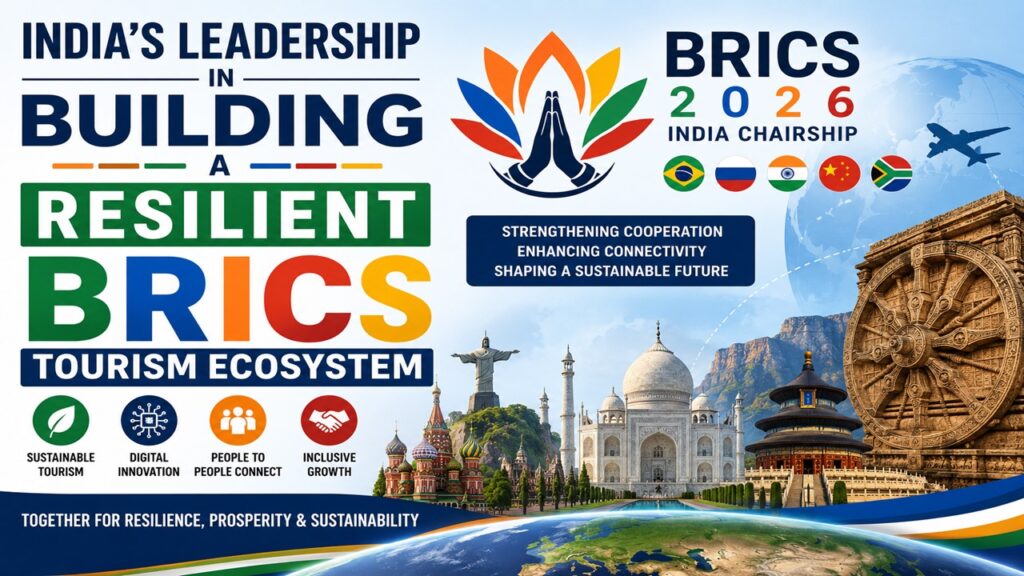
Radiating Petals: The multi-colored petals in the official logo symbolize the diversity, unity, and partnership among member nations.
Central Namaste Emblem: The logo incorporates the traditional Indian “Namaste” gesture, representing hospitality, mutual respect, and collaborative dialogue.
Theme of India’s BRICS 2026 Presidency
Central Theme: India’s presidency is guided by the theme “Building for Resilience, Innovation, Cooperation and Sustainability.”
Four Major Priorities under India’s Presidency
Resilience: Focuses on strengthening macroeconomic stability, supply chain security, and protection against global economic shocks.
Innovation: Promotes India’s Digital Public Infrastructure models, fintech systems, and open-source technological frameworks across developing nations.
Cooperation: Advocates reforms in global institutions, including a more representative United Nations Security Council and balanced multilateral trade systems.
Sustainability: Encourages green finance initiatives, renewable energy cooperation, and balanced carbon reduction strategies aligned with developmental priorities.
Significance for India and the Global South
Strengthening South-South Cooperation: Enhances collaboration among emerging economies in tourism, trade, and governance.
Boost to India’s Soft Power: India’s leadership in tourism and digital governance strengthens its global diplomatic and cultural influence.
Economic Opportunities: Increased tourism exchanges can generate employment, investment, and hospitality sector growth.
Promotion of Sustainable Development: Aligns tourism and economic growth with environmental sustainability goals.
Challenges
Geopolitical Differences: Diverging political and strategic interests among BRICS members may affect policy coordination.
Infrastructure Gaps: Uneven tourism and digital infrastructure among member states could limit seamless integration.
Balancing Sustainability and Growth: Ensuring economic expansion without environmental degradation remains a critical challenge.
Conclusion
The BRICS 2026 Tourism Working Group represents an important step toward strengthening tourism cooperation among emerging economies. Under India’s leadership, the initiative seeks to combine sustainability, digital innovation, and inclusive growth to create a resilient tourism ecosystem. The success of this framework can enhance South-South cooperation and contribute significantly to a more balanced and multipolar global order.
Source : DD News