
PM SVANidhi Completes Six Years of Empowering Urban Street Vendors
Context
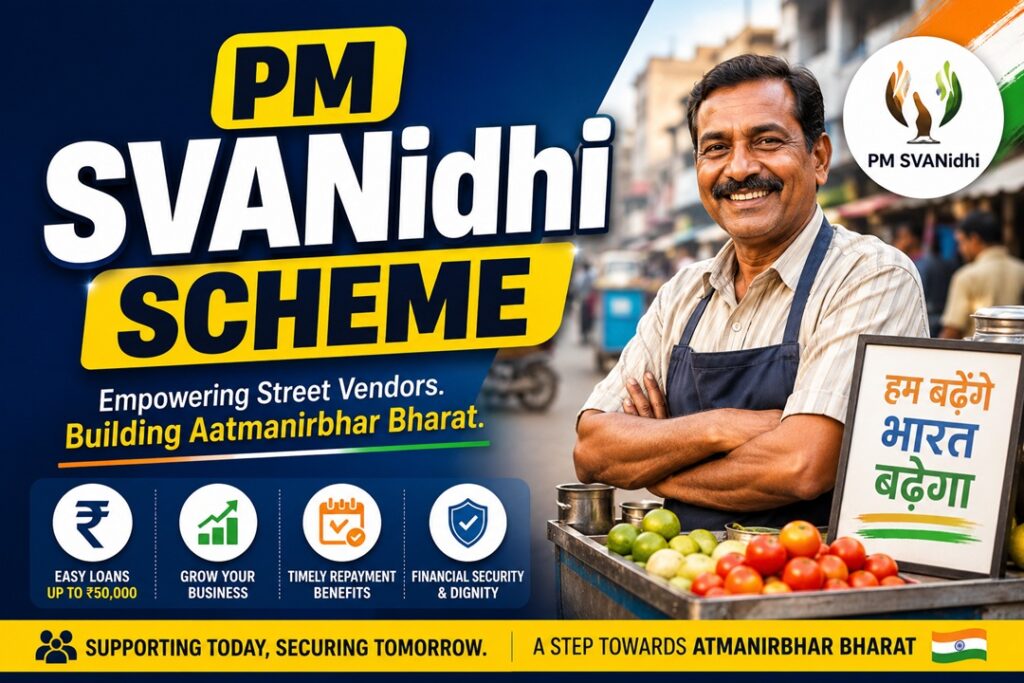
The Prime Minister Street Vendor’s AtmaNirbhar Nidhi (PM SVANidhi) scheme has completed six years since its launch in June 2020. Introduced during the COVID-19 pandemic, the scheme has emerged as a key instrument for financial inclusion, digital empowerment, and social security coverage of urban street vendors across India.
PM SVANidhi Scheme
About PM SVANidhi
What is PM SVANidhi?
PM SVANidhi (Prime Minister Street Vendor’s AtmaNirbhar Nidhi) is a Central Sector micro-credit scheme launched by the Government of India on 1 June 2020. It aims to provide affordable, collateral-free working capital loans to urban street vendors to help them restart and expand their businesses.
The scheme is implemented by the Ministry of Housing and Urban Affairs (MoHUA) in collaboration with the Department of Financial Services (DFS), banks, microfinance institutions, and urban local bodies.
Objectives
- Provide affordable institutional credit to street vendors.
- Reduce dependence on informal moneylenders.
- Encourage digital transactions and financial literacy.
- Promote financial inclusion and credit history creation.
- Extend social security benefits through convergence with welfare schemes.
Key Components of the Scheme
Graduated Working Capital Loans
The scheme follows a progressive lending model:
| Loan Cycle | Maximum Loan Amount |
|---|---|
| First Tranche | ₹10,000 |
| Second Tranche | ₹20,000 |
| Third Tranche | ₹50,000 |
Higher loan eligibility is linked to timely repayment of previous loans.
Interest Subsidy Benefit
- Beneficiaries receive an interest subsidy of 7% per annum.
- The subsidy is directly credited to the borrower’s bank account on a quarterly basis.
- Encourages timely and regular repayment.
Digital Transaction Incentives
To promote a cashless economy:
- Vendors are encouraged to use UPI and other digital payment platforms.
- Cashback incentives are provided for digital transactions.
- Annual cashback benefits can reach up to ₹1,200–₹1,600 depending on transaction frequency.
UPI-Enabled RuPay Credit Cards
- Vendors with satisfactory repayment records become eligible for special RuPay Credit Cards.
- These cards are linked to UPI for seamless digital transactions.
- Help vendors access formal credit systems.
SVANidhi se Samriddhi Initiative
This component focuses on holistic welfare support by linking beneficiary families to major government schemes related to:
- Health insurance
- Food security
- Pension benefits
- Skill development
- Social welfare programmes
Major Achievements of PM SVANidhi
Expanded Credit Access
- More than 75 lakh street vendors have benefited from the scheme.
- Over 1.12 crore loans have been sanctioned across multiple loan cycles.
Significant Financial Assistance
- More than ₹17,800 crore has been disbursed.
- The scheme has strengthened working capital availability in urban informal markets.
Digital Inclusion
- More than 55 lakh vendors have been digitally onboarded.
- Vendors have conducted hundreds of crores of digital transactions worth several lakh crores of rupees.
Social Security Coverage
- Over 50 lakh vendor families have been profiled under SVANidhi se Samriddhi.
- More than 1.5 crore welfare benefits have been delivered through convergence initiatives.
Significance of the Scheme
Formalisation of Informal Economy
The scheme integrates street vendors into the formal financial ecosystem by providing access to bank credit and digital payment infrastructure.
Example
A large proportion of beneficiaries accessed institutional credit for the first time, reducing reliance on high-interest informal borrowing.
Income Enhancement
Easy access to working capital allows vendors to:
- Increase inventory.
- Diversify products.
- Improve business operations.
- Enhance household incomes.
Example
Independent assessments indicate substantial improvement in earnings among beneficiary households.
Women Empowerment
The scheme has promoted greater financial participation of women entrepreneurs.
Example
Nearly half of the beneficiaries are women, strengthening their economic independence and decision-making power.
Social Inclusion
A significant share of beneficiaries belongs to:
- Scheduled Castes (SCs)
- Scheduled Tribes (STs)
- Other Backward Classes (OBCs)
This demonstrates the scheme’s role in inclusive urban development.
Credit History Creation
Regular repayment records help vendors:
- Build creditworthiness.
- Access larger loans.
- Avail other financial products in future.
Challenges Associated with PM SVANidhi
Uneven Regional Coverage
Implementation levels vary considerably across states and urban local bodies.
Impact
Some states have achieved extensive coverage while others continue to record relatively low participation.
Procedural Delays
Although the scheme is technology-driven, delays may occur due to:
- Verification requirements.
- Documentation issues.
- Administrative bottlenecks.
Impact
Vendors requiring urgent capital may face difficulties during processing periods.
Seasonal Income Vulnerability
Street vendors are highly dependent on weather conditions and footfall.
Impact
Heavy rains, extreme heat, or local disruptions can affect business operations and repayment capacity.
Digital Literacy Constraints
Many beneficiaries have been digitally onboarded, but active and sustained usage of digital payment platforms remains uneven.
Impact
Some vendors continue to prefer cash transactions despite digital incentives.
Way Forward
Strengthening Outreach in Low-Coverage Areas
- Use data analytics and digital dashboards to identify underserved regions.
- Improve awareness campaigns through urban local bodies.
Enhancing Financial Literacy
- Conduct regular training programmes on banking services and digital payments.
- Improve awareness regarding credit discipline and financial planning.
Integrating Infrastructure Support
- Link loans with support for modern vending carts, storage facilities, and hygiene improvements.
- Enhance productivity and consumer confidence.
Faster Loan Processing
- Expand technology-enabled verification mechanisms.
- Reduce paperwork and approval timelines.
Flexible Repayment Options
- Introduce season-sensitive repayment schedules.
- Support vendors during periods of temporary income loss.
Conclusion
Over the past six years, PM SVANidhi has evolved from an emergency pandemic-relief measure into a flagship urban financial inclusion programme. By providing collateral-free credit, promoting digital transactions, enhancing social security coverage, and supporting entrepreneurship among vulnerable urban populations, the scheme has played a crucial role in transforming the lives of millions of street vendors. Going forward, improved outreach, digital literacy, and flexible financial support mechanisms can further strengthen its impact and contribute to inclusive urban economic growth.
Source : PIB