
Coral Relocation Initiative at Great Nicobar Island
Context
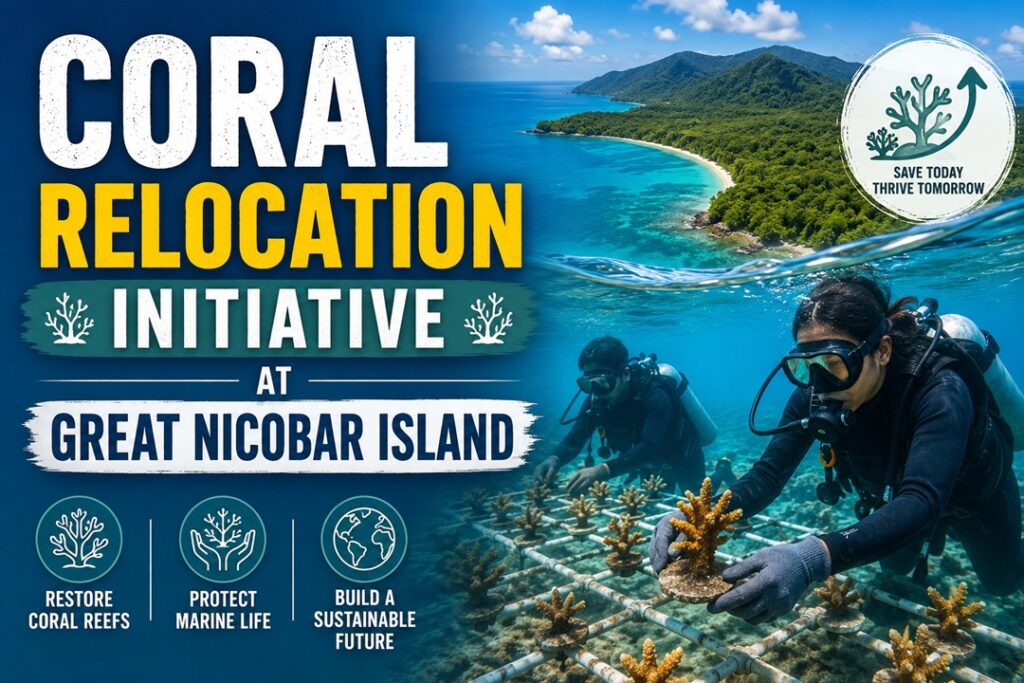
As part of ecological safeguards linked to the proposed international transshipment port project at Great Nicobar Island, coral colonies and giant clams from Galathea Bay are planned to be relocated to designated conservation sites to reduce environmental impacts and protect marine biodiversity.
What are Coral Ecosystems?
Coral Organisms
- Corals are small marine invertebrates belonging to the Cnidaria phylum.
- They consist of numerous tiny animals called polyps, usually only a few millimetres wide.
- Each polyp possesses tentacles equipped with stinging cells that help capture plankton and other microscopic prey.
- Thousands of genetically identical polyps live together, forming a coral colony.
Coral Reef Ecosystems
- Coral reefs are underwater biological structures created by colonies of coral polyps over long periods.
- Although they occupy less than 1% of the ocean floor, they support nearly 25% of marine biodiversity.
- Often referred to as the “Tropical Rainforests of the Ocean,” coral reefs have existed for approximately 450 million years.
- They provide feeding, breeding, and sheltering grounds for countless marine species.
Coral-Algae Partnership
- Corals maintain a mutually beneficial association with microscopic algae known as zooxanthellae.
- These algae perform photosynthesis, supplying nutrients to corals and contributing to their vibrant colours.
Global Occurrence
- Coral reefs are found across the Indian, Pacific, and Atlantic Oceans.
- The Great Barrier Reef is the world’s largest coral reef system, extending for over 2,000 km.
Categories of Corals
Reef-Building (Hard) Corals
- Hard corals create the rigid framework of reefs.
- They produce calcium carbonate skeletons called corallites, which accumulate to form reef structures.
Non-Reef-Building (Soft) Corals
- Soft corals possess flexible bodies and resemble underwater plants.
- Unlike hard corals, they do not construct extensive reef formations.
Reef Formation Process
- Reef development begins when a coral polyp anchors itself to a submerged surface.
- Through repeated budding, thousands of clones are produced.
- Their interconnected skeletons gradually create a large coral colony and eventually a reef ecosystem.
Protection Status in India
- Coral reefs receive the highest level of protection under Schedule I of the Wildlife (Protection) Act, 1972, similar to flagship species such as tigers and elephants.
What are the Key Features of the Coral Relocation Programme?
Proposed Conservation Action
- The Zoological Survey of India (ZSI) has proposed relocating coral colonies and giant clams from Galathea Bay to safer marine habitats.
Selection of New Relocation Sites
- Four suitable sites have been identified along the western coast of Great Nicobar Island.
- The exercise is being conducted in compliance with:
- Environmental Clearance (EC) conditions
- Coastal Regulation Zone (CRZ) regulations
Environmental Management Strategy
- A comprehensive environmental management framework has been established before project implementation.
Oversight Committees
Three independent monitoring bodies have been constituted:
- Biodiversity Conservation Committee
- Environmental Pollution Monitoring Committee
- Tribal Welfare and Community Affairs Committee
Species Under Conservation Monitoring
The biodiversity committee will supervise protection measures for:
- Nicobar Megapode
- Leatherback Turtle
- Saltwater Crocodile
- Nicobar Macaque
- Robber Crab
- Coral colonies and other endemic island bird species
How is Coral Relocation Carried Out?
Coral Translocation Process
- Coral translocation involves carefully removing living coral colonies from threatened areas and re-establishing them at environmentally suitable sites.
- It is used as a conservation strategy in regions affected by developmental activities or habitat degradation.
Scientific Monitoring
- Continuous assessment is required to track survival, growth, and adaptation of relocated corals.
Notable Restoration Efforts
Gulf of Kachchh Project
- More than 16,000 corals have been successfully relocated and restored.
Andaman Reef Restoration Initiative
- Coral fragments have been transplanted onto artificial reef structures since 2017 to promote ecosystem recovery.
Sindhudurg Coral Cultivation Programme
- Coral fragments were attached to concrete frames and placed on the seabed to encourage growth and reef regeneration.
Factors Determining Success
Successful relocation depends on maintaining environmental conditions similar to the original habitat, including:
- Water depth
- Sunlight penetration
- Ocean currents
- Water pressure
- Temperature levels
Why are Coral Reefs Ecologically Significant?
Natural Coastal Protection
- Coral reefs absorb up to 97% of wave energy, reducing the impact of cyclones, storm surges, and coastal flooding.
Marine Biodiversity Reservoirs
- They provide food, shelter, and breeding grounds for thousands of marine species.
Prevention of Coastal Erosion
- Reefs function as natural barriers that protect shorelines from erosion and land degradation.
Economic Importance
- Coral ecosystems generate approximately $375 billion annually through:
- Fisheries
- Tourism
- Coastal protection services
Potential Source of Medicines
- Coral-derived compounds are being studied for pharmaceutical applications.
- Eleutherobin, obtained from soft corals, has shown potential in cancer-related research.
Support for Climate Resilience
- Healthy coral reefs enhance ecosystem stability and strengthen the resilience of coastal communities against climate-related hazards.
Source : The Indian Express