
India’s Water Access Gains and the Challenge of Supply Reliability
Context
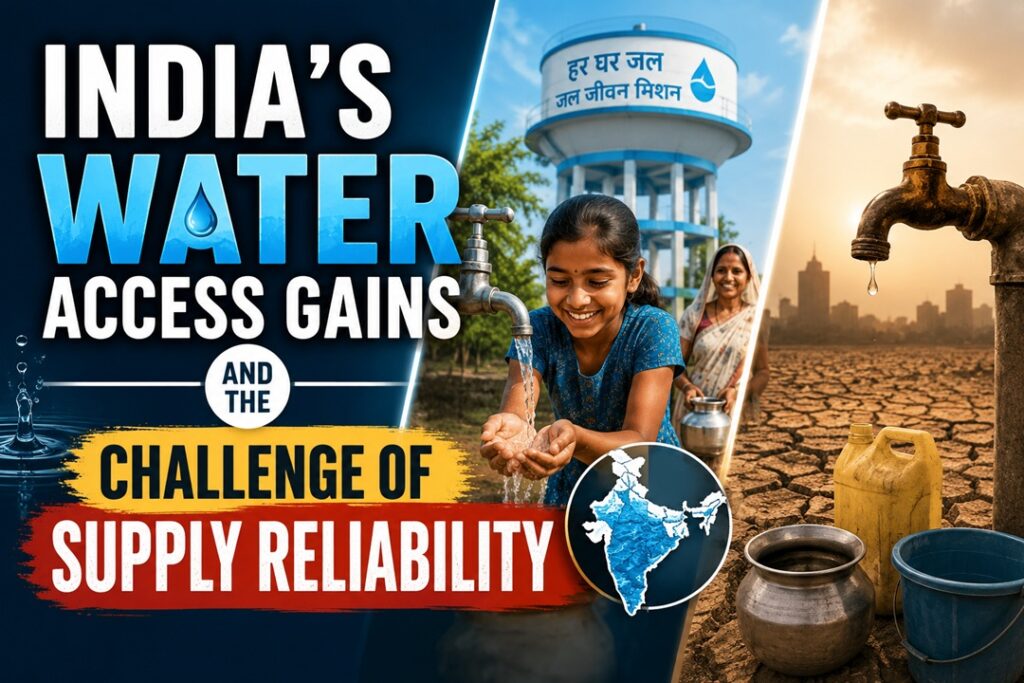
Recent findings from the National Family Health Survey (NFHS) highlight a dual reality in India’s water sector—while household access to drinking water has expanded significantly, the consistency and dependability of supply remain major concerns.
How has India progressed in drinking water coverage?
Expansion of Household Connections
India has witnessed substantial improvement in access to safe drinking water over the past decade. The launch of the Jal Jeevan Mission (JJM) in 2019 accelerated efforts to provide functional tap-water connections to rural households.
Improved Living Conditions
Millions of families that previously relied on wells, hand pumps, community taps, and distant sources now receive water within their premises. This has reduced the burden on women and children, strengthened public health, and improved overall living standards.
Emerging Concern
However, having a tap connection does not automatically ensure uninterrupted water supply. As access expands, a new challenge is becoming evident—service reliability.
Survey-Based Insights
NFHS-5 observations indicate that although water infrastructure has expanded rapidly, regular and dependable water delivery remains uneven across regions. This creates significant concerns for water governance, sustainability, and climate adaptation.
Regions Facing Frequent Disruptions
Areas reporting higher levels of water supply interruptions include:
- Western India
- Rajasthan
- Parts of the Western Ghats
- Himalayan regions
- Northeastern states
Meanwhile, comparatively lower disruption levels were observed across parts of eastern India and the Indo-Gangetic plains.
Why does infrastructure expansion not always ensure water availability?
Interconnected Supply Networks
Modern water systems rely on multiple components functioning together:
- Reservoirs and dams
- Groundwater sources
- Treatment facilities
- Pumping stations
- Electricity networks
- Distribution pipelines
A breakdown in any component can interrupt supply for a large population.
Rising Consumption Needs
Rapid urbanization, population growth, and changing lifestyles have increased water demand, placing significant stress on existing systems.
Over-Extraction of Groundwater
Several regions remain heavily dependent on groundwater. Falling water tables reduce supply security and increase vulnerability during dry periods.
Maintenance Challenges
While infrastructure creation receives substantial investment, operation and maintenance often receive less attention. Leakages, aging pipelines, and equipment failures can reduce service reliability.
Key Takeaway
Infrastructure expansion must be accompanied by effective maintenance and operational management to ensure sustained service delivery.
How is climate change intensifying water stress?
Higher Temperatures
Increasing temperatures raise domestic, industrial, and agricultural water demand while reducing available water resources.
Unpredictable Monsoons
Changing rainfall patterns affect reservoir storage and groundwater recharge.
Extended Dry Spells
Frequent and prolonged droughts reduce water availability and place additional pressure on supply systems.
Extreme Rainfall Events
Floods can damage infrastructure, contaminate water sources, and interrupt distribution networks.
Climate Vulnerability
Many regions identified as water disruption hotspots also face significant climate-related stress, indicating that climate change is amplifying existing weaknesses.
What lessons emerge from different regions?
Karnataka and Bengaluru
The 2024 Bengaluru water crisis demonstrated that extensive network coverage does not necessarily guarantee dependable supply. Weak monsoons, declining groundwater reserves, and stressed reservoirs led to rationing and tanker dependence.
Rajasthan and Gujarat
Despite large investments in canals, dams, and groundwater projects, many districts continue to experience water shortages due to:
- Groundwater depletion
- Recurring drought conditions
- Ecological limitations
Northeastern Region
Although the Northeast receives abundant rainfall, cities such as Aizawl have faced severe supply disruptions because of:
- Power outages
- Pipeline damage
- Treatment-related constraints
This highlights that water availability and water service delivery are not always synonymous.
Understanding the concept of “Reliability Deficit”
Traditional Focus
India’s water policy has historically concentrated on overcoming access deprivation, where households lacked safe and convenient water sources.
New Dimension of Water Insecurity
A growing concern is reliability deficit, where:
- Households possess water connections.
- Infrastructure exists.
- Yet water supply remains irregular or unpredictable.
Major Drivers
- Groundwater depletion
- Climate variability
- Electricity interruptions
- Infrastructure breakdowns
- Inadequate maintenance
- Weak institutional management
As centralized water systems expand, reliability challenges may emerge as a critical component of water insecurity.
What policy measures are needed?
Strengthening Performance Assessment
Monitoring systems should evaluate:
- Supply frequency
- Duration of interruptions
- Water quality
- Infrastructure performance
- Sustainability of sources
Building Climate-Resilient Systems
Water infrastructure must be designed to withstand climate-induced shocks and extreme weather events.
Promoting Recharge and Conservation
Groundwater replenishment, watershed restoration, and sustainable resource management are essential for long-term water security.
Enhancing Operations and Maintenance
Adequate financial resources and institutional capacity for maintenance can significantly improve service reliability.
Encouraging Local Participation
Community involvement can improve monitoring, accountability, and responsiveness in water service delivery.
Integrated Water Governance
A comprehensive approach linking water supply, groundwater management, ecosystem protection, and climate adaptation is necessary.
Ethical Concerns Associated with Water Reliability
Equity and Fairness
Citizens should receive not only infrastructure but also dependable access to water services.
Environmental Responsibility
Sustainable use of groundwater is essential to preserve resources for future generations.
Accountability
Public investments under initiatives such as JJM must translate into consistent and effective service delivery.
Human Dignity
Irregular access to water undermines the fundamental right to safe and adequate water.
Climate Equity
Vulnerable communities disproportionately affected by climate-induced water shortages require greater protection and support.
The Way Ahead
India’s water sector is entering a new phase where the challenge is no longer limited to providing connections but ensuring dependable and continuous service. As climate variability increases and groundwater reserves face mounting pressure, policy focus must shift from infrastructure creation to service reliability. The true measure of success will be not merely the number of taps installed, but the assurance that water remains available whenever households need it.
Source : Down To Earth