
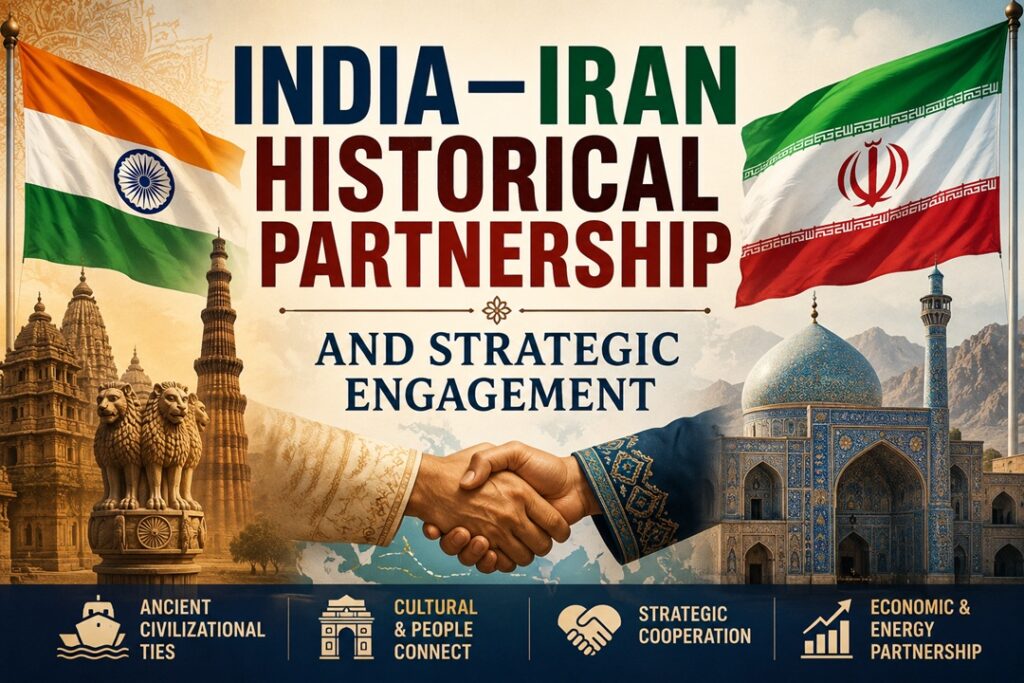
India–Iran Historical Partnership and Strategic Engagement
Context
Following the demise of Iran’s Supreme Leader Ayatollah Ali Khamenei during military operations involving the United States and Israel in February 2026, the Government of Iran invited Prime Minister Narendra Modi to participate in the official funeral ceremony scheduled for July 2026. The development has renewed attention on the long-standing historical, cultural, and strategic partnership between India and Iran.
India and Iran: A Shared Civilizational Legacy
Historical Significance
The India-Iran relationship extends far beyond present-day diplomacy. It is rooted in thousands of years of cultural interaction, intellectual exchange, trade, language, architecture, and political engagement, making it one of Asia’s oldest civilizational partnerships.
Evolution of India–Iran Relations
Ancient Indo-Iranian Foundations
Common Cultural Origins
- Early Indo-Iranian communities shared linguistic and religious traditions.
- Similarities exist between the Rig Veda and the Avesta, reflecting common Indo-European roots.
- Comparable concepts include:
- Asura – Ahura
- Soma – Haoma
- Yajna – Yasna
Persian Influence in Northwest India
- During the Achaemenid Empire (550–330 BCE), regions such as Gandhara and Sindh became part of Persian administration.
- These contacts encouraged commercial exchanges, military cooperation, and cultural diffusion across Central Asia.
Impact on Mauryan Statecraft
- Historians believe that Mauryan imperial architecture adopted several design elements from Persian traditions.
- Polished stone pillars, monumental gateways, and administrative symbolism reflected this artistic interaction.
Medieval Cultural Renaissance
Persian as the Language of Administration
- Under the Delhi Sultanate and the Mughal Empire, Persian became the principal language of governance, diplomacy, literature, and legal administration.
- It was extensively used by scholars, administrators, and royal courts across India.
Architectural Convergence
Indian monuments combined indigenous craftsmanship with Persian architectural innovations such as:
- Domes
- Arches
- Iwans
- Pishtaq gateways
- Charbagh garden layouts
This synthesis produced the distinctive Indo-Persian architectural tradition.
Migration of Intellectuals
Beginning in the 16th century, numerous Iranian scholars, physicians, artists, poets, and administrators migrated to India, contributing significantly to:
- Mughal miniature painting
- Persian literature
- Court administration
- Medical sciences
- Educational institutions
Contemporary Strategic Cooperation
Diplomatic Continuity
Despite Cold War geopolitical divisions, India and Iran maintained cordial diplomatic relations and continued regular political engagement.
Energy and Connectivity
- Iran emerged as one of India’s major crude oil suppliers.
- India regards Iran as an important gateway for connectivity with Afghanistan, Central Asia, and Eurasia.
Strategic Importance of Chabahar Port
- The Chabahar Port project remains one of the most significant pillars of India-Iran cooperation.
- It provides India with alternative access to Afghanistan and Central Asia while reducing dependence on traditional land routes.
Emerging Strategic Constraints
Balancing Multiple Partnerships
India simultaneously maintains strong relations with Iran, Israel, the Gulf countries, and Western partners, requiring careful diplomatic balancing.
Impact of International Sanctions
Sanctions targeting Iran’s banking, shipping, and energy sectors have complicated bilateral trade, energy imports, and financial transactions.
Regional Security Instability
Escalating conflicts in West Asia threaten:
- Maritime shipping routes
- Energy security
- Global oil prices
- Safety of millions of Indian citizens residing in the Gulf region
Expanding Chinese Presence
China’s growing investments and long-term infrastructure initiatives in Iran have intensified strategic competition and reduced India’s relative economic influence.
The Way Ahead
Maintain Strategic Independence
India should continue pursuing an independent foreign policy by strengthening engagement with all major West Asian stakeholders without becoming part of regional rivalries.
Strengthen Chabahar Connectivity
Ensure uninterrupted development of Chabahar Port through innovative financial arrangements and resilient trade mechanisms.
Revitalize Cultural Diplomacy
Expand academic exchanges, heritage cooperation, language studies, and people-to-people interactions to reinforce the historic Indo-Persian connection.
Enhance Diaspora Preparedness
Develop stronger emergency coordination mechanisms to protect Indian nationals during periods of regional instability.
Conclusion
India and Iran share one of the world’s oldest civilizational relationships, shaped by centuries of cultural interaction, trade, governance, and intellectual exchange. While present-day geopolitical challenges complicate bilateral engagement, preserving strategic autonomy, strengthening connectivity initiatives, and leveraging historical ties will remain essential for advancing India’s long-term interests in West Asia.
Source : The Indian Express