
India’s Demographic Transition: Challenges of Declining Fertility and Population Ageing
Context
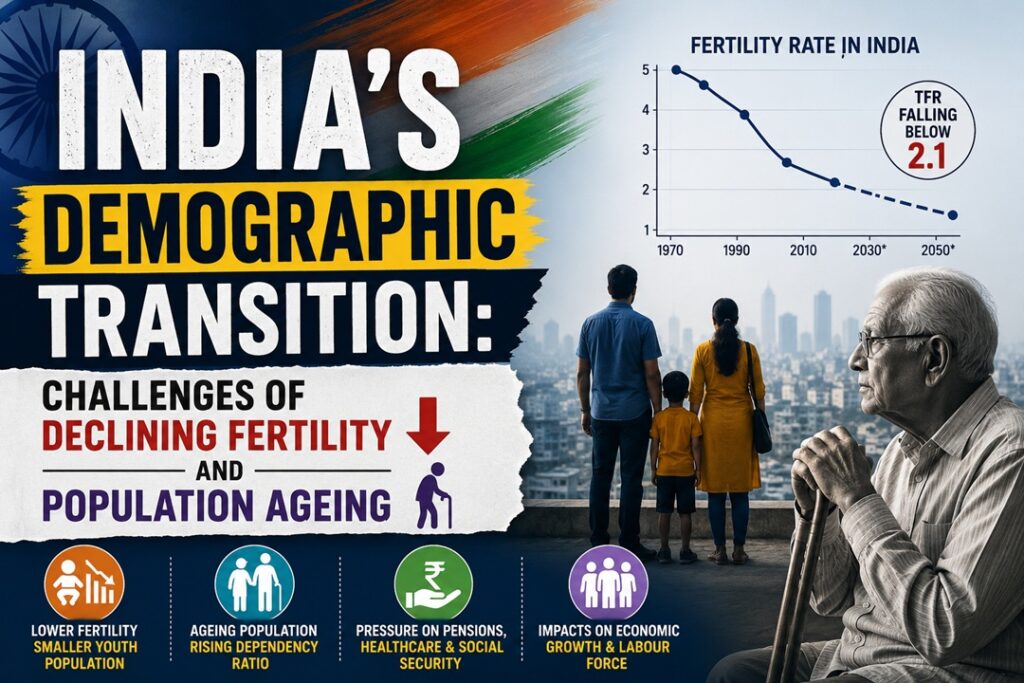
According to the latest Sample Registration System (SRS) data, India’s Total Fertility Rate (TFR) has declined to 1.9 children per woman, falling below the replacement level of 2.1. The country is now entering a new demographic phase characterised by slower population growth, rapid ageing in several states, and widening regional disparities in fertility, creating significant economic and social policy challenges.
India’s Emerging Demographic Transition
What is India’s Demographic Transition?
India is witnessing a fundamental demographic transformation as declining fertility and increasing life expectancy reshape the country’s population profile. However, this transition is highly uneven across states. Several southern and eastern states are experiencing rapid population ageing, whereas many northern states continue to record relatively higher fertility, supplying a large young workforce in the coming decades.
Key Demographic Trends
Regional Variation in Fertility Levels
- Urban-Rural Divide: Urban fertility has declined to nearly 1.5 children per woman, while rural fertility remains closer to the replacement level.
- Ultra-Low Fertility States: Delhi (1.2), Kerala (1.3), Tamil Nadu (1.3) and West Bengal (1.3) have fertility levels comparable to several developed economies.
- Higher Fertility States: Bihar (2.9) records the highest fertility rate, followed by Uttar Pradesh (2.6), Madhya Pradesh (2.4) and Rajasthan (2.3).
Growing Elderly Population
- India currently has nearly 150 million people aged 60 years and above.
- By 2050, the elderly population is projected to rise to approximately 347 million, accounting for nearly 20% of the total population.
- Around 70% of elderly citizens remain financially dependent on others, while nearly 78% lack formal pension coverage.
Major Policy Challenges
Ageing Before Economic Maturity
Unlike developed nations that became wealthy before ageing, India is experiencing rapid demographic ageing while still having relatively low per capita income and incomplete economic formalisation.
Limited Fiscal Capacity
A narrow direct tax base constrains the government’s ability to finance expanding pension systems, healthcare services, and social welfare programmes for senior citizens.
Dominance of Informal Employment
A large share of India’s workforce remains outside formal employment, leaving millions without reliable retirement savings or pension benefits.
Weak Social Security System
Current public pension assistance remains inadequate to meet the rising cost of living and healthcare needs of the elderly population.
Declining Family-Based Care
Urbanisation, migration, and the shift towards nuclear families are weakening traditional family support systems that historically provided care for elderly members.
Changing Healthcare Requirements
Population ageing will increase demand for long-term management of chronic illnesses such as diabetes, hypertension, dementia, disability, and palliative care.
Way Forward
Introduce a Universal Minimum Pension
Develop an inflation-indexed minimum pension to provide basic income security, particularly for elderly citizens working in the informal sector.
Ensure Portable Welfare Benefits
Strengthen nationwide portability of social security and welfare schemes so migrant workers retain access to benefits regardless of location.
Expand Geriatric Healthcare Services
Integrate specialised geriatric care into primary healthcare, district hospitals, and nursing education to address the growing healthcare needs of older adults.
Strengthen Human Capital in High-Fertility States
Increase investments in education, healthcare, and skill development in states with younger populations to maximise India’s demographic dividend.
Build Stronger Public Care Systems
Expand institutional eldercare services and community-based support systems as traditional family-based caregiving continues to decline.
Conclusion
India’s transition to a low-fertility and ageing society represents a major demographic milestone. Ensuring inclusive and sustainable development will require comprehensive reforms in pensions, healthcare, labour markets, and social security while investing in the country’s younger population to fully realise its demographic potential.
Source : The Hindu