
U.S. Strategic Recalibration in Asia: Implications of the PACOM Renaming
Context
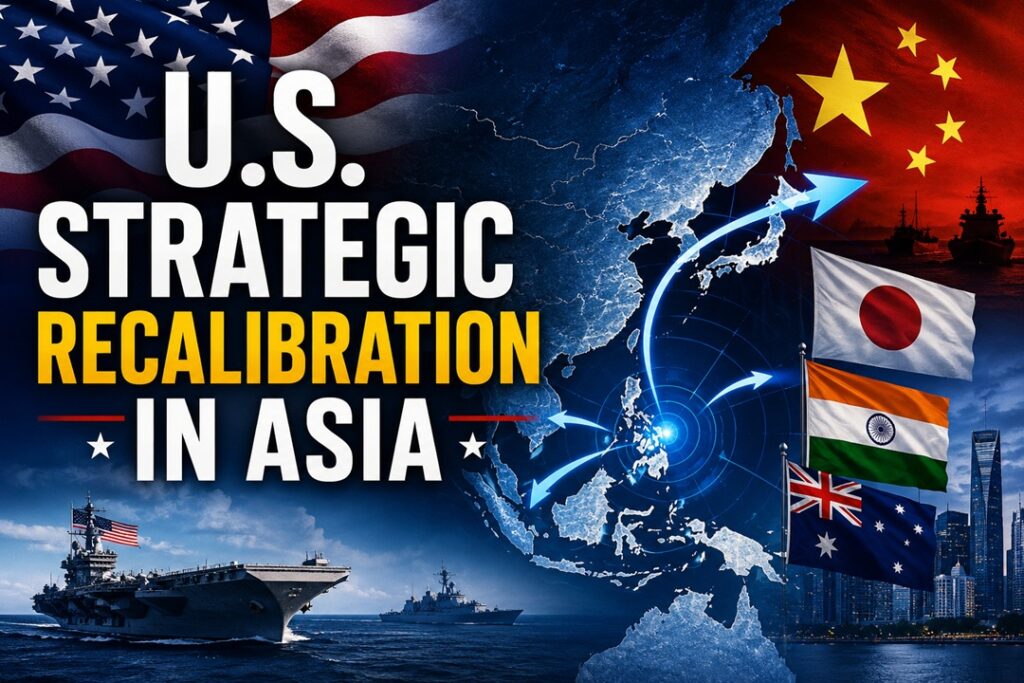
The United States has officially renamed its United States Indo-Pacific Command (INDOPACOM) back to the United States Pacific Command (PACOM). While the command’s geographical area of responsibility remains unchanged, the renaming has triggered discussions over a possible shift in Washington’s strategic priorities. The move is widely interpreted as reflecting a renewed focus on managing relations with China, reduced emphasis on the Quad, and an evolving approach toward West Asia and South Asia. These developments carry important strategic implications for India.
Does the PACOM Renaming Reflect a Strategic Shift?
Return to the Pacific Identity
- The U.S. Department of Defense has restored the name United States Pacific Command (PACOM), replacing United States Indo-Pacific Command (INDOPACOM).
- The command continues to oversee the same operational region, stretching from the western coastline of the United States to India’s western boundary.
- The term “Indo-Pacific” was introduced in 2018 to recognize India’s growing strategic importance and its expanding role in maintaining regional security.
- Reverting to PACOM is widely viewed as a symbolic indication that Washington may be placing comparatively less emphasis on India within its regional strategic framework.
Changing Strategic Messaging
- During 2018, the United States consistently promoted the Indo-Pacific concept and India’s central role within it.
- However, recent diplomatic engagements indicate a noticeable change in messaging.
- At the 2026 Shangri-La Dialogue in Singapore, U.S. officials avoided using the term “Indo-Pacific,” unlike previous years when it featured prominently in official speeches.
- This change in language suggests a broader reassessment of American geopolitical priorities in Asia.
How is the U.S. Approach Towards China and the Quad Changing?
Renewed Engagement with China
- The United States appears to be pursuing a more pragmatic relationship with China while continuing long-term strategic competition.
- Diplomatic interactions between the leadership of both countries indicate an effort to stabilize bilateral relations and prevent direct confrontation.
- References to a possible “G-2” global order suggest an emerging vision in which the U.S. and China jointly shape global affairs, with China exercising greater influence across Asia.
- Such an approach differs from India’s vision of a multipolar Indo-Pacific where multiple regional powers maintain strategic balance.
Declining Momentum of the Quad
- The Quad—comprising India, the United States, Japan, and Australia—was revitalized to strengthen regional security and promote a free, open, and inclusive Indo-Pacific.
- In recent years, however, the grouping appears to have lost strategic momentum.
- Its current cooperation largely focuses on:
- Maritime security
- Economic prosperity
- Critical and emerging technologies
- Critical minerals
- Humanitarian assistance and disaster response
- Progress in several areas has slowed, particularly in advanced technology and Artificial Intelligence collaboration.
- Although Quad members signed initiatives such as Pax Silica and the Critical Minerals Initiative Framework, restrictions imposed by the U.S. on access to advanced AI models have complicated technological cooperation.
Operational Challenges Facing the Quad
- India has attempted to host a Quad Leaders’ Summit since 2024 without success.
- During U.S. Secretary of State Marco Rubio’s visit in May 2026, no assurance was provided regarding President Trump’s participation in a summit in New Delhi.
- This has led to speculation that the Quad may increasingly function only at the Foreign Ministers’ level rather than as a leaders’ summit.
- Meanwhile, maritime security challenges continue to grow due to attacks on commercial shipping and rising tensions involving Iranian naval activities.
How is U.S. Policy Towards West Asia Evolving?
Ceasefire with Iran Reflects Strategic Reassessment
- Following a brief military confrontation, the United States quickly entered into a ceasefire arrangement with Iran.
- The move reflects Washington’s growing reluctance to remain deeply involved in prolonged conflicts in West Asia.
- Despite the ceasefire, regional instability persists as disagreements continue over security arrangements involving Israel and Lebanon.
Major Features of the U.S.–Iran Understanding
Reported provisions of the agreement include:
- Withdrawal of U.S. military forces from areas close to Iran within 30 days after a final agreement.
- Joint management of the Strait of Hormuz involving Iran, Oman, and Gulf littoral states.
- Approximately US$300 billion in reconstruction assistance for Iran from the United States and regional partners.
Changing Regional Alignments
- Oman and Qatar have expanded diplomatic engagement with Iran.
- Saudi Arabia is simultaneously exploring broader security partnerships with Türkiye, Pakistan, and Ukraine.
- These developments indicate changing regional power dynamics and a gradual weakening of the traditional U.S.-led Gulf security architecture.
How is the United States Expanding its Presence in South Asia?
Growing Diplomatic Engagement
- The appointment of Sergio Gor as both U.S. Ambassador to India and Special Envoy for South and Central Asia reflects Washington’s intention to play a larger regional role.
- India has consistently opposed third-party mediation in bilateral matters, particularly regarding India-Pakistan relations.
- Nevertheless, recent U.S. diplomatic initiatives suggest expanding regional involvement.
Broader Regional Outreach
- Senior U.S. diplomatic visits to Kathmandu, Thimphu, Dhaka, and Colombo demonstrate efforts to strengthen American influence across South Asia.
- As regional institutions such as SAARC and BIMSTEC face challenges due to political tensions, the United States appears to be expanding its diplomatic footprint.
- This increasingly places Washington in direct strategic competition with China across the region.
What are the Strategic Implications for India?
Reassessing India’s Position
- India has placed the Indo-Pacific at the centre of its foreign policy since 2018.
- The renaming of PACOM may indicate reduced emphasis on India’s role within U.S. regional strategy.
- New Delhi may therefore need to reassess its long-term strategic planning in response to evolving geopolitical realities.
Strengthening Alternative Maritime Partnerships
- Prime Minister Narendra Modi’s engagements with Japan, Australia, Indonesia, and New Zealand become increasingly important in sustaining regional partnerships.
- India could revive the Australia–India–Japan Trilateral and strengthen other maritime coalitions to maintain influence across the Indo-Pacific.
Revisiting West Asia Policy
- India’s balanced approach towards West Asia requires careful reassessment in light of changing U.S.–Iran relations.
- New Delhi may need to reconsider aspects of its policy relating to Iranian oil imports and the strategic Chabahar Port, while preserving strong ties with Israel and Gulf countries.
Revitalising Regional Institutions
- India should work towards strengthening SAARC, BIMSTEC, and other regional organisations.
- Institutions such as the Indian Ocean Rim Association (IORA) and the Shanghai Cooperation Organisation (SCO) provide valuable platforms for expanding India’s diplomatic influence and maintaining regional balance.
Way Forward
The restoration of the Pacific Command (PACOM) designation represents more than a symbolic administrative change. It reflects broader adjustments in U.S. strategic thinking regarding Asia, China, West Asia, and South Asia. India should closely monitor these developments and adopt a proactive strategy by strengthening regional partnerships, expanding diplomatic engagement, enhancing maritime cooperation, and reinforcing its leadership role in the Indo-Pacific. A flexible and diversified foreign policy will be essential to safeguard India’s long-term strategic interests in an evolving geopolitical landscape.
Source : The Hindu