
VB-G RAM G: India’s New Rural Employment Framework Replacing MGNREGA
Context
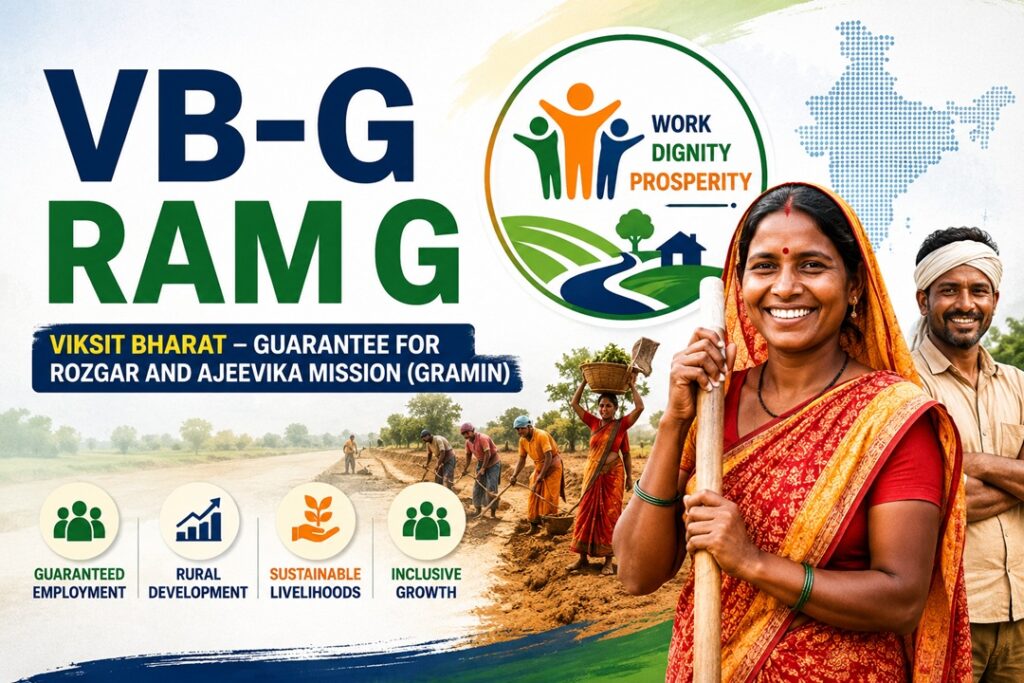
From 1 July 2026, the Government has introduced the Viksit Bharat – Guarantee for Rozgar and Ajeevika Mission (Gramin) (VB-G RAM G) as the successor to the Mahatma Gandhi National Rural Employment Guarantee Act (MGNREGA). The revamped programme aims to combine employment generation with long-term rural infrastructure development under the Viksit Bharat @2047 vision.
About VB-G RAM G
What is it?
VB-G RAM G is a restructured rural employment programme designed to provide wage employment while creating durable productive assets in villages.
Objectives
- Provide 125 days of guaranteed wage employment per rural household annually.
- Strengthen rural livelihoods through productive infrastructure.
- Promote sustainable and climate-resilient village development.
- Integrate employment generation with national infrastructure planning.
Nature of the Scheme
- Centrally Sponsored Scheme.
- Supports the vision of Viksit Bharat @2047 through integrated rural development.
Major Features
- Employment Guarantee: Rural households receive up to 125 days of wage employment every year.
- Unemployment Compensation: Eligible workers are entitled to an allowance if employment is not provided within 15 days of demand.
- Institutional Framework: National and State Steering Committees oversee implementation, monitoring, and fund allocation.
- Digital Governance: Extensive use of biometric authentication, GIS mapping, mobile monitoring applications, and digital payment systems.
VB-G RAM G vs MGNREGA
| Aspect | MGNREGA | VB-G RAM G |
|---|---|---|
| Employment Guarantee | 100 days per household | 125 days per household |
| Planning Model | Demand-driven employment | Planned development linked to village infrastructure plans |
| Funding Pattern | Centre bore entire unskilled wage cost | Cost sharing: 60:40 (Centre:State), 90:10 for NE & Himalayan states |
| Agriculture | Continuous employment throughout the year | States may declare up to 60-day agricultural pause during peak seasons |
| Asset Creation | Small community assets | Focus on large productive and climate-resilient infrastructure |
| Governance | Gram Sabha-based project selection | Village plans integrated with national infrastructure planning framework |
Importance of the New Scheme
Productive Rural Infrastructure
The programme prioritizes four major sectors:
- Water conservation and watershed management.
- Rural roads and public infrastructure.
- Agricultural storage, cold chains, and warehouses.
- Climate-resilient community assets.
Better Rural Productivity
The scheme seeks to convert public expenditure into long-term economic assets that improve agricultural productivity and rural incomes.
Improved Transparency
Digital technologies are expected to reduce corruption through:
- Biometric attendance.
- GPS-enabled worksite monitoring.
- Real-time mobile dashboards.
- Public disclosure of project progress and payments.
Integrated Development
Village development plans are linked with broader infrastructure planning to ensure better coordination between local and national development priorities.
Challenges
Higher Financial Responsibility for States
The revised funding pattern requires states to contribute a larger share of project costs, increasing pressure on state finances.
Reduced Demand-Driven Nature
Critics argue that shifting towards a planned allocation system may weaken the employment guarantee available to vulnerable households during periods of distress.
Seasonal Work Suspension
The provision allowing states to temporarily suspend employment during peak agricultural seasons may reduce income opportunities for landless labourers.
Digital Divide
Heavy dependence on digital authentication and technology could exclude workers facing biometric failures, weak internet connectivity, or limited digital literacy.
Wider Concerns
Centralisation of Planning
Integration with national planning platforms may reduce the decision-making powers traditionally exercised by Gram Sabhas.
Federal Issues
State governments have raised concerns regarding increased financial obligations and reduced flexibility in implementing rural employment programmes.
Government’s Transition Measures
- Released ₹95,692 crore as an initial financial allocation to ensure uninterrupted implementation.
- Coordinated with multiple states for adoption of the revised operational guidelines.
- Deployed dedicated administrative teams at district and block levels to facilitate smooth implementation and resolve operational issues.
Ethical Considerations
Strengthening Accountability
The use of digital technologies can improve transparency, reduce leakages, and ensure benefits reach genuine beneficiaries.
Preventing Digital Exclusion
Technology should complement—not replace—human oversight. Alternative verification methods should be available where biometric or connectivity issues arise.
Balancing Efficiency and Inclusion
Administrative efficiency must be accompanied by safeguards that protect the rights and livelihoods of vulnerable rural workers.
Way Forward
- Introduce flexible financial mechanisms to prevent delays caused by state funding constraints.
- Allow local authorities to determine agricultural pause periods based on regional cropping patterns.
- Preserve the central role of Gram Sabhas in project identification while using digital platforms primarily for monitoring and transparency.
- Establish offline verification and grievance redressal systems to ensure that no eligible worker is excluded due to technological barriers.
- Continuously evaluate the scheme’s outcomes to balance employment security with sustainable rural infrastructure development.
Conclusion
VB-G RAM G represents a significant shift in India’s rural employment strategy by combining livelihood support with productive asset creation. While the programme has the potential to improve rural infrastructure and governance, its long-term success will depend on adequate funding, cooperative federalism, technological inclusion, and preserving employment security for rural households.
Source : Business Standard