
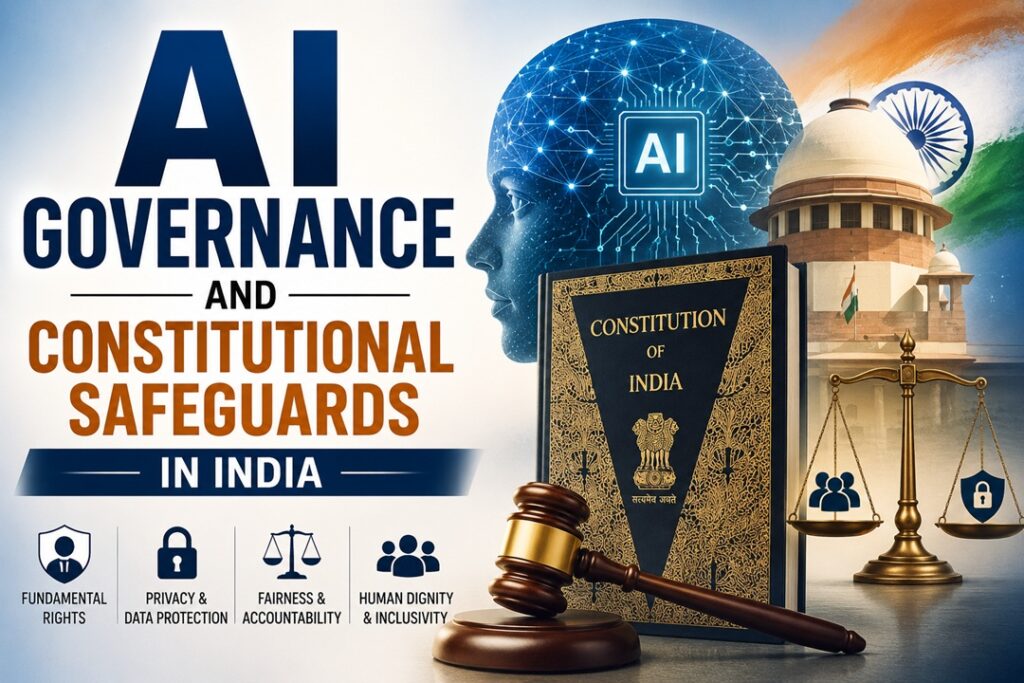
AI Governance and Constitutional Safeguards in India
Context
The rapid expansion of Artificial Intelligence (AI), coupled with the rise of deepfakes, algorithmic influence, data privacy concerns, and AI-enabled misinformation, has renewed calls for a robust governance framework. Experts argue that India must adopt a rights-based regulatory approach to ensure AI supports innovation without compromising constitutional values and democratic institutions.
What are the major concerns associated with Artificial Intelligence?
Privacy and Data Protection Risks
- AI systems depend on vast amounts of personal data for training and decision-making.
- Excessive collection, storage, and commercial use of user information may violate privacy and reduce individual control over personal data.
- Weak safeguards increase the possibility of surveillance and misuse of sensitive information.
Rapid Technological Growth Outpacing Laws
- AI technology evolves much faster than policymaking.
- Existing legal frameworks often struggle to address emerging AI-related risks.
- Delayed regulations create uncertainty and leave critical gaps in governance.
Impact on Democracy
- AI-generated deepfakes, fake news, and automated propaganda can influence public opinion.
- Manipulated digital content may affect elections and reduce trust in democratic processes.
- Distinguishing authentic information from fabricated content becomes increasingly difficult.
Algorithm-Driven Information Ecosystems
- Social media platforms rely on algorithms that prioritize user engagement.
- These systems often promote sensational or divisive content, strengthening echo chambers and social polarization.
- Such practices weaken informed public discourse.
Dominance of Large Technology Companies
- A few global technology firms increasingly control AI infrastructure and digital communication.
- Limited transparency in AI algorithms raises concerns regarding accountability, competition, and public oversight.
- Excessive market concentration may undermine democratic governance.
National Security Challenges
- AI has become a powerful tool for cyber warfare and information manipulation.
- Adversarial actors can deploy AI to spread disinformation, exploit social divisions, and interfere in political processes.
- India’s expanding digital ecosystem makes it more vulnerable to coordinated influence campaigns.
Bias and Discrimination
- AI models may inherit biases present in training datasets.
- Biased algorithms can produce unfair outcomes in recruitment, banking, healthcare, education, policing, and public service delivery.
- Such discrimination conflicts with constitutional principles of equality.
Why does India need a strong AI governance framework?
India’s Unique Digital Landscape
India’s AI governance requirements are shaped by:
- World’s largest democratic population.
- Expanding digital economy.
- Rapid internet and smartphone penetration.
- Massive social media participation.
- Linguistic and cultural diversity.
- Uneven levels of digital awareness.
This combination creates significant opportunities while increasing vulnerability to misinformation and AI misuse.
Beyond Conventional Regulation
- Traditional laws alone cannot effectively govern continuously evolving AI technologies.
- A long-term governance framework should be anchored in constitutional values such as:
- Human dignity
- Privacy
- Equality
- Freedom of expression
- Democratic participation
- National sovereignty
Key pillars of AI governance for India
Citizen-Centric AI Regulation
- Protect personal data and digital rights.
- Ensure informed consent for data usage.
- Prevent algorithmic discrimination.
- Maintain human oversight in critical AI-based decisions.
- Preserve individual autonomy.
Greater Platform Accountability
- Conduct independent audits of AI algorithms.
- Increase transparency in automated decision-making.
- Hold platforms responsible for harmful algorithmic amplification.
- Develop mechanisms to manage systemic digital risks.
Safeguarding Freedom of Expression
- Address deepfakes, bot networks, and coordinated misinformation campaigns.
- Avoid excessive censorship of legitimate political opinions and public debate.
- Maintain a balance between free speech and responsible digital regulation.
Promoting Digital Literacy
- Encourage critical thinking and responsible online behaviour.
- Improve media verification skills.
- Introduce digital literacy in schools, colleges, and universities.
- Build resilience against misinformation.
Strengthening National Security
- Develop AI-based early warning systems to detect misinformation campaigns.
- Foster cooperation among:
- Government agencies
- Cybersecurity experts
- Academic institutions
- Fact-checking organizations
- Civil society
- Technology companies
Constitutional foundations for AI regulation
Article 21 – Right to Life and Personal Liberty
- Protect citizens from arbitrary surveillance and misuse of personal information.
Article 14 – Right to Equality
- Prevent discrimination arising from biased AI systems.
Article 19 – Freedom of Speech and Expression
- Ensure free expression while limiting malicious AI-driven manipulation.
Right to Privacy
- Promote responsible collection, storage, and processing of personal data.
Embedding AI governance within constitutional principles ensures long-term protection despite rapid technological change.
Ethical concerns surrounding AI
Artificial Intelligence raises several ethical questions, including:
- Violation of privacy through excessive surveillance.
- Erosion of individual autonomy due to automated decision-making.
- Algorithmic discrimination affecting fairness and justice.
- Spread of deepfakes and misinformation, weakening public trust.
- Lack of transparency and accountability in AI systems.
- Concentration of technological power among a few corporations.
Ethical AI should promote fairness, transparency, inclusiveness, accountability, and respect for human rights.
Measures required
Authorities should:
- Enact a comprehensive AI governance law aligned with constitutional principles.
- Strengthen personal data protection mechanisms.
- Mandate transparency and explainability in AI systems.
- Establish independent regulators to audit high-risk AI applications.
- Encourage human oversight in sensitive sectors.
- Expand digital literacy and media awareness programmes.
- Develop systems to detect deepfakes and coordinated misinformation.
- Promote collaboration between government, academia, industry, and civil society.
- Invest in secure, trustworthy, and indigenous AI technologies.
- Enhance international cooperation on AI standards and governance.
Way Forward
India should adopt a balanced AI governance model that encourages technological innovation while safeguarding constitutional rights and democratic institutions. A transparent, accountable, and citizen-centric regulatory framework, supported by ethical AI practices, robust digital literacy, and effective institutional oversight, will enable the country to harness AI’s transformative potential while protecting privacy, equality, national security, and public trust.
Conclusion
Artificial Intelligence offers immense opportunities for economic growth and public welfare, but its unchecked use can threaten democratic values, privacy, and social harmony. A governance framework rooted in constitutional principles, ethical standards, transparency, and accountability will help India build a secure, inclusive, and trustworthy AI ecosystem that supports innovation while protecting the rights and freedoms of its citizens.
Source : The Hindu