
Indian Ocean Dipole (IOD) and Its Role in India’s Monsoon
Context
Meteorologists are closely monitoring whether a forecast ‘Super El Niño’ could recreate conditions similar to 1997, when a strong Indian Ocean Dipole (IOD) offset the adverse effects of El Niño and helped India receive above-normal monsoon rainfall. This has renewed interest in understanding how the IOD influences India’s Southwest Monsoon.
What is the Indian Ocean Dipole (IOD)?
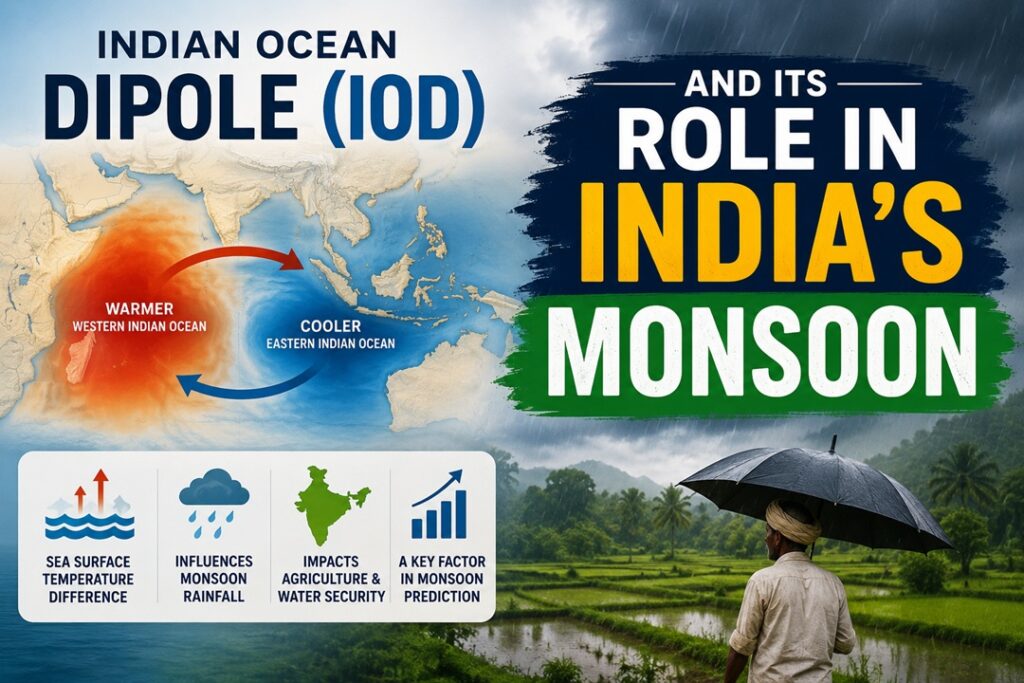
- The Indian Ocean Dipole (IOD) is a coupled ocean-atmosphere climate phenomenon characterised by differences in sea surface temperatures (SSTs) between the western and eastern equatorial Indian Ocean.
- It influences atmospheric circulation, rainfall distribution, and climate patterns across the Indian Ocean region.
- Owing to its climatic influence, the IOD is often referred to as the “Indian Niño.”
1997: A Remarkable Climate Exception
How Did India Escape Drought?
- The 1997 El Niño was among the strongest ever recorded and was expected to cause severe drought across India.
- Contrary to expectations, India received around 2% above-normal monsoon rainfall during the June–September season.
- According to India Meteorological Department (IMD) Director-General Mrutyunjay Mohapatra, such an event has occurred only once in recorded history.
- The unexpected surplus rainfall was largely due to a strong positive Indian Ocean Dipole, which supplied additional moisture and strengthened the Southwest Monsoon.
Current Monsoon Outlook
- With another Super El Niño forecast, scientists are assessing whether a similar positive IOD could reduce its adverse impact.
- At present, India has experienced a significant rainfall deficit during the early monsoon period.
- The IMD projects seasonal rainfall at around 90% of the Long Period Average (LPA), placing it close to the deficient category.
Different Phases of the Indian Ocean Dipole
Positive IOD
- The western Indian Ocean becomes warmer than normal, while the eastern Indian Ocean turns cooler.
- This temperature contrast enhances moisture transport towards India, generally strengthening the Southwest Monsoon and increasing rainfall.
Negative IOD
- The eastern Indian Ocean becomes warmer, while the western Indian Ocean cools.
- Moisture shifts away from the Indian subcontinent, often resulting in weaker monsoon rainfall and longer dry spells.
Neutral IOD
- Sea surface temperatures remain close to their long-term averages across both regions.
- Under this phase, the IOD has little influence on monsoon behaviour.
How is the IOD Measured?
Dipole Mode Index (DMI)
- The intensity of the Indian Ocean Dipole is measured using the Dipole Mode Index (DMI).
- It calculates the difference in sea surface temperature anomalies between the western and eastern equatorial Indian Ocean.
Meaning of DMI Values
- A positive DMI indicates warmer waters in the western Indian Ocean compared to the east.
- A negative DMI indicates warmer waters in the eastern Indian Ocean.
- Since this temperature gradient influences atmospheric circulation and rainfall, the DMI serves as the primary indicator for monitoring IOD conditions.
Present Status
- The Indian Ocean Dipole is currently in a neutral phase.
- Sea surface temperatures across the equatorial Indian Ocean remain close to historical averages, providing neither significant support nor major suppression to the ongoing monsoon.
Impact of the Indian Ocean Dipole
Positive IOD
Oceanic Changes
- Warmer-than-normal waters develop in the western Indian Ocean, while the eastern region becomes relatively cooler.
- Trade winds weaken, allowing moisture to accumulate in the western basin.
Global Effects
- East Africa generally receives above-average rainfall and may experience flooding.
- Indonesia and Australia often face drought conditions and increased bushfire risk.
Impact on India
- A positive IOD usually strengthens the Southwest Monsoon by increasing moisture availability.
- It can partially offset the rainfall deficit caused by El Niño.
Negative IOD
Oceanic Changes
- Stronger trade winds push warm waters toward the eastern Indian Ocean.
- The western Indian Ocean becomes cooler than normal.
Global Effects
- Indonesia and Australia receive above-normal rainfall with higher flood risk.
- East Africa often experiences below-normal rainfall.
Impact on India
- Reduced moisture transport weakens the Southwest Monsoon.
- India is more likely to witness below-normal rainfall and prolonged dry spells.
Neutral IOD
Climatic Conditions
- Ocean temperatures and atmospheric circulation remain close to their long-term averages.
- The IOD exerts minimal influence on seasonal rainfall during this phase.
Way Forward
- Forecast models, including those of the India Meteorological Department (IMD), indicate that the Indian Ocean Dipole is likely to remain neutral during most of the monsoon season.
- The Australian Bureau of Meteorology suggests only a slight possibility of a positive IOD emerging during August or September.
- Even if a positive phase develops, it is expected to be too weak and too late to significantly counter the effects of a strong El Niño on India’s monsoon.
Source : The Hindu