
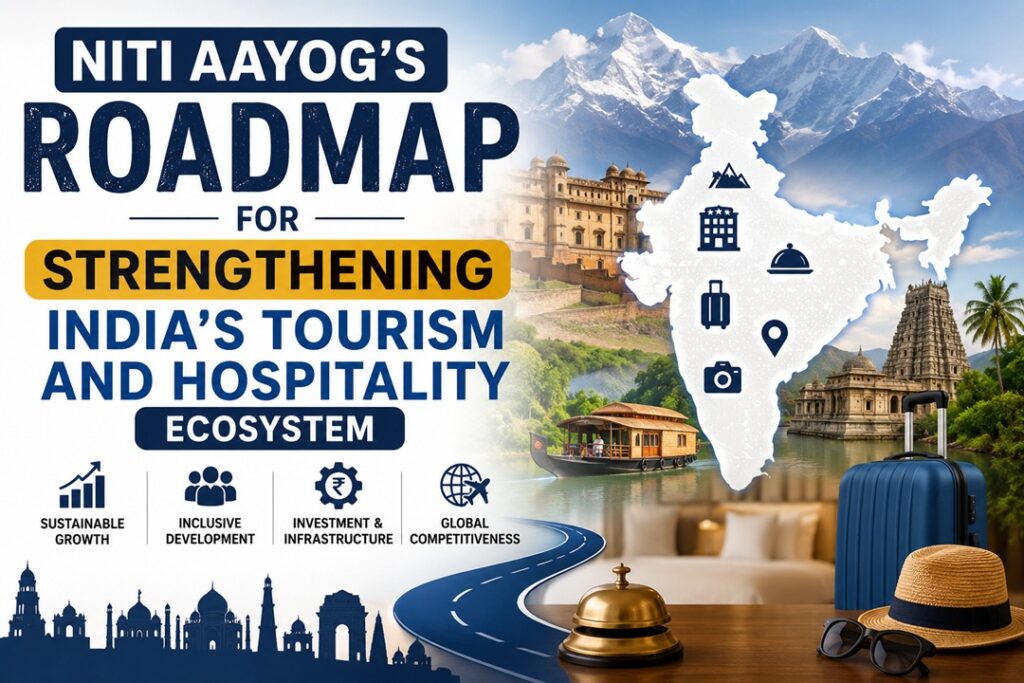
NITI Aayog’s Roadmap for Strengthening India’s Tourism and Hospitality Ecosystem
Context
The Ministry of Tourism, in collaboration with NITI Aayog, released the report “Unlocking Growth in Tourism and Hospitality Sector” during a National Workshop held in New Delhi. The report examines the regulatory and policy challenges affecting India’s tourism industry and proposes reforms to improve ease of doing business, attract greater investment, enhance visitor experience, and support the vision of Viksit Bharat 2047.
India’s Tourism Growth Strategy Report
Overview
The report evaluates structural and regulatory constraints across the tourism and hospitality sector. It recommends reforms in accommodation, hospitality, transport, and travel services to unlock the sector’s full growth potential and improve India’s global tourism competitiveness.
Major Highlights of India’s Tourism Sector
Strong Domestic Tourism Growth
India witnessed nearly 2.9 billion domestic tourist visits in 2024, exceeding the pre-COVID level of 2.3 billion visits in 2019, indicating a robust recovery.
Rise in International Visitors
The country received approximately 9.95 million foreign tourist arrivals in 2024, generating close to USD 35 billion in foreign exchange earnings.
Untapped Global Potential
Although India ranks 6th in Natural Resources and 9th in Cultural Resources under the Travel & Tourism Development Index (TTDI), its overall global ranking remains 39th, highlighting the need for policy improvements.
Slow Hospitality Investments
Developing a hotel project typically requires around 60 regulatory clearances and 36–48 months for completion, delaying investments.
Growth Drivers for the Tourism Industry
Large Employment Generator
Tourism supports employment across both skilled and unskilled sectors, making it one of India’s largest job-creating service industries.
Example: Hotels, airlines, travel agencies, tour operators, and restaurants create extensive employment opportunities.
Balanced Regional Development
Tourism stimulates investment in rural, coastal, ecological, and heritage destinations, helping diversify regional economies.
Example: Heritage tourism in Rajasthan and backwater tourism in Kerala provide sustainable livelihoods for local communities.
Boost to Foreign Exchange
International tourist spending contributes significantly to India’s foreign exchange reserves without requiring merchandise exports.
Example: Foreign visitors spend on accommodation, transportation, shopping, food, and recreational activities.
Focus on Premium Tourism
Encouraging high-value tourism segments can increase tourist spending and improve revenue rather than relying solely on higher tourist numbers.
Example: Wellness tourism, Ayurveda, luxury heritage properties, and spiritual tourism attract premium travellers.
Expansion of Rural Homestays
Homestays offer affordable accommodation while generating direct income for rural households and promoting community-based tourism.
Example: Registered homestays generated around ₹4,722 crore in revenue during 2024.
Key Regulatory Challenges
Rigid Construction Regulations
Restrictive land-use norms and building regulations increase project costs and reduce commercial viability.
Example: Rajasthan’s 40% ground coverage limit raises hotel construction expenses.
Multiple Approval Requirements
Hotels often require separate permissions from various departments, resulting in duplication and administrative delays.
Example: Hotels in Mumbai need independent licenses for facilities such as banquet halls, salons, and laundries.
Heavy Compliance Requirements
Frequent renewal of operational permits increases compliance costs and administrative workload.
Example: Bar licences in Uttar Pradesh must be renewed annually by 31 March.
Interstate Transport Restrictions
Different permit rules and taxation systems across states increase operating costs for tourist vehicles.
Example: Kerala levies additional taxes on tourist vehicles despite possessing valid All India Tourist Permits (AITP).
Complicated Visa Process
Lengthy visa procedures and payment-related technical issues discourage international travellers.
Example: India’s e-Visa application requires more than 70 information fields, along with occasional foreign payment failures.
Policy Reforms Suggested by NITI Aayog
Ease Construction Norms
Relax Floor Area Ratio (FAR) limits and ground coverage restrictions to reduce project costs and encourage private investment.
Introduce Single-Window Licensing
Replace multiple approvals with an integrated licensing mechanism and eliminate redundant permissions to improve ease of doing business.
Strengthen Homestay Ecosystem
Increase the permissible room limit for registered homestays and remove unnecessary No Objection Certificates (NOCs) to promote rural entrepreneurship and community tourism.
Modernise Tourist Transport
Extend the validity of All India Tourist Permits (AITP) and eliminate overlapping state taxes to facilitate seamless interstate travel.
Simplify International Travel
Expand the Visa-on-Arrival (VoA) programme and streamline the e-Visa process through simplified documentation and smoother digital payment systems.
Conclusion
The report provides a comprehensive roadmap for transforming India’s tourism and hospitality sector through regulatory reforms, improved infrastructure, and investment-friendly policies. Implementing these recommendations can enhance India’s global competitiveness, create large-scale employment, increase foreign exchange earnings, and establish tourism as a major engine of inclusive and sustainable economic growth under the Viksit Bharat 2047 vision.
Source : PIB