
INSA Calls for an Integrated National Energy Governance Framework
Context
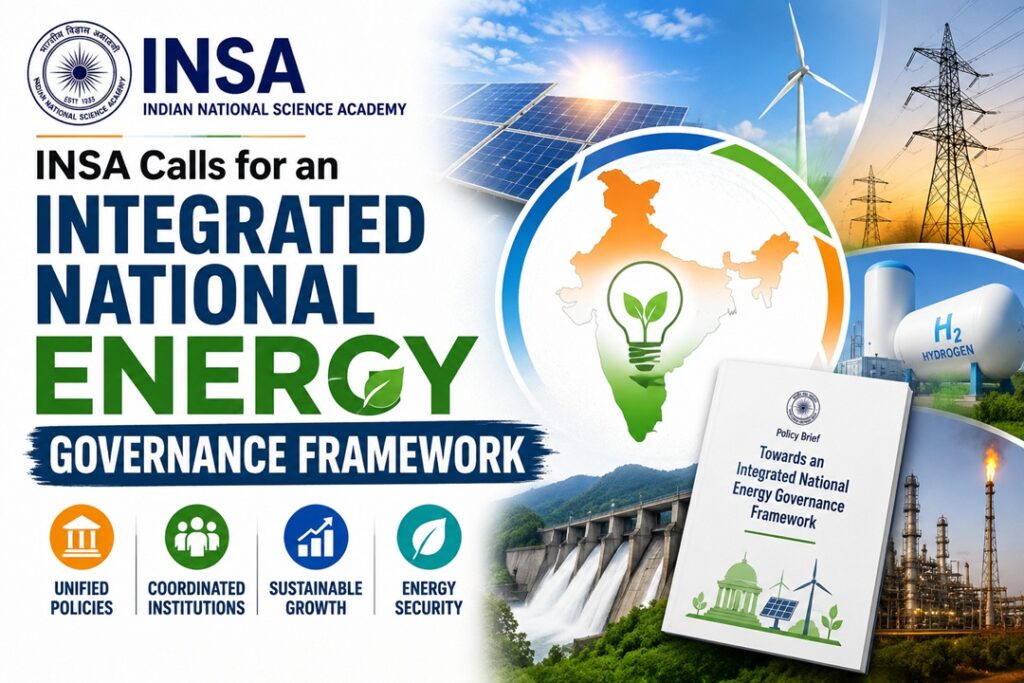
The Indian National Science Academy (INSA), through its Centre for Science, Technology, Innovation and Policy (CSTIP), has released a policy brief proposing a Unified National Energy Governance Framework to strengthen India’s energy security, accelerate the clean energy transition, and support sustainable economic growth. The report highlights the need to replace fragmented energy planning with a coordinated, whole-of-government approach.
Integrated National Energy Governance Framework
What is the Integrated National Energy Governance Framework?
- It is a comprehensive national policy architecture that aims to bring all energy sectors under a single, coordinated governance system instead of separate ministry-wise planning.
- The framework promotes integrated decision-making across electricity, coal, petroleum, natural gas, renewable energy, hydrogen, and emerging clean technologies.
- It is guided by four foundational principles:
- Energy Adequacy – Ensuring sufficient energy supply to meet future demand.
- Universal Access – Providing reliable and equitable energy access for all citizens.
- Affordability – Delivering energy at economically sustainable prices.
- Appropriate Sustainability – Balancing economic growth with environmental protection and efficient resource use.
Key Highlights
Rapid Growth of Renewable Energy
- India’s installed renewable energy capacity has increased from around 40 GW in 2015 to nearly 260 GW by 2025, reflecting one of the world’s fastest clean energy expansions.
National Long-Term Targets
- Energy Independence by 2047 under the vision of Viksit Bharat.
- Net Zero Carbon Emissions by 2070, announced at COP26.
Support for Green Energy
- The framework complements flagship programmes such as the National Green Hydrogen Mission, supported by a ₹19,744 crore budget to promote green hydrogen production, storage, and exports.
Why India Needs a Unified Energy Framework
Eliminate Institutional Fragmentation
- Energy governance is currently spread across multiple ministries and departments, resulting in duplication, policy inconsistencies, and slow decision-making.
Meet Rising Energy Demand
- Rapid industrialization, urbanization, digitalization, and population growth require integrated long-term planning to ensure uninterrupted energy supply.
Enhance Energy Security
- India imports a large share of its crude oil and natural gas requirements, making the economy vulnerable to geopolitical tensions and volatile global energy prices.
Integrate Renewable Energy Efficiently
- Large-scale solar and wind deployment requires stronger transmission infrastructure, flexible power systems, smart grids, and large-scale energy storage.
Enable Region-Specific Transition
- Different states have different resource bases and economic structures; therefore, transition strategies should be tailored to local conditions while ensuring a just transition for fossil-fuel-dependent communities.
Major Government Initiatives Supporting the Transition
Saubhagya Scheme
- Achieved near-universal household electrification across rural and urban India.
Pradhan Mantri Ujjwala Yojana (PMUY)
- Expanded access to clean LPG cooking fuel for millions of low-income households.
National Green Hydrogen Mission
- Aims to establish India as a global hub for green hydrogen production, utilization, and exports.
Carbon Capture Demonstration Projects
- Pilot initiatives such as NTPC’s 150-tonne-per-day Green Urea Plant at Pudimadaka demonstrate the use of Carbon Capture, Utilization and Storage (CCUS) technologies.
Major Challenges
High Infrastructure Costs
- Upgrading thermal power plants, transmission networks, and distribution infrastructure requires substantial financial investment.
Limited Energy Storage Capacity
- Scaling up batteries, pumped hydro storage, and other storage technologies remains technologically and economically challenging.
Centre–State Coordination Issues
- Harmonizing electricity regulations and reforms across states requires strong institutional cooperation.
Hydrogen Infrastructure Gaps
- Green hydrogen adoption requires dedicated pipelines, storage facilities, transport systems, and industrial ecosystems.
High Cost of Green Fuels
- Green hydrogen and green ammonia remain significantly more expensive than fossil-fuel-based alternatives.
Way Forward
Adopt a Phased Energy Transition Strategy
- Implement gradual reforms focusing first on grid modernization, renewable integration, and green hydrogen before deeper industrial decarbonization.
Expand CCUS Technologies
- Promote Carbon Capture, Utilization and Storage across sectors such as steel, cement, fertilizers, and thermal power.
Strengthen Energy Storage
- Invest in grid-scale batteries, pumped-storage hydropower, and other storage technologies to improve grid reliability.
Encourage Public–Private Partnerships
- Promote domestic manufacturing of advanced solar modules, electrolyzers, batteries, and other clean-energy technologies.
Ensure a Just Transition
- Create reskilling programmes, financial assistance, and social protection measures for workers and regions dependent on fossil fuels.
Conclusion
The INSA policy brief emphasizes that India’s long-term energy security and sustainable development require a unified national energy governance framework that integrates planning across all energy sectors. By focusing on the four pillars of adequacy, access, affordability, and sustainability, the proposed framework can strengthen energy security, improve policy coordination, accelerate decarbonization, and help India achieve its goals of energy independence by 2047 and Net Zero emissions by 2070.
Source : The Hindu