
Indian Diaspora in a Changing Global Landscape
Context
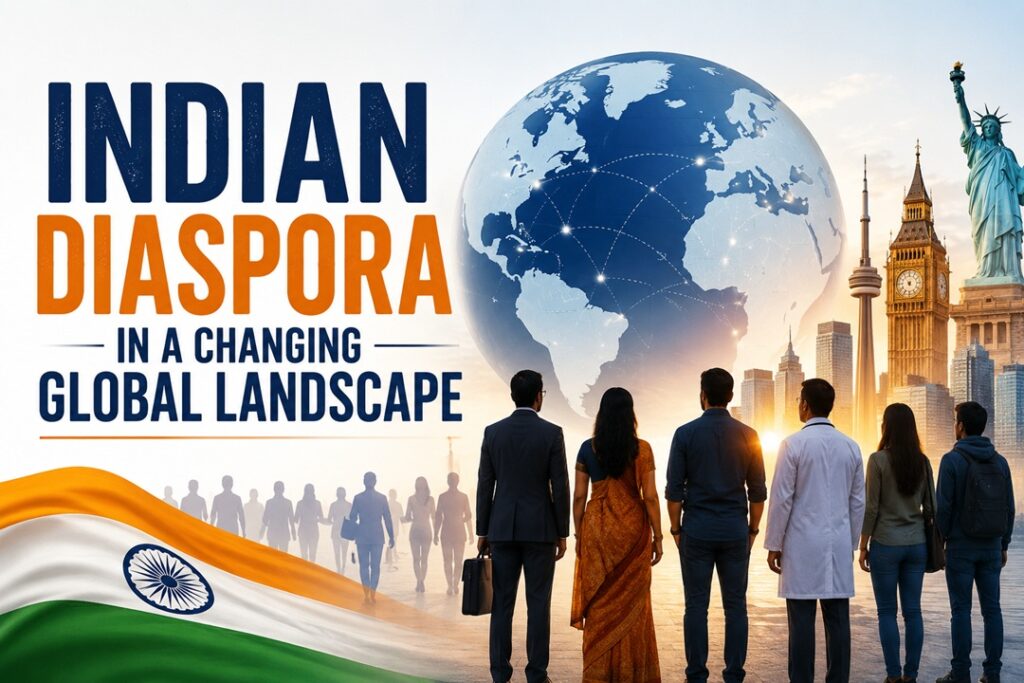
Growing concerns over discrimination, stricter immigration policies, and evolving geopolitical relations—particularly between India and the United States—have renewed attention on the Indian diaspora. Many overseas Indians, especially Indian Americans, are navigating issues of identity, social integration, and changing immigration policies, highlighting the need for stronger engagement and welfare measures by India.
What is the Indian Diaspora?
The Indian diaspora refers to people of Indian origin who reside outside India while maintaining cultural, economic, emotional, or political ties with their ancestral homeland. India has the world’s largest diaspora community, spread across more than 200 countries and territories, playing an important role in global trade, technology, diplomacy, and cultural exchange.
Types of Diasporas
Victim Diasporas
Communities that were forcibly displaced because of war, persecution, slavery, or ethnic violence.
Examples:
- Jewish diaspora
- Armenian diaspora
- African diaspora during the transatlantic slave trade
Labour Diasporas
Migration driven by employment opportunities and improved living standards.
Examples:
- Indian professionals working in North America, Europe, and the Gulf
- Turkish workers in Europe
Trade Diasporas
Merchant communities that establish business and commercial networks across different regions.
Examples:
- Chinese merchant communities
- Lebanese trading communities
Imperial Diasporas
Migration associated with colonial expansion and imperial administration.
Examples:
- British settlers during the colonial period
- French colonial communities
De-territorialized Diasporas
Communities dispersed globally without a single existing homeland but united through common religion, culture, or historical identity.
Cultural (Cognitive) Diasporas
Groups that migrate gradually through family and community networks while preserving their language, traditions, customs, and cultural heritage.
Importance of the Indian Diaspora
Largest Source of Remittances
India remains the world’s largest recipient of remittances, receiving nearly $135 billion annually from overseas Indians. These inflows improve household incomes, strengthen the banking sector, increase savings, and support investment in housing and education.
Investment and Entrepreneurship
The diaspora contributes significantly to:
- Foreign Direct Investment (FDI)
- Startup funding
- Venture capital
- Business partnerships
- Technology transfer
Investment avenues such as Non-Resident External (NRE) accounts encourage overseas Indians to invest in India’s economy.
Knowledge and Skill Transfer
Indian professionals working abroad contribute expertise in engineering, medicine, research, artificial intelligence, finance, and higher education through:
- Collaborative research
- Return migration
- Innovation partnerships
- Academic exchanges
Global Corporate Leadership
Many Indians occupy leadership positions in multinational corporations, enhancing India’s global reputation and promoting research collaborations and investments.
India’s Soft Power
The diaspora promotes Indian culture through:
- Yoga
- Ayurveda
- Indian cuisine
- Festivals
- Languages
- Arts and literature
Strategic and Diplomatic Influence
NRIs and Overseas Citizens of India (OCIs) often advocate for India’s interests in foreign legislatures and policy discussions, strengthening bilateral relations.
Tourism and Cultural Linkages
Government initiatives encourage overseas Indians, especially younger generations, to reconnect with India’s heritage, boosting tourism and cultural exchange.
Challenges Faced by the Indian Diaspora
Racism and Hate Crimes
Indian communities in North America, Europe, and Australia increasingly face racial discrimination, hate crimes, and anti-immigrant sentiments.
Immigration Restrictions
Challenges include:
- Long visa processing times
- Green Card backlogs
- Tightened work permit regulations
- Deportation concerns
- Policy uncertainty
These affect students, professionals, and families.
Exploitation of Migrant Workers
Millions of Indian workers in Gulf countries continue to experience:
- Contract substitution
- Delayed wages
- Poor working conditions
- Restrictions under the Kafala system
- Employment losses due to localisation policies
Identity and Cultural Challenges
Second and third-generation overseas Indians often struggle to balance Indian traditions with integration into host societies.
Some communities also experience caste-related discrimination and social divisions.
Legal and Consular Issues
Common problems include:
- NRI marital disputes
- Desertion by spouses
- Property disputes
- Social security portability
- Limited legal assistance abroad
Indian Diaspora in the United States
Rising Social Exclusion
Increasing anti-immigration rhetoric, criticism of skilled visa holders, attacks on diversity programmes, and online abuse have created uncertainty among many Indian Americans.
Changing India–U.S. Relations
Trade disagreements, deportation issues, tariffs, and diplomatic differences have influenced perceptions regarding the future of bilateral cooperation and diaspora engagement.
Identity and Integration
Many Indian Americans continue to balance their Indian heritage with integration into American society while facing questions regarding identity and belonging.
Government Initiatives for Overseas Indians
Indian Community Welfare Fund (ICWF)
Established in 2009, the fund provides:
- Emergency assistance
- Medical support
- Legal aid
- Shelter
- Repatriation assistance
for Indians facing distress abroad.
Pravasi Bharatiya Bima Yojana (PBBY)
A mandatory insurance scheme for workers migrating to Emigration Check Required (ECR) countries, providing financial protection against accidental death and disability.
MADAD Portal
An online grievance redressal system operated by the Ministry of External Affairs that enables overseas Indians to register and track consular complaints.
Know India Programme (KIP)
Introduces young Persons of Indian Origin (PIOs) and Overseas Citizens of India (OCIs) to India’s:
- Economy
- Culture
- Governance
- Development
through educational visits.
Overseas Citizen of India (OCI) Card
Provides:
- Lifetime multiple-entry visa
- Exemption from FRRO registration
- Several economic benefits (excluding agricultural land ownership)
Knowledge Exchange Programmes
Initiatives such as:
- VAJRA
- VAIBHAV
- PRABHASS
encourage overseas Indian scientists and researchers to collaborate with Indian institutions.
Pravasi Bharatiya Divas (PBD)
Celebrated every two years on 9 January to commemorate Mahatma Gandhi’s return from South Africa and honour the achievements of the Indian diaspora.
Way Forward
India should strengthen its engagement with the diaspora by negotiating comprehensive migration agreements, improving labour protection, simplifying legal assistance, and expanding welfare mechanisms for overseas Indians. Encouraging greater investment through easier regulations, tax incentives, and dedicated investment instruments can enhance economic growth. Expanding cultural initiatives such as the Know India Programme, Chalo India Campaign, and digital outreach can help younger generations maintain stronger emotional and cultural ties with India. A well-connected, protected, and empowered diaspora will continue to serve as a valuable strategic, economic, and cultural asset for India’s global aspirations.
Source : The Hindu