
Europe’s Record Heatwave and the Role of Atmospheric Blocking
Context
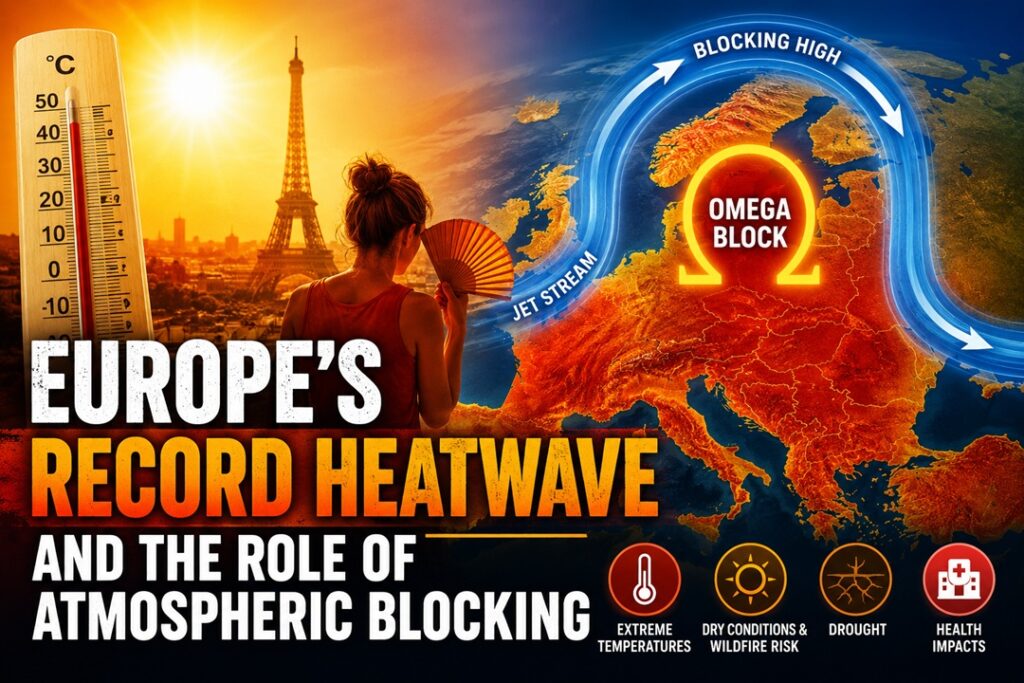
Europe is experiencing one of its most severe summer heatwaves, with temperatures exceeding 40°C across several countries. The prolonged spell of extreme heat has caused multiple fatalities, strained healthcare systems, increased wildfire risks, and renewed concerns over the growing impact of climate change.
Europe’s Heatwave: Understanding the Omega Block
What is an Omega Block?
- An Omega Block is a large-scale atmospheric circulation pattern shaped like the Greek letter Ω (Omega).
- It develops when a strong high-pressure system becomes trapped between two low-pressure systems.
- Since the weather systems cannot move freely, the same weather conditions persist for many days.
Why is it causing Europe’s extreme heat?
- A persistent high-pressure ridge has settled over western Europe.
- This blocks the arrival of cooler Atlantic air and allows continuous sunshine.
- Descending air compresses and warms further, leading to extremely high daytime temperatures.
- Warm nights prevent the land from cooling, increasing heat stress and health risks.
Importance of the Omega Block
- Produces prolonged heatwaves during summer.
- Can also cause extended periods of rainfall or drought in other seasons.
- Climate scientists warn that global warming may increase the duration and intensity of such blocking patterns.
Heat Dome vs Heatwave
| Aspect | Heat Dome | Heatwave |
|---|---|---|
| Meaning | A persistent high-pressure system trapping hot air over a region. | An extended period of unusually high temperatures. |
| Formation | High pressure compresses and heats the air while blocking clouds. | Develops due to trapped heat or other atmospheric conditions. |
| Function | Creates conditions favourable for prolonged extreme heat. | Represents the actual period of excessive temperatures experienced by people. |
| Relationship | Often triggers severe heatwaves. | May occur with or without a heat dome depending on weather conditions. |
Findings of the World Weather Attribution (WWA)
Climate Change as the Primary Driver
- Extreme heat events that were once exceptionally rare have become many times more frequent due to human-induced climate change.
- Daytime temperatures are now 2–4°C higher than similar historical events.
- Night-time temperatures have increased by 1–4°C, reducing recovery from daytime heat.
Greenhouse Gases over El Niño
- Scientists conclude that greenhouse gas emissions are the dominant cause of the current heatwave.
- El Niño has only a limited influence compared to long-term global warming.
Additional Factors Intensifying Heat
- Hot, dry winds arriving from the Sahara Desert raise temperatures further.
- Dry soils reduce evaporation, preventing natural cooling.
- Urban areas retain heat because of concrete surfaces and limited vegetation, creating urban heat islands.
Climate Change and Compound Extreme Events
Intensified Water Cycle
- Warmer air stores more moisture, resulting in heavier rainfall.
- At the same time, higher temperatures increase evaporation, rapidly drying soils.
Combined Heat and Drought
- Reduced soil moisture amplifies surface heating.
- Heatwaves and droughts reinforce each other, making both events more severe.
Cascading Hazards
- Dry landscapes increase wildfire risks.
- Subsequent heavy rainfall may trigger flash floods, landslides, and water contamination.
Coastal Impacts
- Rising sea levels combined with intense storms increase flooding in coastal regions.
- Drainage systems and power infrastructure face greater pressure.
How Jet Stream Changes Create Persistent Heatwaves
Slower Jet Stream
- The jet stream normally moves weather systems across continents.
- When it weakens and develops large waves, weather patterns become stationary.
Formation of a Heat Dome
- A stalled jet stream supports the development of a strong high-pressure ridge.
- Sinking air compresses and becomes hotter.
Continuous Heating
- The high-pressure system blocks cloud formation.
- Constant sunshine allows temperatures to rise day after day.
Arctic Amplification and Global Weather Extremes
Rapid Arctic Warming
- The Arctic is warming much faster than lower latitudes.
- This weakens the temperature difference that powers the jet stream.
Persistent Weather Systems
- A weaker jet stream becomes more wavy and slower.
- Heatwaves, droughts, and cold spells remain over the same regions for longer periods.
Polar Vortex Instability
- Disturbances in the polar vortex allow cold Arctic air to move farther south.
Changes in Moisture Distribution
- Melting sea ice exposes open water.
- Increased evaporation alters rainfall patterns and may intensify storms and heavy snowfall.
Influence of El Niño on Europe’s Climate
Northern Europe
- El Niño can shift Atlantic storm tracks southward.
- This often creates drier conditions in northwestern Europe and may contribute to late-winter cold episodes.
Southern Europe
- Mediterranean regions may receive wetter winters initially.
- Later seasons often experience reduced rainfall and prolonged dry periods.
Interaction with Global Warming
- When combined with rising global temperatures, El Niño can worsen droughts, increase summer heat, and reduce agricultural productivity.
Debate Over Europe’s Cooling Strategy
Rising Heat Risks
- Europe is warming faster than any other continent.
- Heatwaves are becoming more frequent, longer, and more intense.
Public Health Concerns
- Elderly people, children, and outdoor workers face the highest health risks.
- Access to cooling is increasingly viewed as an essential public health measure.
Policy Differences
- Some policymakers favour wider use of air conditioning to protect lives.
- Others advocate sustainable urban planning, green infrastructure, and passive cooling to reduce long-term energy demand.
Major Challenges Facing Europe
Heat-Resilient Buildings
- Older buildings require better insulation, ventilation, and cooling design.
Rising Electricity Demand
- Greater reliance on air conditioners increases peak electricity consumption.
Climate Goals
- Increased fossil fuel use for cooling may conflict with emissions reduction targets.
Urban Heat Island Effect
- Air conditioners release waste heat outdoors, making cities even warmer.
Social Inequality
- High cooling costs disproportionately affect low-income households.
Way Forward
Protect Vulnerable Populations
- Ensure temporary cooling centres and affordable access to cooling during extreme heat events.
Promote Sustainable Cooling
- Encourage energy-efficient cooling technologies powered by renewable energy.
Greener Cities
- Increase tree cover, parks, reflective roofing, and shaded public spaces to reduce urban temperatures.
Climate-Resilient Infrastructure
- Strengthen building regulations to improve insulation, natural ventilation, and heat-resistant construction.
Ensure Inclusive Access
- Provide financial support for cooling facilities in schools, hospitals, and economically weaker communities.
Integrated Climate Policy
- Balance public health protection with long-term climate objectives through innovation, regulation, and sustainable urban planning.
Source : The Indian Express