
India–Japan Annual Summit 2026: Strengthening Strategic Partnership
Context
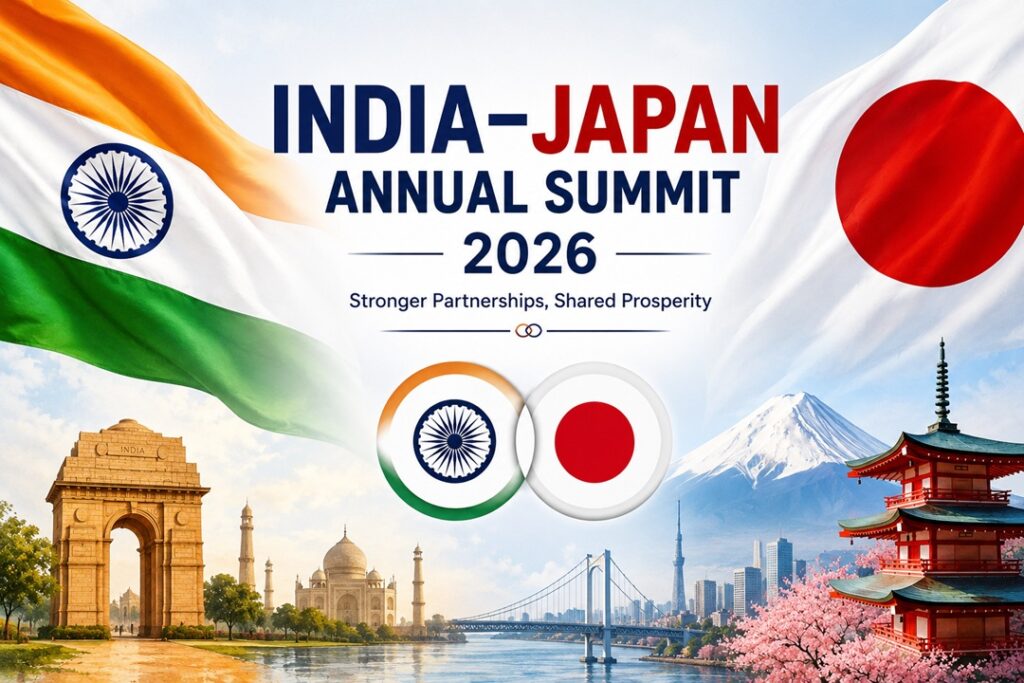
Japanese Prime Minister Sanae Takaichi visited New Delhi on her first official State Visit to participate in the 16th India–Japan Annual Summit, where both countries expanded cooperation in defence, economic security, technology, clean energy, and Indo-Pacific stability.
16th India–Japan Annual Summit
Overview
The 16th India–Japan Annual Summit reaffirmed the growing strategic partnership between two major Indo-Pacific democracies. Against the backdrop of geopolitical tensions, supply-chain disruptions, and energy security concerns, both nations agreed to deepen collaboration across defence, trade, emerging technologies, and sustainable development.
The summit also strengthened coordination between Japan’s Free and Open Indo-Pacific (FOIP) vision and India’s Indo-Pacific Oceans’ Initiative (IPOI) and MAHASAGAR framework to promote a free, open, and rules-based maritime region.
Major Decisions Taken
Defence and Security Cooperation
- India and Japan advanced discussions on the UNICORN defence technology project, their first joint defence equipment development initiative.
- Both countries agreed to convene the 4th India–Japan 2+2 Foreign and Defence Ministers’ Dialogue in Tokyo later in 2026.
- Naval cooperation will be enhanced through expanded JAIMEX exercises, defence industrial collaboration, and maintenance, repair and overhaul (MRO) partnerships under the Make in India initiative.
Trade and Economic Partnership
- A new framework was agreed upon to strengthen cooperation in semiconductors, critical minerals, digital technologies, pharmaceuticals, and clean industries.
- Both sides committed to promoting secure supply chains, simplifying technology trade, and encouraging the use of local currencies in bilateral commerce.
- The summit also initiated discussions on upgrading the India–Japan Comprehensive Economic Partnership Agreement (CEPA).
Energy and Climate Collaboration
- India and Japan jointly launched the Cooperative Biogas for Sustainable Growth Initiative to promote renewable energy and support India’s biofuel expansion.
- Cooperation on green hydrogen and clean ammonia production projects in Odisha received renewed support.
- Both countries signed an agreement on energy resilience, including cooperation on strategic petroleum reserves and global energy security.
Technology and Infrastructure
- A new Strategic Dialogue on Artificial Intelligence was established to encourage responsible and secure AI development.
- Japan reaffirmed support for the Mumbai–Ahmedabad High-Speed Rail Project and future high-speed rail expansion.
- Progress was reviewed on Japanese-funded infrastructure projects including metro rail systems, healthcare, education, and urban development.
Importance for India
Enhancing Investment and Manufacturing
- Greater Japanese investment can accelerate industrial growth, manufacturing expansion, and the vision of Viksit Bharat.
- Stronger cooperation will help diversify supply chains and reduce dependence on a limited number of global suppliers.
Supporting India’s North-East
- Japanese assistance can strengthen connectivity and industrial development in the North Eastern Region while improving links with BIMSTEC countries.
Promoting Innovation
- Joint research programmes, semiconductor cooperation, and space collaboration will improve India’s technological capabilities and innovation ecosystem.
Boosting MSMEs
- The India–Japan SME cooperation platform provides new opportunities for Indian MSMEs to participate in advanced global manufacturing networks.
Key Challenges
Supply Chain Risks
Dependence on a few countries for critical minerals and advanced manufacturing inputs continues to expose both economies to external disruptions.
Maritime Security Concerns
Increasing tensions across the Indo-Pacific and disruptions in major sea routes threaten regional trade and energy transportation.
Cybersecurity Threats
Growing cyberattacks and emerging digital security risks require stronger cooperation in cyber resilience and information security.
Technology Transfer Issues
Differences in regulatory standards, industrial practices, and skilled workforce availability may slow implementation of advanced technology projects.
Regional Strategic Competition
Rising geopolitical rivalry in the Indo-Pacific requires continuous diplomatic coordination to preserve regional peace and stability.
Way Forward
Complete Defence Collaboration
Early implementation of the UNICORN defence project will strengthen trust and demonstrate successful defence technology cooperation.
Expand Energy Security
India should utilise Japanese expertise in developing strategic petroleum reserves, renewable energy infrastructure, and hydrogen technologies.
Accelerate Infrastructure Projects
Timely completion of the Mumbai–Ahmedabad High-Speed Rail corridor and other flagship projects should remain a priority.
Strengthen Digital and Financial Connectivity
Promoting secure digital payment systems and greater local currency settlements will facilitate trade and tourism.
Deepen Indo-Pacific Cooperation
India and Japan should expand coordination with like-minded regional partners to ensure a secure, stable, and rules-based Indo-Pacific.
Conclusion
The 16th India–Japan Annual Summit marked another important milestone in the Special Strategic and Global Partnership between the two countries. By expanding cooperation in defence, advanced technology, infrastructure, energy security, and resilient supply chains, India and Japan are reinforcing a long-term partnership that supports economic growth, regional stability, and a free and open Indo-Pacific.
Source : PMI