
Third India–Australia Annual Summit
Context
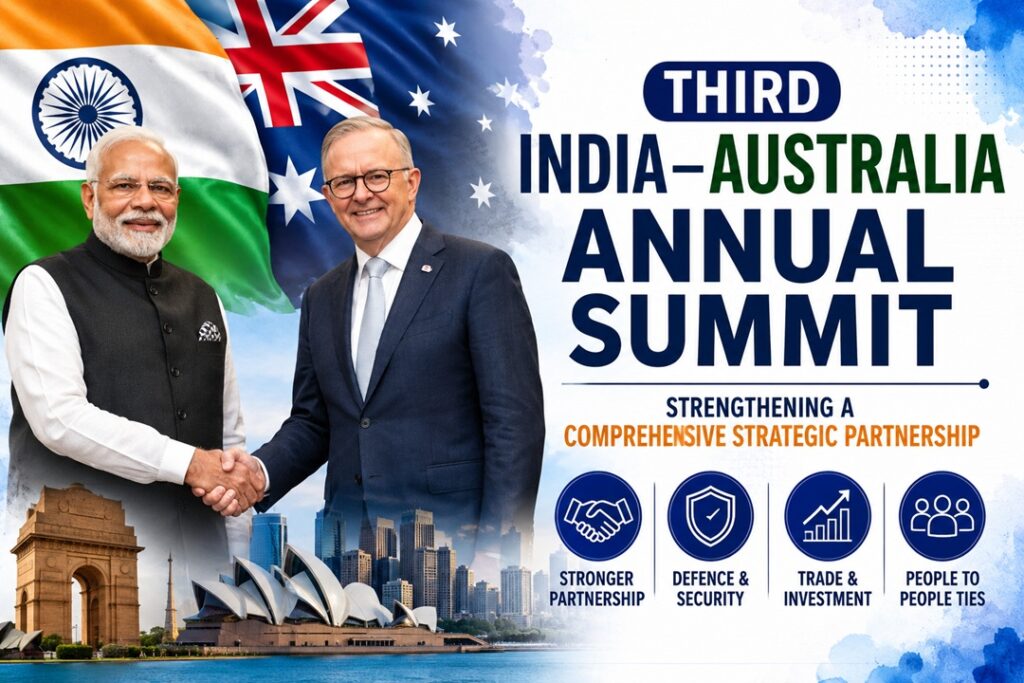
Prime Minister of India visited Australia for the Third India–Australia Annual Summit in Melbourne. During the summit, both countries reaffirmed their commitment to strengthening the Comprehensive Strategic Partnership (CSP) through a Joint Statement covering defence, trade, technology, energy, education and regional security.
Third India–Australia Annual Summit
What is the Summit?
The India–Australia Annual Summit is the highest-level bilateral engagement between the two countries. Conducted every year, it reviews the progress of the Comprehensive Strategic Partnership (CSP), launched in 2020, and expands cooperation across strategic, economic, technological and people-to-people sectors.
Major Outcomes of the Summit
Defence and Maritime Cooperation
- India and Australia adopted a Joint Declaration on Defence and Security Cooperation to deepen strategic ties.
- Both countries agreed to institutionalise an Annual Defence Ministers’ Dialogue for greater military coordination.
- The India–Australia Maritime Security Cooperation Roadmap was launched to strengthen maritime domain awareness in the Indo-Pacific.
- An MoU was signed between the Australian Maritime Border Command and the Indian Coast Guard.
- Both nations agreed to expand defence industrial cooperation through future agreements on defence equipment, logistics and services.
- Australia will host an Indian military instructor at the Australian Defence College during 2028–29 to strengthen professional military exchanges.
Trade, Investment and Critical Minerals
- Leaders reaffirmed their commitment to conclude the Comprehensive Economic Cooperation Agreement (CECA) at the earliest.
- Building upon the Economic Cooperation and Trade Agreement (ECTA), both countries aim to expand bilateral trade and investment.
- New investment frameworks were announced to support collaboration in lithium, cobalt, rare earth elements and other critical minerals.
- Both nations agreed to strengthen resilient supply chains for semiconductors, clean energy technologies and advanced manufacturing.
Energy, Climate and Space Partnership
- The Administrative Arrangement under the India–Australia Nuclear Cooperation Agreement was finalised, enabling long-term Australian uranium exports to India under International Atomic Energy Agency (IAEA) safeguards.
- Cooperation in renewable energy was strengthened through initiatives promoting rooftop solar deployment and energy security.
- Australia reaffirmed its support for India’s Gaganyaan Human Space Flight Mission by providing satellite tracking support through facilities on the Cocos (Keeling) Islands.
- Both countries agreed to expand collaboration in clean hydrogen, green technologies and climate resilience.
Education, Mobility and Cultural Engagement
- Flinders University received approval to establish its international campus in Bengaluru.
- Victoria University was granted permission to establish a campus in Gurugram.
- Australia announced additional funding under the Maitri Grants Programme to strengthen educational, research and cultural partnerships.
- India and Western Australia agreed to establish a National Centre of Excellence for Skilling in Mining at Bhubaneswar, Odisha.
- Both countries committed to enhancing student mobility, academic exchanges and mutual recognition of professional qualifications.
Importance of the Summit
Expanding Bilateral Trade
- A comprehensive CECA will reduce tariff and non-tariff barriers, encouraging greater trade, investment and business collaboration.
- The existing ECTA has already increased exports in agriculture, manufacturing and services.
Securing Critical Mineral Supply
- Australia can serve as a dependable supplier of lithium, cobalt and other strategic minerals needed for India’s electric vehicle, semiconductor and renewable energy sectors.
- Joint investments in mining and mineral processing will reduce dependence on limited suppliers.
Strengthening Indo-Pacific Security
- Enhanced defence cooperation improves interoperability between the armed forces of both countries.
- Maritime cooperation contributes to a free, open and rules-based Indo-Pacific region.
- Joint initiatives support regional peace, maritime safety and disaster response.
Advancing Space and Technology Cooperation
- Satellite tracking support strengthens India’s future space missions, including Gaganyaan.
- Collaboration in emerging technologies such as artificial intelligence, cybersecurity and quantum computing enhances innovation.
Developing Skilled Human Resources
- Joint vocational training programmes improve workforce capabilities in mining, engineering and advanced manufacturing.
- Internationally recognised skill certifications increase global employment opportunities.
Enhancing Educational and Cultural Relations
- Australian university campuses in India improve access to world-class education.
- Academic exchanges and research partnerships strengthen long-term people-to-people ties.
Challenges
Supply Chain Risks
- Dependence on a limited number of global suppliers for critical minerals and advanced technologies remains a strategic concern.
- Diversification requires sustained investments and international coordination.
Regional Security Challenges
- Terrorism, cyber threats and emerging security risks continue to threaten regional stability.
- Strengthening intelligence sharing and counter-terrorism cooperation remains essential.
Maritime Geopolitical Tensions
- Instability around major sea lanes can disrupt global trade and energy transportation.
- Ensuring secure shipping routes remains a common priority.
Delayed Trade Negotiations
- Domestic policy concerns, regulatory issues and market access negotiations continue to slow the finalisation of CECA.
- Harmonising standards and investment regulations remains challenging.
Global Governance Reforms
- India continues to seek permanent membership of the UN Security Council with Australia’s support.
- Reform of international institutions remains slow due to differing global political interests.
Way Forward
Finalise the Comprehensive Economic Cooperation Agreement
- Resolve remaining trade issues and conclude CECA to unlock greater economic opportunities.
Build Resilient Supply Chains
- Strengthen cooperation in semiconductors, telecommunications, critical technologies and strategic minerals.
Expand Defence Cooperation
- Increase joint military exercises, intelligence sharing and defence industrial collaboration.
- Strengthen maritime surveillance and Indo-Pacific security partnerships.
Accelerate Clean Energy Collaboration
- Implement long-term uranium supply arrangements.
- Expand cooperation in renewable energy, green hydrogen and clean technology.
Promote Innovation and Skill Development
- Strengthen research partnerships between universities and industries.
- Align vocational training programmes with international standards.
Enhance People-to-People Connectivity
- Expand student exchanges, tourism, cultural cooperation and mobility partnerships.
Conclusion
The Third India–Australia Annual Summit significantly strengthened the Comprehensive Strategic Partnership by expanding cooperation in defence, trade, energy, education, technology and regional security. Timely implementation of the summit’s commitments, particularly the CECA, critical minerals partnership and strategic technology cooperation, will further reinforce bilateral relations while contributing to a stable, secure and prosperous Indo-Pacific region.
Source : PIB