
G Minus Two Indo-Pacific Framework: A New Strategic Balancing Approach
Context
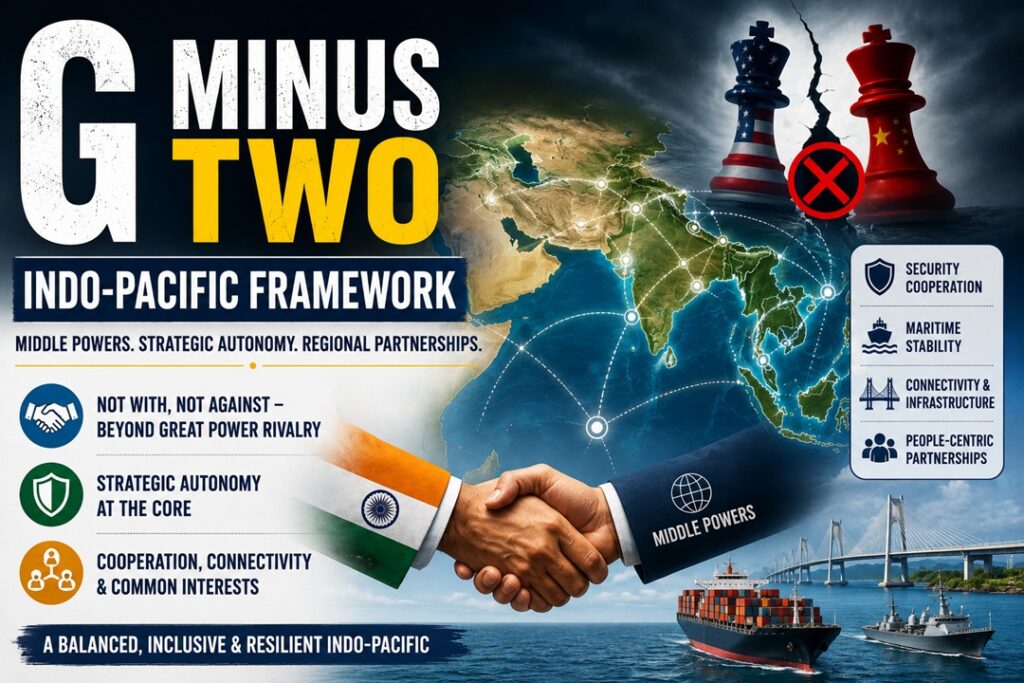
Strategic analyst C. Raja Mohan has underlined the emergence of the “G Minus Two” Indo-Pacific framework, wherein regional middle powers such as India, Japan, South Korea, Australia, and ASEAN countries are strengthening strategic cooperation while preserving policy independence amid shifting United States–China dynamics.
G Minus Two Indo-Pacific Framework
What is the G Minus Two Framework?
- The G Minus Two approach is a regional strategic model that enables Asian middle powers to expand cooperation without aligning exclusively with either the United States or China.
- It rejects the concept of a US–China bipolar order (G2) determining the future of the Indo-Pacific.
- Instead of establishing a formal third bloc or military coalition, it promotes a flexible web of bilateral, trilateral, and minilateral partnerships based on common interests.
- The framework emphasizes strategic autonomy, diversified partnerships, and issue-based collaboration.
Why Has This Strategy Emerged?
Concerns Over Great-Power Competition
- Many Indo-Pacific countries remain cautious about excessive dependence on either Washington or Beijing and seek greater diplomatic flexibility.
Changing U.S. Strategic Priorities
- Variations in American foreign policy have encouraged regional powers to develop stronger security and economic arrangements among themselves.
Rise of Middle-Power Diplomacy
- Increased engagements among countries such as India, Japan, South Korea, Australia, and ASEAN members have accelerated regional cooperation.
Need for External Security Support
- While strengthening intra-regional partnerships, countries continue to value U.S. security engagement to maintain strategic stability in the Indo-Pacific.
Economic Interdependence with China
- Despite geopolitical competition, China remains a major trading partner, making complete economic disengagement impractical.
Major Advantages of the Framework
Diversified Supply Chains
- Reduces excessive dependence on a single country for critical technologies and industrial inputs.
- Encourages trusted production and resilient manufacturing ecosystems.
Maritime Security Cooperation
- Joint naval coordination helps secure important sea lanes and protects international commerce across the Indo-Pacific.
Complementary Economic Partnerships
- Countries utilize comparative strengths such as critical minerals, advanced technology, clean energy, and agricultural innovation for mutual benefit.
Enhanced Defence Collaboration
- Expands defence production, logistics cooperation, military exercises, and technology sharing without requiring formal alliance commitments.
Financial and Digital Cooperation
- Promotes local currency settlements, digital payment connectivity, and resilient financial systems to reduce vulnerability to external disruptions.
Significance for India
Greater Strategic Autonomy
- Enables India to strengthen relations with multiple partners while avoiding alignment with any single power bloc.
Boost to Defence Manufacturing
- Expands opportunities for joint defence production, technology transfer, and indigenous military capability under Make in India.
Strengthening Maritime Influence
- Reinforces India’s role as a key security provider across the Indian Ocean and the wider Indo-Pacific region.
Improved Regional Connectivity
- Supports integration of India’s eastern and coastal regions into regional trade, investment, and supply-chain networks.
Enhanced Global Standing
- Stronger partnerships with major Indo-Pacific economies improve India’s influence in regional and global institutions.
The Way Ahead
Strengthen Strategic Partnerships
- Expand defence, technology, infrastructure, and economic cooperation with trusted Indo-Pacific partners.
Accelerate Domestic Reforms
- Improve ease of doing business, industrial competitiveness, and defence manufacturing capabilities.
Build Resilient Supply Chains
- Invest in semiconductors, critical minerals, renewable energy, and advanced manufacturing to reduce strategic vulnerabilities.
Enhance Digital Sovereignty
- Strengthen cybersecurity, data governance, and protection of strategic digital infrastructure.
Promote Regional Connectivity
- Expand transport corridors, maritime infrastructure, and economic integration with Indo-Pacific economies.
Conclusion
The G Minus Two Indo-Pacific framework reflects the growing role of middle powers in shaping a stable and balanced regional order. By deepening cooperation with trusted partners while maintaining strategic autonomy, India can enhance its security, strengthen economic resilience, and emerge as a leading pillar of the evolving Indo-Pacific architecture.
Source : The Indian Express