
Iran’s Post-War Resurgence: Is West Asia Witnessing a “Second Iranian Revolution”?
Context
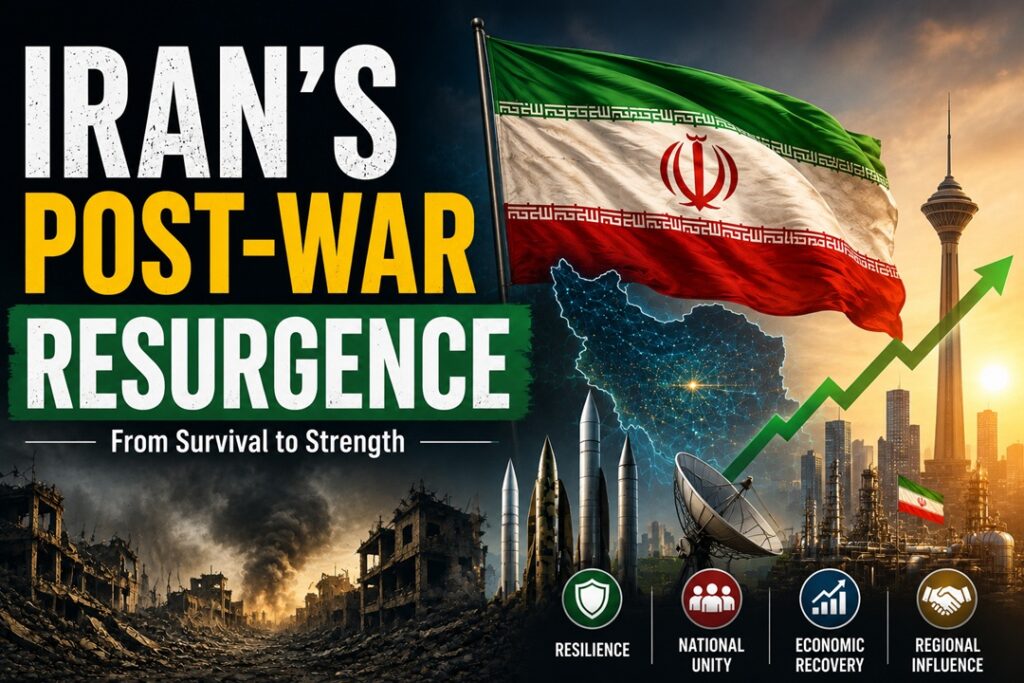
The recent military confrontation involving Iran, Israel, and the United States has significantly altered the geopolitical landscape of West Asia. Contrary to expectations of strategic isolation, Iran has emerged with greater political confidence, strengthened nationalism, and enhanced regional influence. These developments have prompted comparisons with the 1979 Iranian Revolution, leading analysts to describe the current phase as a possible “Second Iranian Revolution”—not through regime change, but through the consolidation of state power and strategic resilience.
How did the current geopolitical situation evolve?
Iran Demonstrates Strategic Endurance
- Despite sustained military strikes, Iran has projected itself as a resilient and unified nation.
- Instead of weakening the leadership, the conflict has reinforced domestic cohesion and enhanced Tehran’s regional standing.
- Several analysts describe the present phase as a “Second Iranian Revolution”, not because of regime change, but due to the consolidation of state authority, nationalism, and strategic influence.
- The developments carry significant implications for regional stability, global energy markets, and India’s foreign policy.
Post-Conflict Political Consolidation
- Contrary to expectations, Iran has emerged from the conflict with greater political confidence.
- Large public gatherings following the death of senior national leaders reflected widespread public mobilisation and reinforced the regime’s legitimacy.
- Tehran has portrayed survival under external pressure as a strategic success.
Key Drivers Behind Iran’s Renewed Strength
- The Islamic Revolutionary Guard Corps (IRGC) has further strengthened its influence over national security institutions.
- Iran has retained much of its nuclear infrastructure and ballistic missile capability, preserving its deterrence capacity.
- The leadership has successfully projected an image of resistance against foreign military pressure.
- National resilience has enhanced Iran’s reputation as an independent regional power capable of defending its sovereignty.
The Enduring Legacy of the 1979 Iranian Revolution
Historical Significance
- The 1979 Iranian Revolution fundamentally transformed the political landscape of West Asia.
- Widespread dissatisfaction with authoritarian rule, economic inequality, and foreign influence culminated in the establishment of the Islamic Republic under Ayatollah Ruhollah Khomeini.
Core Foundations of the New Republic
The post-revolutionary political system rested upon three major principles:
- Protection of national sovereignty and independence.
- Establishment of Islamic governance based on Velayat-e-Faqih.
- Promotion of social justice and equitable economic development.
Major Obstacles Faced
Following the revolution, Iran navigated multiple challenges:
- US Embassy hostage crisis.
- Iran-Iraq War.
- International sanctions.
- Nuclear-related disputes.
- Prolonged regional confrontations.
Despite these pressures, Iran maintained political continuity and strategic autonomy for over four decades.
Why is the Present Phase Called a “Second Revolution”?
Unlike the events of 1979, today’s transformation has strengthened rather than replaced the existing political establishment.
Greater Internal Consolidation
- External military pressure has strengthened institutional unity.
- Political leadership and security agencies have expanded their influence while limiting internal fragmentation.
Nationalism Becomes the Central Narrative
- Religious ideology remains important, but national identity and sovereignty have emerged as the dominant sources of legitimacy.
- Public discourse increasingly emphasises resistance to external interference.
Strengthened Social Cohesion
- The conflict has fostered a stronger sense of collective identity.
- Public demonstrations indicate increased national solidarity rather than political instability.
Changing Security Dynamics in West Asia
From Containment to Strategic Reassessment
- Following the 1979 revolution, Gulf monarchies established the Gulf Cooperation Council (GCC) to collectively balance Iran’s growing influence.
- The United States subsequently became the principal external security provider across the Gulf.
Emerging Regional Reality
Recent events have altered regional security perceptions:
- Confidence in exclusive American security guarantees has weakened.
- Iran’s retaliatory capabilities have highlighted vulnerabilities across the Gulf.
- Regional powers are increasingly exploring diplomatic engagement with Tehran.
- West Asia appears to be transitioning towards a multipolar security framework based on strategic balancing rather than fixed alliances.
What Opportunities Could Emerge for Iran?
Prospects for Economic Recovery
Potential drivers of economic improvement include:
- Gradual relaxation of international sanctions.
- Access to previously frozen overseas assets.
- Expansion of crude oil and natural gas exports.
- Greater participation in regional trade and connectivity initiatives.
- Enhanced strategic leverage over the Strait of Hormuz, a vital global energy corridor.
If effectively managed, these developments could strengthen Iran’s fiscal position and expand its regional economic influence.
Strategic Significance for India
Iran’s renewed prominence presents both opportunities and policy challenges.
India’s Major Strategic Priorities
- Ensuring stable and diversified energy supplies.
- Protecting maritime trade routes through the Strait of Hormuz.
- Advancing connectivity projects such as the Chabahar Port and the International North-South Transport Corridor (INSTC).
- Maintaining balanced relations with Iran, Israel, the Gulf states, and the United States.
- Protecting the interests of the large Indian diaspora in West Asia.
India will likely continue pursuing a multi-aligned diplomatic strategy that balances competing regional interests while safeguarding its long-term strategic objectives.
Key Challenges Going Forward
Despite its strengthened position, Iran continues to face several constraints:
- Persistent economic weaknesses and inflationary pressures.
- Continued confrontation with Israel and the United States.
- Sectarian divisions and geopolitical competition across West Asia.
- Domestic expectations for governance reforms and economic improvement.
- Uncertainty surrounding future political leadership and succession.
Long-term strategic gains will depend on effective governance, economic reforms, and sustained diplomatic engagement.
Way Forward
Iran’s post-conflict resurgence represents a major turning point in West Asian geopolitics. The conflict has reinforced state authority, strengthened nationalism, and accelerated changes in the regional security order. Much as the 1979 Iranian Revolution reshaped the Middle East, the present phase may redefine regional power dynamics for years ahead.
For India, the evolving geopolitical landscape demands a calibrated foreign policy that simultaneously protects energy security, connectivity initiatives, strategic partnerships, and regional stability while avoiding entanglement in regional rivalries.
Source : The Hindu