
China Restricts Helium Exports Amid West Asia Supply Concerns
Context
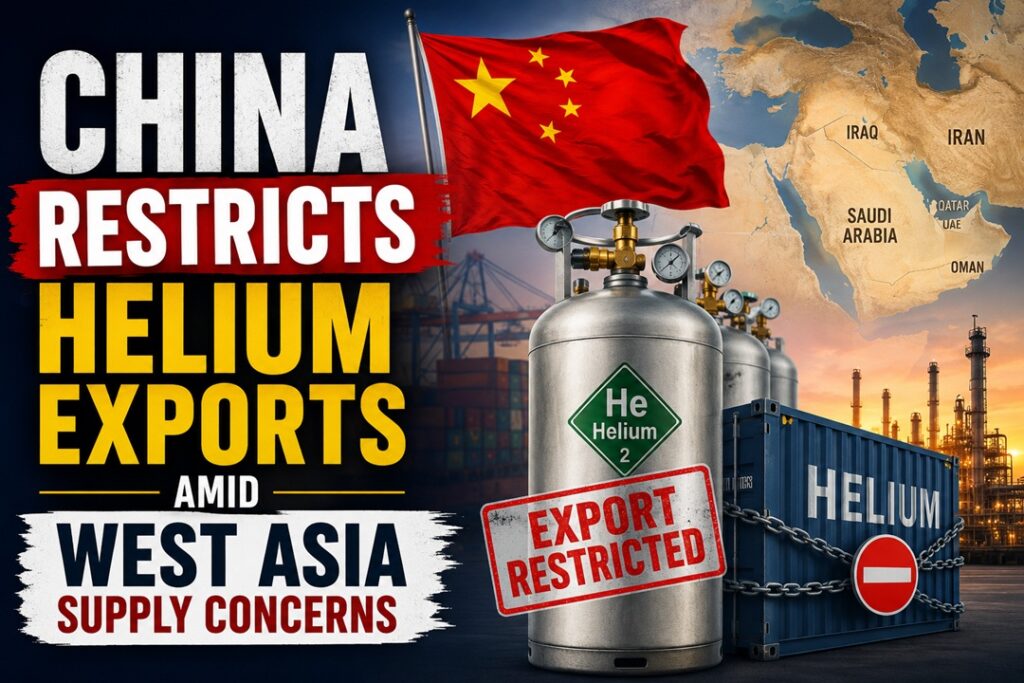
China has temporarily restricted helium exports following escalating tensions in West Asia and attacks on helium production facilities in Qatar. The move is intended to secure domestic helium supplies as shipments passing through the Strait of Hormuz face increasing risks of disruption. The development has highlighted helium’s growing strategic significance, as it is indispensable for semiconductors, quantum computing, healthcare, aerospace, defence, and advanced scientific research.
Helium: A Critical Strategic Resource
Overview
Helium has evolved from a commonly used industrial gas into a strategically important natural resource that underpins modern technology, national security, healthcare, and scientific innovation. It is a non-renewable resource that cannot be manufactured artificially on a commercial scale and has no practical substitute for several cryogenic and high-technology applications.
Unique Properties of Helium
Lowest Boiling Point
Helium has the lowest boiling point among all elements (−269°C or 4.2 Kelvin), enabling it to remain liquid near absolute zero. This makes it essential for ultra-low temperature applications.
Chemically Inert
As a noble gas, helium is chemically non-reactive, providing contamination-free environments required for sensitive industrial and scientific processes.
Excellent Thermal Conductivity
Helium rapidly absorbs and transfers heat, making it highly effective for cooling sophisticated electronic and scientific equipment.
Extremely Small Atomic Size
Its tiny atoms can easily pass through microscopic openings, making helium the preferred gas for detecting minute leaks in industrial systems.
Formation and Extraction
Natural Formation
Helium is produced naturally over millions of years through the radioactive alpha decay of uranium and thorium deep within the Earth’s crust.
Accumulation in Gas Reservoirs
The helium generated gradually migrates upward and accumulates in underground natural gas reservoirs.
Commercial Production
Helium is economically extracted only from natural gas fields containing commercially viable helium concentrations. It is separated through cryogenic fractional distillation, which exploits helium’s exceptionally low boiling point.
Strategic Importance
Semiconductor Manufacturing
Helium is indispensable for advanced semiconductor fabrication processes such as EUV lithography, plasma etching, wafer cooling, and chip manufacturing.
Quantum Computing
Superconducting quantum computers require liquid helium to maintain temperatures close to absolute zero, ensuring stable quantum operations.
Space and Rocket Technology
Space agencies, including ISRO and NASA, use helium for pressurizing fuel tanks, purging fuel systems, transferring cryogenic propellants, and testing rocket components.
Healthcare
MRI scanners rely on liquid helium to cool superconducting magnets that generate high-resolution medical images.
Scientific Research
Helium is widely used in particle accelerators, nuclear magnetic resonance (NMR) spectroscopy, cryogenic laboratories, and advanced physics research.
Challenges and Vulnerabilities
Finite Resource
Helium is non-renewable and cannot be replenished within human timescales, making long-term availability a growing concern.
Difficult Transportation
Liquid helium requires highly specialized vacuum-insulated cryogenic containers, which are expensive and produced by only a few manufacturers worldwide.
Evaporation Losses
Because of its extremely low boiling point, helium gradually evaporates during storage and transportation. Once released into the atmosphere, it eventually escapes Earth’s gravity and cannot be recovered.
Concentrated Global Production
Global helium production is dominated by a small number of countries, including the United States, Qatar, Algeria, and Russia, creating supply-chain vulnerabilities.
Geopolitical Risks
Conflicts in West Asia, export restrictions, sanctions, and disruptions in strategic maritime routes such as the Strait of Hormuz can significantly affect global helium availability.
Major Applications
Electronics Industry
Creates ultra-clean environments for semiconductor manufacturing, optical fibre production, and precision electronics.
Space Exploration
Used for rocket propulsion systems, fuel tank pressurization, leak testing, and cryogenic operations.
Weather Balloons and Airships
Provides a safe, non-flammable lifting gas for meteorological balloons, research balloons, and commercial airships.
Industrial Leak Detection
Detects microscopic leaks in pipelines, refrigeration systems, nuclear reactors, vacuum chambers, and high-pressure equipment.
Arc Welding
Acts as a shielding gas during Gas Tungsten Arc Welding (GTAW), especially for aluminium, titanium, magnesium, and other specialised metals.
Nuclear and Scientific Facilities
Supports cryogenic cooling in particle accelerators, superconducting magnets, and advanced research laboratories.
Global Significance
The rapid expansion of artificial intelligence, semiconductor manufacturing, quantum computing, electric vehicles, and space exploration has sharply increased global helium demand. China’s export restrictions, combined with instability in Qatar and shipping uncertainties in the Strait of Hormuz, expose the fragility of global helium supply chains. Any prolonged disruption could affect technology production, healthcare services, defence preparedness, and scientific research worldwide.
Way Forward
India should strengthen domestic helium exploration and recovery from natural gas fields, encourage helium recycling technologies, establish strategic helium reserves, diversify import sources, and support research into efficient helium conservation. Building a resilient helium supply chain will be essential for India’s ambitions in semiconductor manufacturing, space technology, advanced healthcare, defence, and high-technology industries.
Source : The Hindu