
India–New Zealand Strategic Partnership
Context
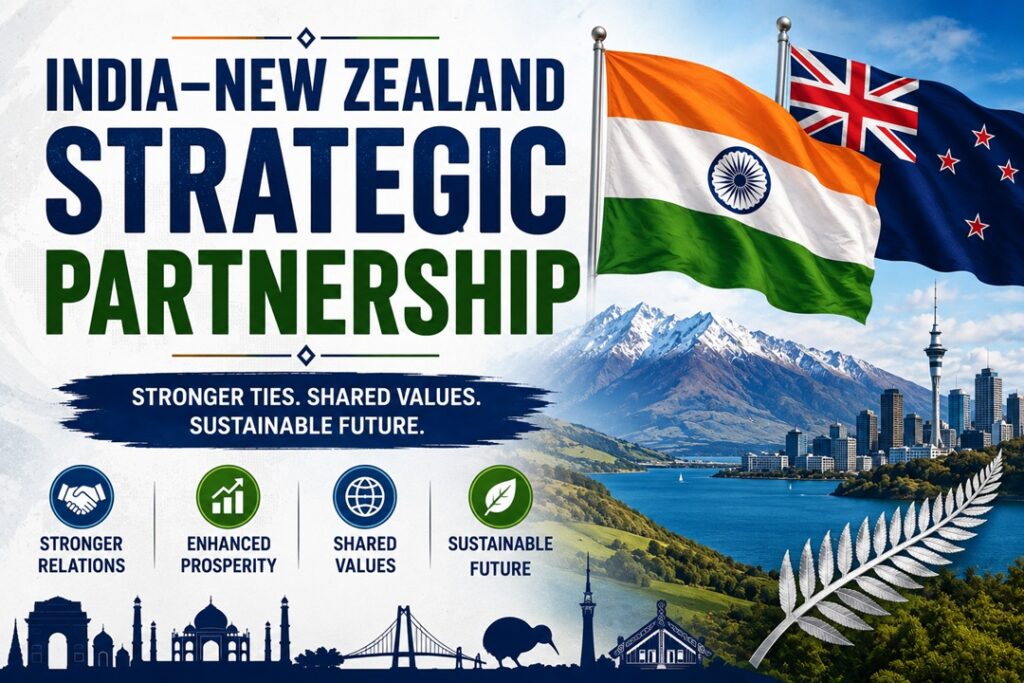
Prime Minister Narendra Modi’s landmark visit to New Zealand—the first by an Indian Prime Minister in four decades—marked a new phase in bilateral relations. During the visit, both nations upgraded their engagement to a Strategic Partnership and jointly unveiled the India–New Zealand Strategic Partnership: Vision 2030, a framework aimed at strengthening cooperation in trade, security, climate action, innovation and people-to-people exchanges.
India–New Zealand Strategic Partnership
About India–New Zealand Strategic Partnership
What is it?
India and New Zealand share a steadily expanding relationship founded on democratic principles, Commonwealth linkages, vibrant Indian diaspora connections, complementary economies and a common commitment to a peaceful, inclusive and rules-based Indo-Pacific region. The newly announced Strategic Partnership broadens cooperation across political, economic, defence, technological and cultural sectors.
Major Highlights of the India–New Zealand Summit
Strategic Partnership and Vision 2030
The two countries formally upgraded bilateral ties to a Strategic Partnership and adopted the Vision 2030 Roadmap, providing long-term direction for collaboration in strategic, economic and social sectors.
Institutionalising Political Cooperation
India and New Zealand agreed to deepen diplomatic engagement through regular meetings between Foreign Ministers, annual consultations among senior officials and enhanced parliamentary interactions.
Enhanced Defence and Maritime Collaboration
Cooperation expanded through new arrangements on maritime security, naval coordination, logistics support, hydrographic cooperation and regular maritime security consultations.
Cooperation Against Transnational Threats
Both countries agreed to strengthen coordination on counter-terrorism, cyber security, organised crime, narcotics control, human trafficking and financial crimes through dedicated institutional mechanisms.
Trade and Economic Integration
The leaders welcomed the conclusion of a comprehensive India–New Zealand Free Trade Agreement (FTA) and set an ambitious objective of increasing bilateral trade to NZ$7 billion by 2030.
Agricultural and Food Sector Partnership
A new partnership in agricultural productivity was launched, focusing on horticulture, dairy development, animal health, food processing, post-harvest management and agricultural value chains.
Tourism and Connectivity
The two countries signed a tourism cooperation arrangement, explored the possibility of direct air connectivity and agreed to improve maritime mobility through mutual recognition of seafarer qualifications.
Cultural, Sports and Community Engagement
A fresh framework for sports cooperation was adopted while both sides also strengthened cultural exchanges, heritage cooperation and interactions between academic and community institutions.
Education, Innovation and Climate Partnership
India and New Zealand expanded collaboration in higher education, research, student exchanges, clean energy, emerging technologies, disaster resilience and climate adaptation. New Zealand also joined the Global Biofuels Alliance.
Indo-Pacific and Global Cooperation
Both countries reiterated their commitment to a free, open and inclusive Indo-Pacific, respect for international law including UNCLOS and ASEAN centrality. New Zealand also reaffirmed support for India’s aspiration for permanent membership of the UN Security Council and entry into the Nuclear Suppliers Group (NSG).
Significance of the Partnership for India
Strengthening India’s Indo-Pacific Presence
Closer defence and maritime engagement enhances India’s strategic role in the South Pacific and complements its Indo-Pacific Oceans Initiative and engagement with Pacific Island countries.
Expanding Export Opportunities
The FTA can boost exports of pharmaceuticals, IT services, textiles, engineering products and professional services while diversifying India’s overseas markets.
Improving Agricultural Productivity
New Zealand’s expertise in precision farming, dairy management, horticulture and food safety can contribute to modernising Indian agriculture.
Greater Educational and Research Collaboration
Enhanced academic partnerships can provide new opportunities for Indian students, researchers and innovators in advanced technologies and climate research.
Expanding India’s Engagement in Oceania
New Zealand’s close relationship with Pacific Island nations offers India an opportunity to deepen diplomatic outreach under the Forum for India-Pacific Islands Cooperation (FIPIC).
Key Challenges in India–New Zealand Relations
Modest Trade Volume
Despite positive momentum, bilateral trade remains relatively small compared to India’s trade with major Indo-Pacific economies.
Concerns in Agriculture and Dairy
Opening agricultural markets requires balancing trade liberalisation with protection for India’s small farmers and dairy producers.
Connectivity Constraints
Limited direct air and shipping links continue to affect tourism, business exchanges and logistics efficiency.
Divergent Strategic Approaches
Although both countries support a rules-based Indo-Pacific, their approaches to regional security and geopolitical issues may differ on certain matters.
Implementation Challenges
Effective execution of multiple agreements requires sustained political commitment, institutional coordination, adequate funding and continuous monitoring.
Way Forward
Ensure Effective Implementation of Vision 2030
Both governments should establish measurable targets, periodic reviews and dedicated implementation mechanisms to translate commitments into tangible outcomes.
Pursue Balanced Trade Liberalisation
The FTA should protect sensitive agricultural sectors while expanding opportunities for Indian exports in manufacturing, pharmaceuticals, services and digital trade.
Deepen Maritime and Defence Cooperation
Regular naval exercises, maritime information-sharing, logistics support and capacity-building initiatives should strengthen Indo-Pacific security cooperation.
Promote Innovation-Led Growth
Joint research programmes, technology partnerships and academic collaborations should focus on artificial intelligence, biotechnology, climate-smart agriculture, renewable energy and disaster management.
Conclusion
The elevation of India–New Zealand relations to a Strategic Partnership represents an important milestone in bilateral diplomacy. Supported by the Vision 2030 Roadmap, an ambitious FTA and expanded cooperation in defence, trade, technology and education, the partnership has the potential to become a key pillar of India’s broader Indo-Pacific strategy. Timely implementation and sustained political engagement will be essential to realise its full strategic and economic potential.
Source : PIB