
Index of Services Production (ISP)
Context
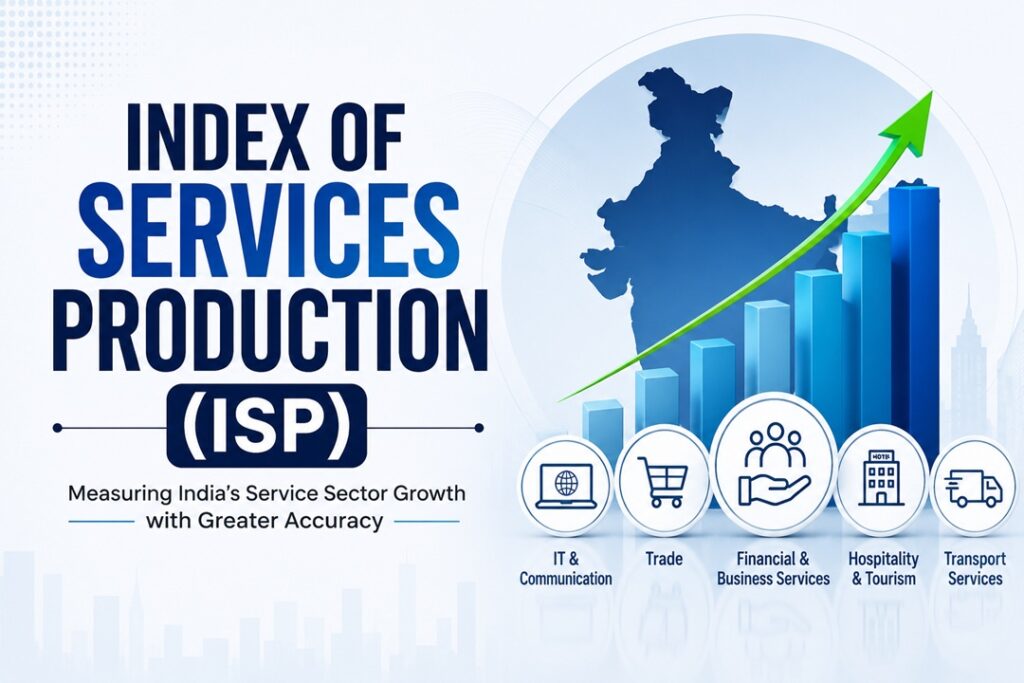
The Ministry of Statistics and Programme Implementation (MoSPI) has announced the launch of the Index of Services Production (ISP), India’s first dedicated monthly indicator to measure the performance of the services sector. With 2024–25 as the base year, trial estimates will be released from July 2026, strengthening India’s macroeconomic statistical framework and aligning it with global statistical standards.
Why was the ISP introduced?
Shift Towards a Service-Driven Economy
- Over the last three decades, India’s economy has undergone a major structural transformation, with the services sector emerging as the largest contributor to Gross Value Added (GVA).
- Today, the sector contributes over 50% of India’s GVA and plays a vital role in economic growth, employment, exports, and investment.
Absence of a Monthly Indicator
- While industrial activity is measured every month through the Index of Industrial Production (IIP), India lacked a comparable indicator for services.
- Policymakers mainly relied on quarterly GDP estimates and indirect indicators, making timely assessment of service-sector performance difficult.
Purpose of the New Index
- To address this gap, MoSPI has developed the Index of Services Production (ISP), which will provide a monthly measure of real output in the formal services sector.
- The initiative represents a significant reform in India’s statistical system and follows internationally accepted best practices.
What is the Index of Services Production (ISP)?
Definition
- The Index of Services Production (ISP) is a monthly volume index that measures changes in the real output of service industries relative to the base year 2024–25.
- Unlike nominal turnover, the ISP removes the effect of inflation and reflects the actual growth in services output.
Objectives
- Measure monthly performance of the services sector.
- Complement the Index of Industrial Production (IIP).
- Strengthen India’s short-term macroeconomic indicators.
- Improve economic forecasting and business cycle analysis.
- Support evidence-based policymaking.
Institutional Framework
- To develop the methodology, MoSPI constituted a Technical Advisory Committee (TAC) in May 2025.
- The committee is chaired by Debjani Ghosh, Distinguished Fellow at NITI Aayog.
Which sectors are covered under the ISP?
Major Sectors Included
The ISP initially covers the organised services sector, including:
- Wholesale and retail trade
- Repair and maintenance services
- Road, rail, air and water transport
- Warehousing and logistics
- Banking
- Insurance
- Telecommunications
- Hotels and restaurants
- Real estate
- Information technology and computer services
- Professional, scientific and technical services
- Administrative and support services
- Arts, entertainment and recreation
Sectors to be Added Later
These sectors will be incorporated after adequate data become available through the Annual Survey of Incorporated Services Sector Enterprises (ASISSE).
- Private health services
- Private education services
Sectors Excluded
Certain activities remain outside the ISP because they are predominantly government-run, non-market, or difficult to measure.
These include:
- Public administration and defence
- Government health and education
- Central banking activities
- Social work without accommodation
- Membership organisations
- Personal services
- Household services
- Extraterritorial organisations
- Gambling and betting activities
What are the major data sources?
Administrative Data
Operational databases are used for sectors where reliable administrative information is available, such as:
- Railways
- Civil aviation
- Banking
- Insurance
GST-Based Data
- GST GSTR-1 outward supply data forms the backbone of the ISP for most service industries.
- It covers sectors such as:
- Trade
- Hospitality
- Telecommunications
- Information technology
- Professional services
- Real estate
- Logistics
- Administrative services
- Entertainment
- MoSPI uses aggregated Service Accounting Code (SAC)-wise data, ensuring taxpayer confidentiality.
Annual Survey of Incorporated Services Sector Enterprises (ASISSE)
- Provides benchmark estimates for sectors that are largely GST-exempt, particularly:
- Health
- Education
Why is the ISP important?
Timely Economic Monitoring
- Provides monthly assessment of the services sector between quarterly GDP releases.
Better Policy Formulation
- Enables the Government and the Reserve Bank of India (RBI) to respond more quickly to sector-specific economic developments.
Improved National Accounts
- Enhances estimation of quarterly and annual GDP through reliable high-frequency data.
Better Economic Forecasting
- Helps economists identify economic slowdowns and business cycle turning points at an early stage.
Improved Investment Decisions
- Businesses and investors gain access to reliable monthly information on sectoral trends.
Global Comparability
- Brings India’s statistical framework closer to international standards adopted by many advanced economies.
What are the major challenges?
Limited Formal Sector Coverage
- The ISP mainly measures the organised services sector, while informal service activities remain outside its scope.
Dependence on GST Data
- Accuracy depends on GST reporting quality and taxpayer compliance.
Methodological Constraints
- Limited availability of Service Producer Price Indices (SPPI) affects precise measurement of real output.
Partial Coverage of Key Sectors
- Health and education services will initially have limited representation until sufficient survey data become available.
Continuous Data Improvement
- Regular refinement of the mapping between Service Accounting Codes (SAC) and National Industrial Classification (NIC) codes will be required to improve accuracy.
Way Forward
The Index of Services Production (ISP) is one of India’s most significant statistical reforms in recent years. By introducing a dedicated monthly measure of real services sector output, it fills a long-standing gap in India’s macroeconomic data framework. Together with the Index of Industrial Production (IIP), the ISP will provide a more comprehensive picture of economic activity, strengthen GDP estimation, improve policy responsiveness, and support informed decision-making. As the services sector continues to dominate India’s economy, the ISP is expected to become an indispensable tool for policymakers, researchers, businesses, and investors.
Source : The Hindu