
BIMSTEC Strengthens Regional Maritime Security Cooperation
Context
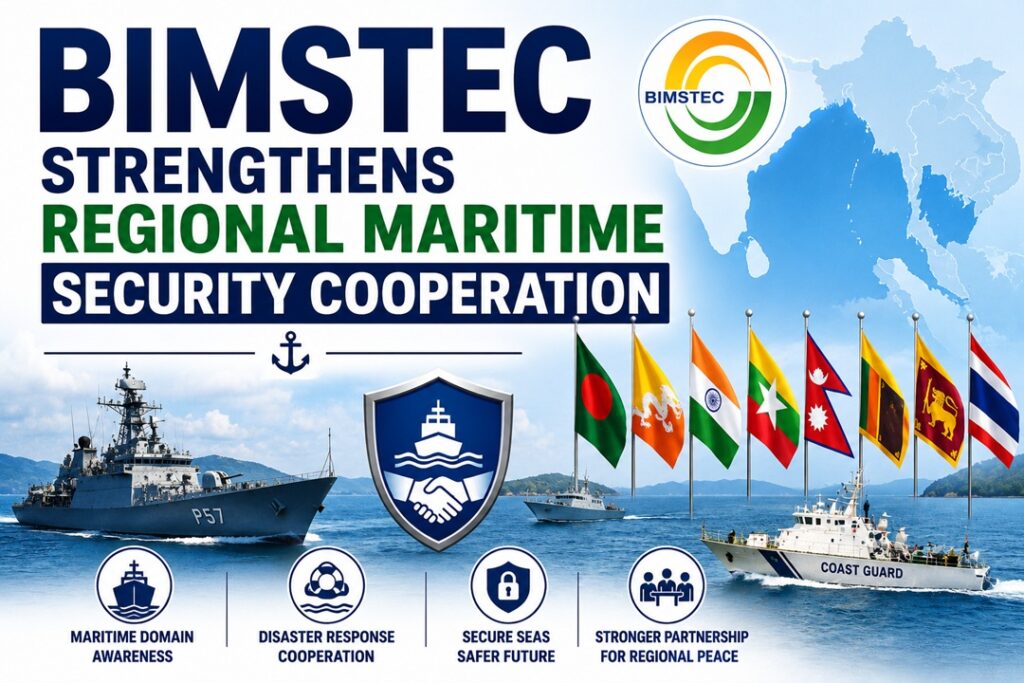
At a recent meeting of National Security Advisers (NSAs) of BIMSTEC member countries held in New Delhi, member nations adopted a set of common guiding principles for maritime law enforcement and Humanitarian Assistance and Disaster Relief (HADR) operations. The initiative reflects the grouping’s increasing emphasis on strengthening regional security, maritime cooperation, disaster preparedness, and coordinated responses to emerging challenges in the Bay of Bengal region.
BIMSTEC (Bay of Bengal Initiative for Multi-Sectoral Technical and Economic Cooperation)
Overview
- BIMSTEC is a regional organization established to promote economic integration, technical cooperation, connectivity, and sustainable development among countries surrounding the Bay of Bengal.
- Established: 1997 through the Bangkok Declaration.
- Headquarters: Dhaka, Bangladesh.
- It represents nearly 22% of the global population (around 1.7 billion people) and a combined economy of about US$3.8 trillion.
- The organization serves as a strategic bridge between South Asia and Southeast Asia.
Member Countries
The seven BIMSTEC member nations are:
South Asian Members
- Bangladesh
- Bhutan
- India
- Nepal
- Sri Lanka
Southeast Asian Members
- Myanmar
- Thailand
These countries share common ecological, maritime, economic, and strategic interests linked to the Bay of Bengal.
Major Areas of Cooperation
BIMSTEC promotes collaboration across several priority sectors, including:
- Trade and Investment
- Transport and Connectivity
- Energy Cooperation
- Science, Technology and Innovation
- Agriculture and Food Security
- Fisheries and Blue Economy
- Tourism
- Public Health
- Disaster Management
- Climate Cooperation
Importance of BIMSTEC
Alternative Regional Platform
With SAARC facing prolonged political challenges, BIMSTEC has emerged as an effective platform for regional cooperation without major political deadlocks.
Supports India’s Foreign Policy
BIMSTEC complements India’s:
- Neighbourhood First Policy
- Act East Policy
- Indo-Pacific Vision
It also improves connectivity between India’s North-Eastern states and Southeast Asia through Bangladesh and Myanmar.
Enhances Maritime Security
The Bay of Bengal has become strategically important due to increasing trade, shipping, piracy concerns, illegal fishing, and geopolitical competition.
BIMSTEC promotes cooperation in:
- Maritime domain awareness
- Coastal security
- Search and rescue operations
- Maritime law enforcement
- Disaster response
Boosts Regional Trade
The proposed BIMSTEC Free Trade Area (FTA) aims to:
- Reduce tariffs
- Increase intra-regional trade
- Strengthen regional value chains
- Improve investment flows
Promotes Connectivity
The grouping is developing:
- Road connectivity
- Rail links
- Coastal shipping
- Port connectivity
- Digital connectivity
- Energy grids
Important projects include:
- India–Myanmar–Thailand Trilateral Highway
- Coastal Shipping Agreement
- Motor Vehicles Agreement
Strengthens Disaster Management
The Bay of Bengal is highly vulnerable to:
- Cyclones
- Floods
- Tsunamis
- Storm surges
BIMSTEC promotes joint disaster preparedness through:
- Humanitarian Assistance and Disaster Relief (HADR)
- Early warning systems
- Capacity building
- Climate cooperation
India hosts the BIMSTEC Centre for Weather and Climate at Noida.
Promotes Strategic Balance in the Indo-Pacific
BIMSTEC provides member countries with an opportunity to strengthen regional cooperation and maintain a balanced strategic environment amid growing geopolitical competition in the Indo-Pacific.
Challenges Before BIMSTEC
Slow Progress on Free Trade Agreement
Although negotiations for the BIMSTEC Free Trade Area started in 2004, agreements relating to goods, services, and investments are still incomplete.
Poor Connectivity
Several flagship projects have progressed slowly because of:
- Regulatory differences
- Security concerns
- Financial constraints
- Administrative delays
Examples include:
- Motor Vehicles Agreement
- Coastal Shipping Agreement
Weak Institutional Capacity
Although the Secretariat was established in Dhaka in 2014, it continues to face:
- Limited financial resources
- Shortage of staff
- Restricted operational powers
Lack of Dispute Resolution Mechanism
Unlike ASEAN, BIMSTEC does not have a formal institutional framework to resolve disputes, affecting timely implementation of decisions.
Regional Asymmetry
India is the largest economy in BIMSTEC.
Some smaller member countries occasionally express concerns regarding:
- Unequal benefits
- Dominance by larger members
- Balancing national interests
Diverse Strategic Priorities
Member countries maintain different geopolitical alignments.
For example:
- Myanmar and Thailand have close engagement with ASEAN.
- Nepal and Sri Lanka often balance relations between India and China.
Political Instability
Internal political developments have slowed regional projects, particularly:
- Civil conflict in Myanmar
- Political transition in Bangladesh
These have affected projects like the India–Myanmar–Thailand Trilateral Highway.
Emerging Security Threats
The region faces growing challenges such as:
- Cybercrime
- Terrorism
- Human trafficking
- Illegal fishing
- Maritime crime
These require greater intelligence sharing and coordinated security cooperation.
Climate Vulnerability
The Bay of Bengal remains one of the world’s most disaster-prone regions.
Despite progress, BIMSTEC still lacks a comprehensive regional disaster response mechanism.
Way Forward
Complete the BIMSTEC Free Trade Agreement
Concluding negotiations on trade in goods, services, and investments will significantly strengthen regional economic integration.
Strengthen the Secretariat
Providing greater funding, technical expertise, and decision-making authority will improve implementation and monitoring of regional initiatives.
Accelerate Connectivity Projects
Priority should be given to:
- Multi-modal transport corridors
- Coastal shipping
- Customs harmonisation
- Digital public infrastructure
- Energy connectivity
Institutionalise Regular Engagement
Regular:
- Annual Summits
- Ministerial Meetings
- Business Forums
- Security Dialogues
will improve coordination and implementation.
Enhance Maritime and Security Cooperation
Member countries should expand cooperation in:
- Maritime surveillance
- Intelligence sharing
- Cybersecurity
- Counter-terrorism
- Humanitarian Assistance and Disaster Relief (HADR)
Strengthen Climate Resilience
Developing a coordinated regional framework for:
- Disaster risk reduction
- Early warning systems
- Climate adaptation
- Sustainable Blue Economy
will improve the resilience of the Bay of Bengal region against future environmental and security challenges.
Source : The Indian Express