
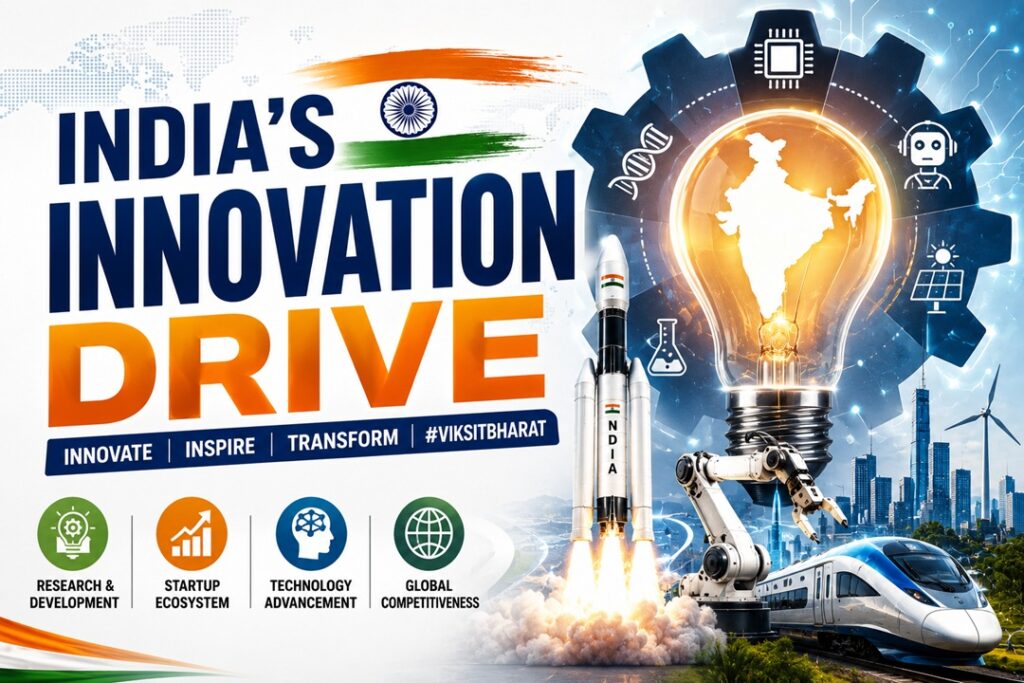
India’s Innovation Drive
Context
The CEO of the Anusandhan National Research Foundation (ANRF) and the Chief Economic Adviser highlighted that evolving global supply-chain disruptions have opened a unique opportunity for India to emerge as a global innovation and research hub.
India’s Innovation Drive: Why Research & Technology Will Shape India’s Future
What is it?
India is steadily moving towards technology-driven growth by strengthening domestic research and innovation capabilities. Building indigenous technologies is critical for achieving strategic autonomy, reducing dependence on imported intellectual property, and securing India’s position in an increasingly competitive global economy.
Current Status of India’s R&D Ecosystem
Modest Investment in Research
- India spends only 0.64% of GDP on Research & Development (R&D), well below most advanced innovation-driven economies.
Lower Corporate Participation
- Private companies contribute nearly 40% of total R&D spending, whereas leading economies witness private-sector participation exceeding 75%.
ANRF as a National Innovation Platform
- The Anusandhan National Research Foundation (ANRF) serves as a statutory institution promoting collaboration among universities, industries, startups, and government agencies.
Major Public Funding Support
- The government has allocated:
- ₹1 lakh crore under the Research, Development and Innovation (RDI) Fund to promote industrial innovation.
- ₹50,000 crore through ANRF Core to strengthen fundamental scientific research.
Why Industry Participation is Essential
Public Funds as Risk-Sharing Capital
- ANRF reduces investment risks by providing long-term funding that encourages industries to undertake high-risk research instead of relying solely on government support.
Crowding-in Private Investment
- Every ₹1 invested by ANRF has the potential to attract ₹5–10 of private-sector investment, accelerating commercialization of new technologies.
From Discovery to Commercialization
- Industries possess manufacturing capabilities, business expertise, and market networks necessary to transform laboratory discoveries into successful products.
Diverse Collaboration Opportunities
- Companies can contribute through:
- Joint R&D programmes
- Co-funding with startups
- Participation in national technology missions
- CSR support for innovation initiatives
Learning from India’s Pharmaceutical Transformation
India’s pharmaceutical sector successfully adapted after the WTO product patent regime came into force.
Instead of declining, Indian firms:
- Built strong capabilities in advanced process engineering.
- Achieved compliance with global quality and regulatory standards.
- Established India as the “Pharmacy of the World,” demonstrating that stronger competition can accelerate innovation.
Emerging Opportunities for India
Retaining High-End Scientific Talent
- Expanding advanced research projects can create attractive opportunities for highly skilled researchers trained within India.
Benefiting from Global Supply Chain Diversification
- Countries are seeking reliable alternatives for critical technologies, creating new export opportunities for Indian innovation.
Building on Digital Public Infrastructure
- Platforms like India’s digital public infrastructure provide a strong foundation for developing next-generation digital technologies.
Leveraging Global Capability Centres (GCCs)
- India’s large network of multinational GCCs can become major centres for collaborative industrial research and advanced technology development.
Major Challenges
Preference for Incremental Innovation
- Many firms continue focusing on low-risk improvements instead of breakthrough technologies.
Global Competition in Research
- Countries like China invest around 2.43% of GDP in R&D, supported by strong corporate investments.
Short-Term Business Priorities
- Pressure to deliver immediate financial performance often discourages long-term research investments.
Traditional Procurement Practices
- Government procurement frequently emphasizes the lowest-cost bidder (L1) rather than rewarding innovation and technological excellence.
Way Forward
Accelerate Utilisation of the RDI Fund
- Ensure faster deployment of the ₹1 lakh crore fund to support frontier technologies and high-risk research.
Strengthen Corporate Innovation Centres
- Encourage companies to establish dedicated R&D divisions with long-term investment strategies.
Reform Public Procurement
- Introduce procurement policies that reward indigenous technologies, patented innovations, and value-based evaluation.
Develop Mission-Oriented Research Partnerships
- Foster sustained collaboration among universities, startups, industries, and government institutions in strategic sectors such as semiconductors, AI, biotechnology, and clean energy.
Conclusion
India has laid a strong institutional foundation through the establishment of ANRF and significant public investment in research. Sustained private-sector participation, stronger academia-industry collaboration, and long-term innovation policies can transform India from a technology adopter into a global leader in scientific research and innovation.
Source : The Indian Express