
India’s Gen Z Employment Challenge: Bridging the Education–Employment Gap
Context
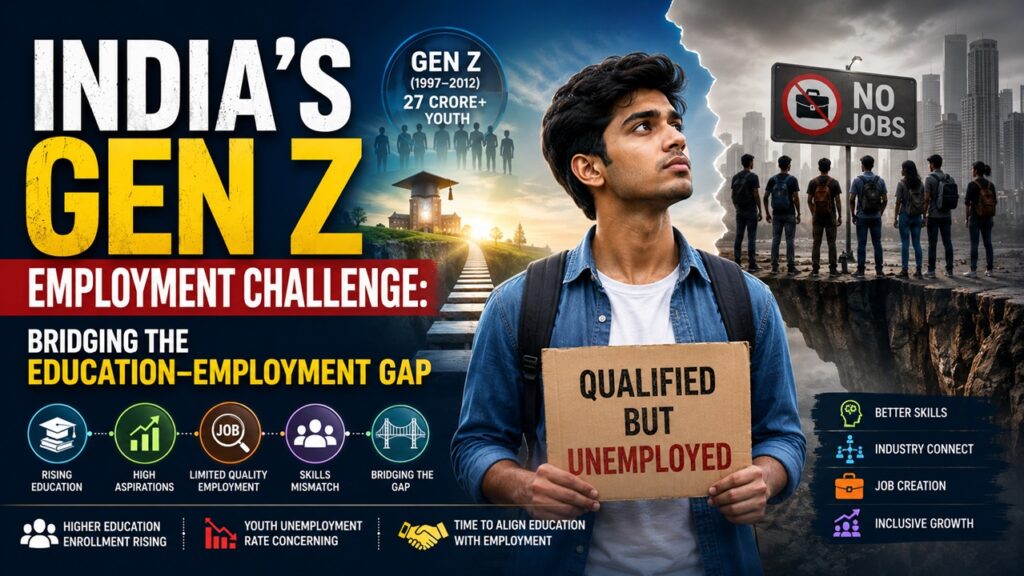
A recent analysis of the Periodic Labour Force Survey (PLFS) 2023–24 highlights a growing employment transition challenge in India, where a large section of Generation Z is struggling to obtain secure, formal employment despite the country’s demographic advantage.
India’s Gen Z Employment Challenge
What is it?
India’s Generation Z comprises individuals aged 15–26 years (born between 1997 and 2012), representing nearly 29.94 crore people and forming a significant share of the country’s working-age population.
The Gen Z employment challenge refers to the increasing difficulty young people face in moving from education into productive and formal employment. Many remain unemployed, underemployed, or engaged in informal and unpaid work despite higher educational attainment.
Key Facts and Statistics
Low Regular Employment
- Only 14.8% of Gen Z men and 4.7% of Gen Z women are employed as regular salaried workers.
- Most young workers are engaged in casual labour, self-employment, unpaid family work, or domestic duties.
High Informality
- Nearly 79.9% of employed Gen Z workers do not receive social security benefits.
- Only 14.1% possess a formal employment contract, reflecting widespread informal employment.
Low Labour Force Participation
- Gen Z Labour Force Participation Rate (LFPR): 41.7%
- Millennial LFPR: Around 75%
- Female LFPR remains particularly low:
- Rural: 28%
- Urban: 21.1%
Heavy Unpaid Domestic Responsibilities
- Around 27.1% of young women are engaged exclusively in unpaid household work.
- In comparison, only 0.32% of young men perform unpaid domestic duties full-time.
Reasons Behind India’s Gen Z Employment Challenge
Education–Employment Skill Gap
- Higher education focuses heavily on academic qualifications rather than practical and industry-relevant skills.
- Many graduates lack employability skills demanded by modern industries.
Changing Nature of Jobs Due to AI and Automation
- Artificial Intelligence (AI), automation, and digital technologies are replacing or transforming many entry-level administrative and white-collar jobs.
- Demand is increasing for technology-oriented and specialized skills.
Barriers to Female Employment
- Lack of affordable childcare facilities.
- Safety concerns during commuting.
- Social norms restricting women’s mobility.
- Unequal burden of household responsibilities.
Rise of Informal and Gig Employment
- Industries increasingly prefer contract workers, gig workers, and temporary employees.
- Permanent jobs offering social security and employment benefits are becoming relatively fewer.
Implications of the Employment Challenge
Social Implications
Growing Youth Frustration
- Difficulty in securing quality employment increases financial insecurity.
- Rising dissatisfaction may contribute to protests, labour unrest, and declining confidence among youth.
Reduced Returns on Educational Investment
- Families invest substantial resources in higher education.
- Poor employment outcomes reduce returns on these investments and increase financial pressure on households.
Widening Gender Inequality
- Limited employment opportunities push many educated women back into unpaid domestic work.
- This reduces women’s financial independence and labour market participation.
Economic Implications
Loss of Demographic Dividend
- India’s large young population can become an economic burden if quality jobs are not created.
- Failure to absorb skilled youth reduces long-term economic growth potential.
Lower Household Consumption
- Informal employment and low wages reduce disposable income.
- Weak purchasing power affects domestic demand and economic expansion.
Lower Productivity
- Skilled youth working in low-productivity or informal occupations reduces innovation, industrial competitiveness, and overall productivity growth.
Way Forward
Promote Labour-Intensive Industries
- Expand sectors such as textiles, food processing, construction, tourism, MSMEs, and manufacturing.
- Encourage formal job creation through targeted industrial policies.
Strengthen Industry–Academia Linkages
- Introduce structured apprenticeship programmes.
- Promote internships, vocational education, and skill-based learning.
- Align university curricula with industry requirements.
Increase Female Workforce Participation
- Expand affordable childcare services.
- Improve public transport safety.
- Encourage flexible work arrangements and gender-friendly workplaces.
- Strengthen maternity and workplace support systems.
Strengthen Urban Employment and Social Security
- Develop urban employment guarantee programmes.
- Extend social security, health insurance, and contractual protections to gig and informal workers.
- Promote labour law compliance in emerging sectors.
Conclusion
India’s demographic dividend can become a powerful engine of economic growth only if its young population gains access to formal, productive, and secure employment. Bridging the gap between education and labour market needs, expanding labour-intensive industries, improving women’s workforce participation, and strengthening social security systems will be essential for ensuring that India’s Gen Z contributes fully to the country’s long-term development.
Source : The Hindu