
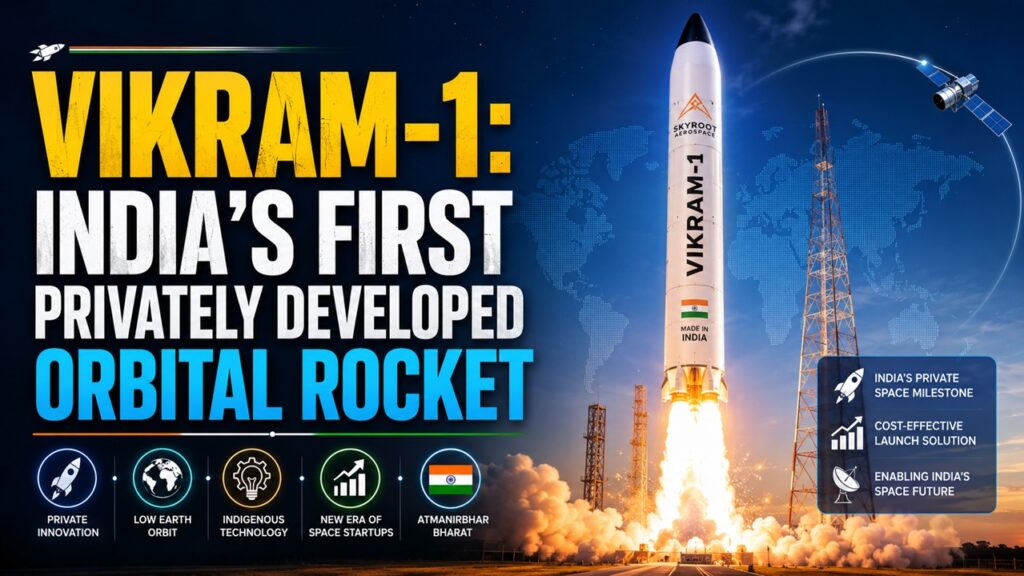
Vikram-1: India’s First Privately Developed Orbital Rocket
Context
India achieved a landmark milestone in its space sector with the successful launch of Vikram-1, the country’s first privately developed orbital launch vehicle, on July 18. Developed by Skyroot Aerospace, the mission marks the beginning of India’s private orbital launch era, reducing exclusive dependence on ISRO for orbital launches. The success of Mission Aagaman also reflects the rapid growth of India’s private space ecosystem following the space sector reforms and the establishment of IN-SPACe.
What is Vikram-1?
Overview
- Vikram-1 is India’s first privately designed and developed multi-stage orbital launch vehicle capable of placing satellites into Low Earth Orbit (LEO).
- Developed by Skyroot Aerospace, a Hyderabad-based private space technology company.
- Before Vikram-1, all Indian orbital launch vehicles were developed and operated by ISRO.
- Mission Name: Mission Aagaman, symbolising India’s entry into private orbital launch capability.
- The mission places India among the few countries where private companies have independently developed and launched orbital rockets.
Major Features of Vikram-1
Launch Vehicle Design
- Four-stage launch vehicle.
- First three stages use solid propellant.
- Fourth stage uses liquid propulsion for precise orbital insertion.
Lightweight Structure
- Constructed using an all-carbon composite airframe.
- Designed for faster manufacturing and frequent launch operations.
- Features India’s longest single-piece composite rocket stage.
Advanced Propulsion
- Powered by indigenously developed 3D-printed rocket engines.
- Uses high-performance solid rocket boosters.
- Includes restartable liquid propulsion for orbital adjustment.
Payload Capacity
- 350 kg to Low Earth Orbit (LEO).
- 290 kg to a 500 km Sun-Synchronous Orbit (SSO).
- 480 kg to low-inclination Earth orbit.
Payloads Carried
The maiden mission deployed six payloads, including:
- Embrace – Robotic-arm technology demonstration for space debris capture.
- SOLARAS – Satellite developed by Grahaa Space.
- SCOPE – Experimental satellite developed by Skyroot Aerospace.
- uD3PP and mD3RN – Deployable technology demonstrators by Germany’s Dcubed.
- Cosmic Bloom – Payload developed by Cosmos Diamonds.
- Micro Art Tribute – Artistic payload by Ajay Kumar Mattewada.
Symbolic Payloads
The mission also carried:
- A lab-grown diamond lotus.
- An 18-karat gold miniature rocket engraved with rice-grain sculptures honouring Vikram Sarabhai, C. V. Raman, and A. P. J. Abdul Kalam, after whom Skyroot names its rockets and engines.
Mission Performance
- Successfully completed every planned flight milestone.
- Demonstrated the challenging long-coast phase, where the rocket maintains its orientation without engine thrust.
- Successfully completed the final burn using its 3D-printed liquid engine.
- Although intended mainly as a technology demonstration, the vehicle successfully reached orbit.
- Unlike several global launch vehicles such as Electron, Firefly Alpha, and ISRO’s SSLV, which faced setbacks during their maiden missions, Vikram-1 achieved orbital success on its first attempt.
Skyroot’s 3D-Printed Rocket Engine
What is 3D Printing?
- Conventional rocket engines are manufactured through forging, machining, and welding dozens of separate components.
- Additive manufacturing (3D printing) builds the engine layer by layer using laser-fused metal powder, producing a single integrated component.
Advantages
- Eliminates numerous bolts, welds, joints, and seals.
- Reduces leak points and improves reliability.
- Skyroot’s Raman engine reduced injector weight by nearly 50%.
- Manufacturing time and component count reduced by almost 80%.
- Enables sophisticated regenerative cooling channels.
- Allows rapid prototyping and faster design improvements.
Importance of the Carbon Composite Body
Carbon Composite
- Carbon-fibre reinforced polymer combines lightweight carbon fibres with resin.
- Provides exceptionally high strength-to-weight ratio, significantly better than aluminium and many aerospace steels.
Benefits
- Lower structural weight increases payload carrying capacity.
- Excellent resistance to fatigue and corrosion.
- Supports seamless manufacturing of large rocket stages.
- Improves launch efficiency and reduces manufacturing time.
Limitations
- Expensive raw materials and curing facilities.
- Requires specialised manufacturing processes.
- Internal damage may not be visible externally.
- Requires ultrasonic and advanced non-destructive testing.
Comparison: Vikram-1 vs PSLV vs SSLV
| Feature | Vikram-1 | PSLV | SSLV |
|---|---|---|---|
| Developer | Skyroot Aerospace | ISRO | ISRO (Licensed to HAL) |
| Height | 22 m | 44 m | ~34 m |
| Lift-off Mass | ~30 tonnes | 320 tonnes | ~120 tonnes |
| Configuration | 4 stages (3 Solid + 1 Liquid) | 4 stages (Solid & Liquid) | 3 Solid + 1 Liquid |
| Payload Capacity | 350 kg to LEO | 1,750 kg to Polar Orbit | 500 kg to LEO |
| Main Material | Carbon Composite | Maraging Steel | Conventional Structure |
| Key Innovation | Fully 3D-printed engine, monolithic composite stage | High reliability | Small satellite launcher |
India’s Expanding Private Space Ecosystem
Healthy Competition
- Skyroot Aerospace and AgniKul Cosmos are India’s leading private launch companies.
Growth of Space Startups
- Since the 2020 space reforms and the establishment of IN-SPACe (2022), India’s private space sector has expanded rapidly.
- More than 400 space startups are now active across launch vehicles, satellites, propulsion systems, and downstream applications.
Changing Launch Landscape
- Private launch vehicles reduce India’s dependence on ISRO.
- Space access is gradually becoming market-driven, enabling commercial launch services for domestic and international customers.
Business Challenges Ahead
Limited Domestic Demand
- India’s dedicated small-satellite launch market remains relatively small.
- Domestic satellite manufacturers are still expanding.
Global Market Dynamics
- Many satellite operators prefer rideshare launches aboard larger rockets like SpaceX Falcon 9, which offer lower launch costs.
- Dedicated launches provide flexibility but remain comparatively expensive.
Increasing Competition
Vikram-1 competes with:
- SpaceX
- Rocket Lab
- European and Chinese launch startups
- Japanese and Australian private launch companies
- ISRO’s Small Satellite Launch Vehicle (SSLV)
Commercial Challenges
- Launch services are capital-intensive with relatively low profit margins.
- Regulatory compliance, including space debris mitigation, increases operational costs.
- Long-term success depends on securing frequent launch contracts and expanding global demand for dedicated small-satellite launches.
Source : The Hindu