
Ken–Betwa River Interlinking Project Faces Fresh Protests
Context
Recently, protests intensified against the Ken–Betwa River Interlinking Project, with tribal communities and environmental groups expressing concerns over displacement, forest loss, biodiversity impacts, and the rehabilitation process.
Ken–Betwa River Interlinking Project
What is the Project?
- It is India’s first large-scale inter-state river linking programme.
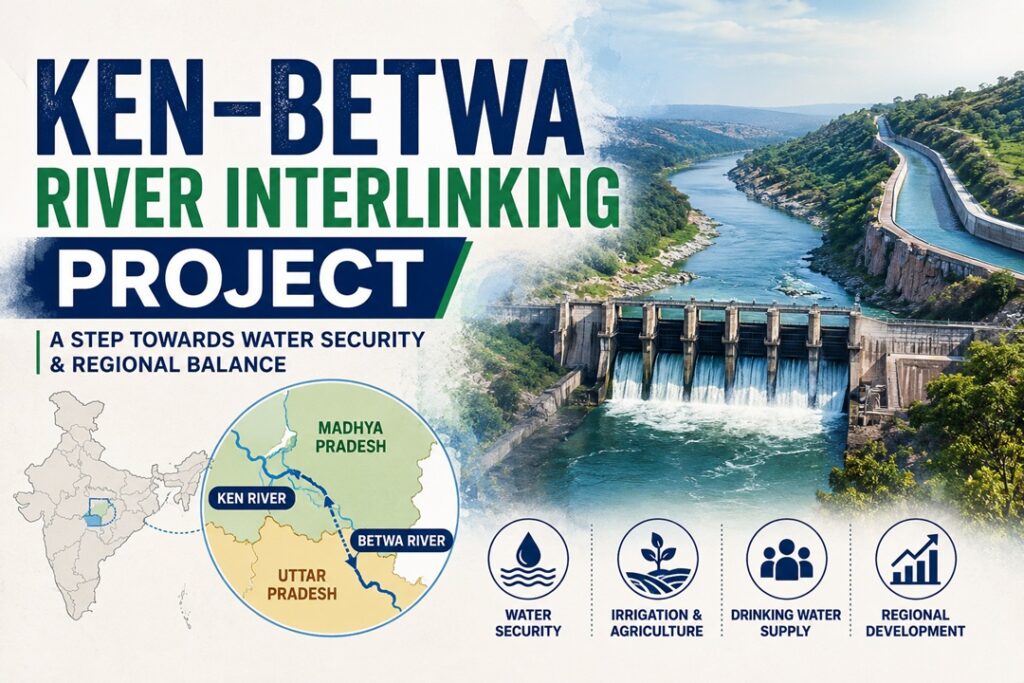
- Rivers Connected – The project proposes diverting surplus water from the Ken River (Madhya Pradesh) to the Betwa River (Uttar Pradesh).
- Core Objective – To reduce water scarcity in the Bundelkhand region by improving irrigation, drinking water availability, and renewable energy generation.
- About Bundelkhand – A semi-arid historical region spread across nearly 69,000 sq. km in Madhya Pradesh and Uttar Pradesh, inhabited by around 14.5 million people. It is bounded by the Yamuna River in the north and the Vindhya Range in the south, with Jhansi as its largest city.
What are the Expected Benefits?
Agricultural Expansion
- The project is expected to provide irrigation to nearly 1.06 million hectares of farmland, enhancing agricultural productivity and farmers’ incomes.
Safe Drinking Water
- Around 6.2 million people in drought-prone districts are expected to receive reliable drinking water.
Renewable Energy Boost
- It is planned to generate 103 MW of hydropower and 27 MW of solar power, contributing to clean energy production.
Groundwater Conservation
- Greater dependence on surface water is expected to reduce groundwater over-extraction and strengthen drought resilience.
What are the Major Concerns?
Impact on Panna Tiger Reserve
- The proposed Daudhan Dam may submerge over 10% of the core area of the Panna Tiger Reserve.
Threat to Biodiversity
- Experts warn of habitat fragmentation affecting tigers, gharials, vultures, and other wildlife species.
Large-scale Deforestation
- According to the Ministry of Jal Shakti, nearly 17,101 trees had been identified for felling up to July 2025, including 12,404 trees within the Panna Tiger Reserve.
Hydrological and Climate Impacts
- Studies, including those by IIT Bombay, indicate possible changes in local rainfall patterns, river ecology, and microclimate.
Displacement of Local Communities
- More than 6,600 families, including tribal communities dependent on forests, are likely to be displaced.
Rehabilitation Issues
- Protesters allege inadequate compensation, delayed rehabilitation, and poor implementation of resettlement measures.
Forest Rights Concerns
- Tribal communities fear the loss of community forest rights due to weak implementation of the Forest Rights Act.
High Project Cost
- The estimated project cost exceeds ₹44,000 crore, raising concerns over long-term financial sustainability.
What are the Demands of Tribal Communities?
Individual Compensation
- Compensation of ₹12.5 lakh should be provided to each eligible adult instead of a family-based package.
Revision of Eligibility Date
- The compensation cut-off date should be updated beyond 16 February 2024.
Transparent Beneficiary Survey
- Survey errors should be corrected to ensure only genuine beneficiaries receive compensation.
Equal Treatment in Other Projects
- Similar rehabilitation benefits should be extended to families affected by the Majhgaon and Runjh irrigation projects.
Protection of Community Rights
- Tribal groups have demanded an end to forced evictions, electricity disconnections, and alleged false police cases.
What Measures Can Improve the Project?
Fair Rehabilitation
- Ensure transparent compensation, recognise each eligible adult separately, and update beneficiary records.
Independent Monitoring
- Create an impartial authority to oversee environmental compliance and rehabilitation.
Scientific Evaluation
- Release updated hydrological assessments to validate surplus water availability.
Environmental Protection
- Adopt measures to minimise deforestation and safeguard wildlife habitats.
Participatory Governance
- Involve tribal communities and local stakeholders in planning and implementation.
Way Forward
The Ken–Betwa River Interlinking Project represents a significant step towards improving water security in central India. However, its long-term success depends on balancing developmental objectives with ecological conservation, transparent rehabilitation, and the protection of tribal rights to ensure inclusive and sustainable development.
Source : The Hindu