
Canada–India Strategic Defence Partnership
Context
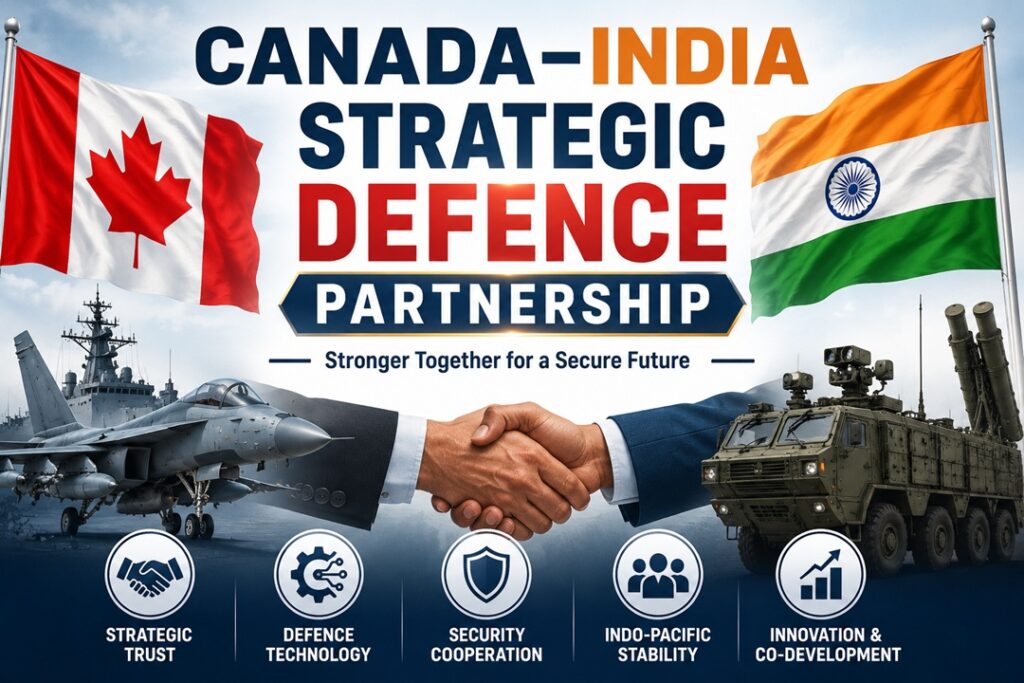
Canadian High Commissioner to India Chris Cooter unveiled a strategic roadmap to strengthen Canada–India defence and high-technology cooperation, highlighting opportunities in defence manufacturing, aerospace, critical minerals, space technologies, and Indo-Pacific security. The initiative reflects the growing convergence of strategic interests between the two democracies as they seek to build resilient supply chains, diversify defence partnerships, and promote technological cooperation amid an evolving global security environment.
About Canada–India Strategic Defence Partnership
What is it?
The Canada–India Strategic Defence Partnership is an expanding framework of defence, security, and technology cooperation aimed at strengthening military-industrial collaboration between the two countries.
The partnership seeks to combine Canada’s strengths in aerospace innovation, defence research, critical minerals, nuclear technology, and artificial intelligence with India’s large manufacturing base, skilled workforce, defence modernization programme, and growing defence exports.
It also supports both countries’ objective of reducing excessive dependence on single-country supply chains while promoting secure, trusted, and diversified defence production networks.
Key Facts and Statistics
- Higher Defence Spending: Canada has increased defence expenditure beyond 2% of GDP (2026) and has announced long-term plans to further modernize its armed forces.
- Critical Mineral Resources: Canada possesses commercially significant reserves of 31 critical minerals, including lithium, cobalt, graphite, nickel, uranium, rare earth elements, and tungsten.
- Aerospace Innovation Investment: Nearly $500 million has been allocated for advanced aerospace technologies, autonomous systems, and drone research.
- Global Uranium Leader: Canada ranks among the world’s leading producers and holders of recoverable uranium resources, supporting civil nuclear cooperation.
- Advanced Space Capabilities: Canada is internationally recognized for satellite technology, Earth observation systems, robotics, and remote sensing.
Major Areas of Cooperation
Defence Manufacturing and Industrial Partnership
Canada’s defence industrial policy encourages collaboration with trusted partners for co-development of military equipment, subsystem manufacturing, defence electronics, and integration into global defence supply chains.
Indian defence manufacturers can contribute through cost-effective production, engineering expertise, and expanding indigenous manufacturing capabilities.
Aerospace and Emerging Technologies
Joint collaboration can accelerate development of:
- Unmanned Aerial Vehicles (UAVs)
- Artificial Intelligence-enabled defence systems
- Autonomous military platforms
- Advanced avionics
- Space technologies
- Defence software and cyber capabilities
Space Cooperation and Maritime Surveillance
Canada’s satellite systems, Earth observation capabilities, and space robotics can complement India’s affordable launch services and expanding space programme.
Together, both countries can improve:
- Maritime domain awareness
- Coastal surveillance
- Disaster monitoring
- Arctic and Indo-Pacific observation
- Space-based defence applications
Critical Minerals Partnership
Critical minerals are essential for:
- Missile systems
- Fighter aircraft
- Batteries
- Semiconductors
- Radar systems
- Defence electronics
- Renewable energy technologies
Canada can become a reliable supplier while India develops refining, processing, and manufacturing capabilities under its critical minerals strategy.
Indo-Pacific Maritime Cooperation
Both countries support a free, open, inclusive, and rules-based Indo-Pacific.
Cooperation includes:
- Joint naval exercises
- Maritime security operations
- Humanitarian Assistance and Disaster Relief (HADR)
- Anti-piracy cooperation
- Maritime information sharing
- Strengthening interoperability between navies
Steps Taken So Far
Defence Representatives
Both countries have appointed dedicated Defence Advisers to improve military communication and institutional cooperation.
High-Level Defence Dialogue
A structured bilateral defence dialogue has been established to coordinate strategic priorities, defence procurement, and industrial collaboration.
Military Education and Training
Regular exchanges between military colleges, defence universities, and officer training institutions are strengthening professional cooperation.
Critical Minerals Cooperation
Both nations have initiated cooperation through a bilateral framework on critical minerals to build resilient and diversified supply chains.
Growing Industrial Engagement
Canadian and Indian defence companies are increasingly exploring partnerships in:
- Aerospace manufacturing
- Defence electronics
- Space technologies
- Artificial Intelligence
- Advanced materials
- Drone technologies
Challenges
Diplomatic Trust Deficit
Past political disagreements and diaspora-related issues have affected bilateral relations, requiring sustained diplomatic engagement.
Regulatory Differences
Different defence procurement procedures, export controls, certification standards, and investment regulations can delay collaborative projects.
Technology Transfer Restrictions
Sensitive defence technologies remain subject to export control regimes, intellectual property protections, and national security regulations.
Supply Chain Vulnerabilities
Global geopolitical conflicts, shipping disruptions, and critical mineral price volatility continue to affect defence manufacturing.
Limited Institutional Mechanisms
Several bilateral cooperation mechanisms remain at an early stage and require stronger implementation, monitoring, and policy coordination.
Way Forward
Strengthen Joint Defence R&D
Encourage collaborative research between Canadian innovation centres, Indian defence startups, universities, and research laboratories.
Expand Defence Manufacturing
Promote co-production of defence equipment, aerospace components, drones, and next-generation military technologies under India’s defence manufacturing initiatives.
Deepen Logistics Cooperation
Conclude logistics support arrangements to facilitate:
- Port access
- Refuelling
- Maintenance
- Humanitarian missions
- Joint naval deployments
Develop Critical Mineral Ecosystem
Establish joint processing facilities, certification centres, and long-term commercial agreements for strategic minerals.
Enhance Military Exchanges
Increase:
- Officer exchange programmes
- Joint military exercises
- Staff college cooperation
- Cyber defence training
- Multi-domain war-gaming
Accelerate Economic Cooperation
Fast-track negotiations on the Comprehensive Economic Partnership Agreement (CEPA) to facilitate greater investment in defence manufacturing, aerospace, space technology, and advanced industrial sectors.
Conclusion
The evolving global security environment presents India and Canada with an important opportunity to build a comprehensive strategic defence partnership. By combining Canada’s technological leadership, aerospace expertise, and critical mineral resources with India’s manufacturing strength, expanding defence industry, and strategic location, both countries can strengthen defence preparedness, promote resilient supply chains, enhance Indo-Pacific security, and contribute to a stable and rules-based international order.
Source : The Hindu