
Cauvery Water Sharing Issue Revisited
Context
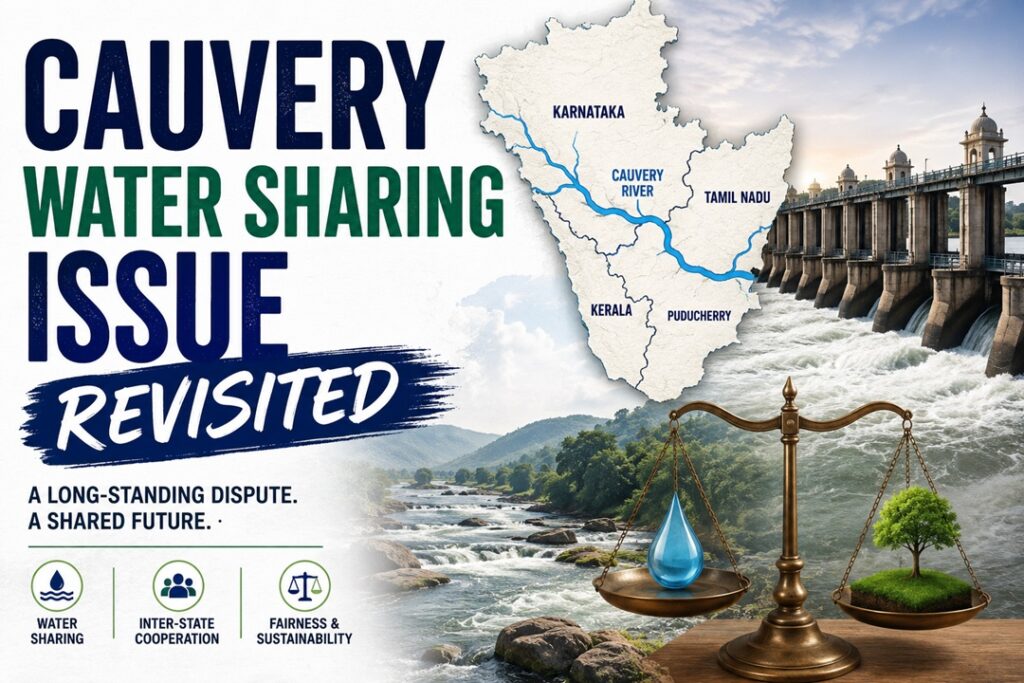
The 53rd meeting of the Cauvery Water Management Authority (CWMA) was held in New Delhi on 22 July 2026 to assess the water availability in the Cauvery basin and review water releases among Karnataka, Tamil Nadu, Kerala, and Puducherry. The meeting assumed significance due to below-normal southwest monsoon rainfall, declining reservoir storage, and renewed concerns over equitable water distribution among the basin states.
Understanding the Cauvery Water Dispute
States Involved
The Cauvery River dispute is one of India’s oldest inter-state water conflicts involving Karnataka, Tamil Nadu, Kerala, and Puducherry.
The primary disagreement is between Karnataka (upper riparian state) and Tamil Nadu (lower riparian state) regarding the sharing of Cauvery waters, particularly during years of deficient rainfall.
Historical Background
The dispute traces its origin to the 1892 and 1924 agreements signed between the Madras Presidency and the Princely State of Mysore during British rule.
After Independence, Karnataka argued that these agreements disproportionately favoured the downstream Madras Presidency and sought a more equitable allocation to support its expanding irrigation, industrial growth, and urban water requirements.
Karnataka’s Position
- Seeks a greater share of Cauvery water to meet rising drinking water demand, especially in Bengaluru.
- Requires additional water for irrigation expansion and industrial development.
- Maintains that the colonial-era agreements restricted its rightful utilization of the river.
Tamil Nadu’s Position
- Relies extensively on Cauvery water for irrigating the fertile Cauvery Delta.
- Millions of farmers depend on timely water releases for paddy cultivation.
- Argues that any reduction in river flow adversely affects agriculture, livelihoods, and food security.
Judicial Intervention and Water Allocation
Cauvery Water Disputes Tribunal (CWDT)
The Government of India constituted the Cauvery Water Disputes Tribunal (CWDT) in 1990 under the Inter-State River Water Disputes Act, 1956.
After extensive hearings, the Tribunal delivered its final award in 2007, which was modified and affirmed by the Supreme Court in 2018.
Supreme Court Judgment (2018)
The Supreme Court declared the Cauvery a national asset and finalized the annual water-sharing arrangement.
Key features include:
- Total annual water availability assessed at 740 thousand million (TMC) feet.
- Allocation of water among Karnataka, Tamil Nadu, Kerala, and Puducherry.
- 4.75 TMC ft earmarked exclusively for Bengaluru’s drinking water needs, acknowledging the city’s rapid urban growth.
- The Biligundlu gauging station serves as the official interstate point for measuring water releases from Karnataka to Tamil Nadu.
Cauvery Water Management Authority (CWMA)
About
The Cauvery Water Management Authority (CWMA) is a statutory and quasi-judicial body established by the Government of India in 2018 to implement the Supreme Court’s directions.
Objective
Its mandate is to regulate, monitor, and ensure compliance with the Cauvery water-sharing arrangement among the basin states.
Statutory Basis
The Authority was constituted under Section 6A of the Inter-State River Water Disputes Act, 1956.
Headquarters
- New Delhi
- Functions under the Union Ministry of Jal Shakti.
Composition
The CWMA consists of:
- Full-time Chairperson.
- Two full-time technical members (Water Resources and Agriculture).
- Part-time representatives from the Ministries of Jal Shakti and Agriculture.
- One representative each from Karnataka, Tamil Nadu, Kerala, and Puducherry.
The Member Secretary of the Authority also functions as the head of the Cauvery Water Regulation Committee (CWRC).
Cauvery Water Regulation Committee (CWRC)
Role
The CWRC assists the CWMA by:
- Monitoring reservoir storage and river inflows.
- Assessing rainfall and hydrological conditions.
- Recommending operational water releases.
- Supervising implementation of water-sharing decisions.
It also includes representatives from the India Meteorological Department (IMD) and other technical agencies.
Meetings
- Meets every 10 days during June and October.
- Meets at least once every fortnight after the onset of the southwest and northeast monsoons.
- The CWMA generally meets at the beginning of every water year (June–May) and whenever necessary based on hydrological conditions.
Major Challenges in Cauvery Water Sharing
Deficient Monsoon
Poor southwest monsoon rainfall reduces inflows into reservoirs, creating severe competition over available water resources.
Agricultural Dependence
Both Karnataka and Tamil Nadu depend heavily on Cauvery waters.
- Tamil Nadu requires assured releases for its traditional multi-crop paddy cultivation.
- Karnataka needs increasing quantities for expanding irrigation and local agriculture.
Mekedatu Reservoir Project
Karnataka proposes constructing the Mekedatu balancing reservoir to strengthen Bengaluru’s drinking water supply and generate hydroelectric power.
Tamil Nadu opposes the project, arguing that it could reduce downstream water availability and adversely affect agriculture.
Historical Disagreements
The differing interpretations of the colonial-era agreements continue to influence political and legal disputes.
Distress-Sharing Formula
During drought years, proportional reduction of water allocations remains contentious due to disagreements over actual water availability and competing priorities.
Measures for Long-Term Resolution
Promote Water-Efficient Agriculture
Encourage cultivation of less water-intensive crops such as millets and pulses while reducing dependence on water-intensive paddy cultivation.
Improve Irrigation Efficiency
Expand the adoption of drip and sprinkler irrigation systems to conserve water and improve irrigation efficiency.
Restore Catchment Areas
Promote afforestation and ecological restoration in upper catchment regions such as Kodagu to enhance groundwater recharge and improve river flow.
Strengthen Urban Water Management
Urban centres, particularly Bengaluru, should:
- Reduce distribution losses.
- Mandate rainwater harvesting.
- Increase wastewater recycling and reuse.
Enhance Groundwater Recharge
Revive tanks, lakes, ponds, and traditional water bodies to improve groundwater storage during dry periods.
Strengthen Cooperative River Basin Governance
Improve transparency in hydrological data sharing, strengthen the role of the CWMA, and encourage continuous dialogue among basin states for evidence-based decision-making.
Way Forward
The renewed focus on the Cauvery dispute in 2026 reflects the impact of deficient southwest monsoon rainfall and declining reservoir storage across the basin. Sustainable resolution requires scientific water management, efficient irrigation practices, transparent data sharing, ecological conservation, and stronger institutional cooperation through the Cauvery Water Management Authority (CWMA) to ensure equitable and sustainable utilization of the Cauvery River for all basin states.
Source : The Hindu