
Rome Declaration on AI, Nuclear Security and Global Peace
Context
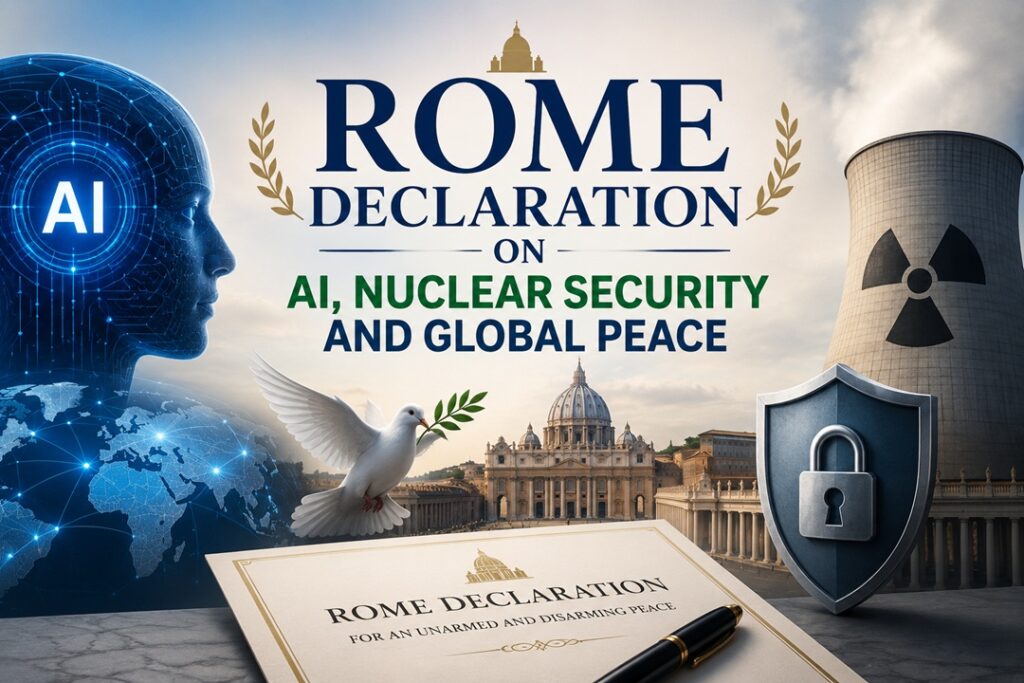
A historic gathering of Nobel Prize winners, artificial intelligence experts, spiritual leaders, and former world leaders convened at Rome’s Capitoline Hill to endorse the Rome Declaration on an Unarmed and Disarming Peace. The declaration emphasizes preserving human control over nuclear decision-making and preventing artificial intelligence from determining the use of nuclear weapons.
About the Rome Declaration
What is the Declaration?
The Rome Declaration is a global ethical initiative inspired by Pope Leo XIV’s “Magnifica Humanitas”, advocating that advances in artificial intelligence must always uphold human dignity. It cautions against integrating AI into nuclear command systems, arguing that machines cannot possess conscience, compassion, or ethical judgment, and therefore must never be entrusted with life-and-death military decisions.
Key Pillars of the Declaration
Six Guiding Commitments
- Preventing Future Technological Arms Races: Promote international cooperation to reduce competition in both AI-enabled military technologies and nuclear weapons.
- Ethical Innovation: Ensure scientific and technological progress follows principles of transparency, accountability, and respect for humanity.
- Human-Centred AI: Encourage the use of AI for peaceful purposes while preventing its deployment in autonomous warfare.
- International Regulatory Frameworks: Strengthen global governance mechanisms for monitoring high-risk emerging technologies.
- Leadership Accountability: Hold governments and technology companies responsible for the ethical development and deployment of AI.
- Advancing Nuclear Disarmament: Reaffirm the objective of achieving a world free of nuclear weapons through verifiable and irreversible disarmament.
Ethical and Operational Priorities
Major Action Areas
- Human Authority Over Nuclear Decisions: Require meaningful human oversight for every nuclear launch decision, prohibiting fully autonomous execution.
- Global Digital Cooperation: Encourage transparent data-sharing to enable independent experts to evaluate AI risks and support countries with limited technological capacity.
- Responsible AI Standards: Require developers to disclose ethical safeguards and prohibit uncontrollable self-learning AI systems.
- Security Assessments of Nuclear Networks: Recommend regular audits of command-and-control systems against cyberattacks, AI manipulation, and misinformation.
- Verified Disarmament Roadmap: Support renewed international negotiations for the gradual elimination of nuclear arsenals through measurable commitments.
Why the Declaration Matters
Emerging Global Security Concerns
- Rapid Decision Cycles: AI significantly shortens military response times, leaving little opportunity for human judgment or diplomatic intervention during crises.
- Algorithmic Errors: AI systems may produce false assessments because of opaque decision-making, flawed datasets, or cyber manipulation, increasing the risk of accidental escalation.
- Weakening Arms Control Agreements: The decline of traditional nuclear treaties has encouraged countries to rely more heavily on automated military technologies.
- Automation Pressure: Nations may increasingly delegate military authority to AI to avoid strategic disadvantages against technologically advanced rivals.
Key Challenges
Obstacles to Implementation
- Limited International Agreement: Leading military powers remain cautious about accepting legally binding restrictions on autonomous weapon systems.
- Verification Difficulties: Unlike physical weapons, AI software can be copied, modified, and concealed, making compliance monitoring more complex.
- Fast Technological Progress: AI innovation is advancing much faster than international negotiations and regulatory frameworks.
The Way Forward
Strengthening Global AI Governance
- Develop Legally Binding Agreements: Convert the declaration’s ethical principles into enforceable international treaties under the United Nations framework.
- Institutionalize Human Oversight: Make human involvement mandatory in every strategic military decision involving nuclear weapons.
- Enhance Public Awareness: Build global public support to encourage governments to prioritize AI safety and nuclear risk reduction.
- Strengthen Cybersecurity Measures: Protect nuclear command infrastructure by separating critical systems from vulnerable commercial AI platforms and insecure digital networks.
Conclusion
The Rome Declaration reinforces the principle that moral responsibility for nuclear weapons must remain exclusively in human hands. While artificial intelligence can enhance analysis and efficiency, decisions affecting human survival require ethical judgment that machines cannot provide. Sustainable global peace depends on combining technological innovation with responsible governance, international cooperation, and unwavering human accountability.
Source : The Hindu