
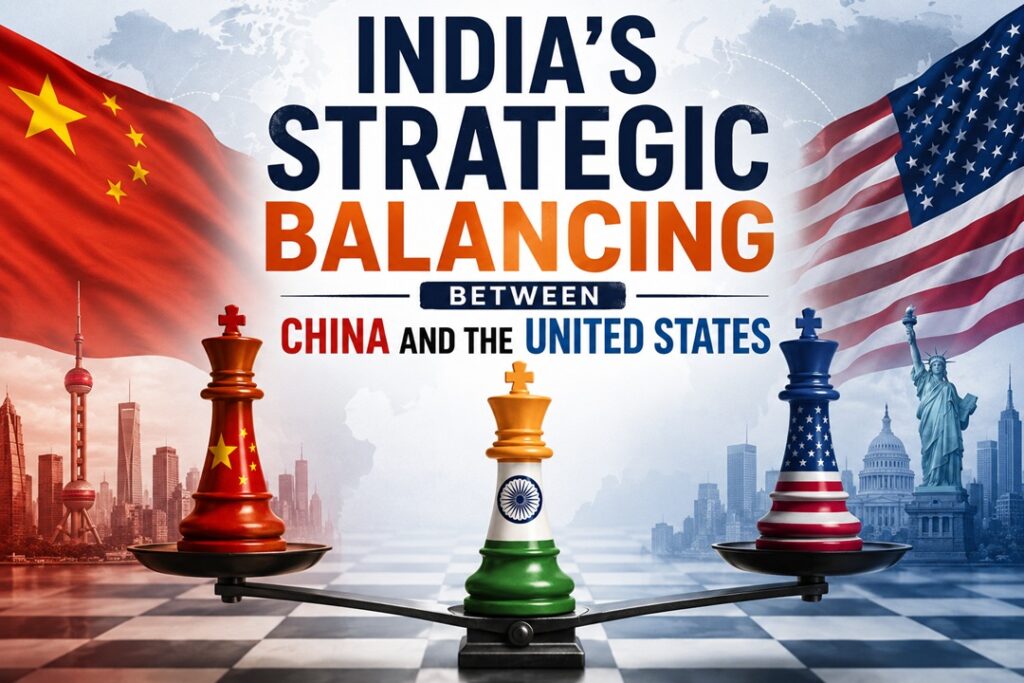
India’s Strategic Balancing Between China and the United States
Context
Renewed discussions on India’s foreign and economic policy have gained momentum as the United States under the Trump administration adopts a more transactional trade approach, while sections of Indian industry advocate easing economic restrictions on China despite continuing geopolitical tensions.
India Must Balance China and the U.S. Without Strategic Dependence
Overview
India faces a complex strategic challenge of maintaining productive relations with both the United States and China while avoiding excessive dependence on either. The country must safeguard its economic interests, national security, and strategic autonomy amid changing global power dynamics.
Key Background
Changing U.S. Approach
- The Trump administration imposed tariffs on Indian steel and aluminum exports.
- India lost its preferential trade status under the Generalized System of Preferences (GSP).
- H-1B visa regulations became more restrictive for Indian professionals.
- The U.S. also revived diplomatic engagement with Pakistan, creating strategic concerns for India.
Persistent Challenges from China
- China has repeatedly tested India’s territorial sovereignty through border confrontations at Depsang (2013), Chumar (2014), Doklam (2017), and Galwan (2020).
- Border disputes along the Line of Actual Control (LAC) remain unresolved despite multiple rounds of military and diplomatic talks.
Economic Interdependence
- India continues to import critical goods such as pharmaceutical ingredients (APIs), electronics, machinery, industrial equipment, and rare earth materials from China.
- This dependence contributes to an annual trade deficit exceeding $100 billion.
China–Pakistan Strategic Cooperation
- During Operation Sindoor (May 2025), China reportedly provided intelligence and satellite support to Pakistan, highlighting the growing strategic partnership between Beijing and Islamabad.
Concerns Over Calls for Greater Economic Engagement with China
Prioritizing Immediate Commercial Interests
Some business groups emphasize lower production costs, inexpensive imports, and higher corporate profitability while paying less attention to long-term strategic and security concerns.
Ignoring Border Security Issues
Advocates of closer economic engagement often overlook China’s continuing military activities along the LAC and repeated assertions over Indian territory.
Example:
- Continued PLA incursions and the renaming of locations in Arunachal Pradesh.
Underestimating Economic Pressure
China has previously demonstrated its ability to restrict exports of strategically important goods during periods of diplomatic tension.
Example:
- Export controls on rare earth minerals and specialized industrial equipment.
Overlooking Diplomatic Challenges
China has repeatedly opposed India’s strategic interests in international institutions.
Example:
- Blocking India’s Nuclear Suppliers Group (NSG) membership and delaying international action against Pakistan-based terrorist organizations.
Risks of Relaxing Economic Restrictions Prematurely
Expanding Strategic Vulnerability
Greater Chinese investment and imports without meaningful progress on border disputes could increase India’s long-term dependence on Beijing.
Supply Chain Risks
Heavy reliance on Chinese manufacturing could disrupt Indian industries during future geopolitical or military crises.
Weakening Negotiating Position
Removing post-Galwan restrictions on Chinese investments, apps, and telecom participation without reciprocal concessions may reduce India’s diplomatic leverage.
Strengthening China’s Economic Influence
Premature normalization may allow Beijing to gain greater influence over India’s economy while unresolved strategic disputes continue.
Limitations of Excessive Dependence on the United States
Policy Uncertainty
American foreign policy often changes with domestic political priorities, making long-term commitments uncertain.
Example:
- Tariffs and tighter H-1B visa policies despite expanding India-U.S. strategic cooperation.
Changing Strategic Priorities
The U.S. may pursue its own geopolitical interests even when they differ from India’s regional security concerns.
Example:
- Renewed engagement with Pakistan despite India’s objections.
No Direct Security Commitment
Although India and the U.S. cooperate extensively in defense and technology, Washington is unlikely to become India’s primary security guarantor along the Himalayan border.
Importance of Independent Decision-Making
India should strengthen partnerships with the U.S. while preserving the flexibility to pursue its own national interests without becoming strategically dependent.
The Way Ahead
Maintain Strategic Vigilance
Continue firm diplomatic and military engagement with China while insisting on meaningful progress in border negotiations before major economic normalization.
Strengthen Domestic Manufacturing
Expand indigenous production of critical technologies, APIs, electronics, semiconductors, and strategic minerals to reduce external dependence.
Diversify International Partnerships
Increase trade, investment, technology, and defense cooperation with Europe, Japan, South Korea, ASEAN countries, Australia, and the Global South.
Protect Strategic Autonomy
Continue India’s multi-alignment strategy by engaging with all major powers while ensuring that national decisions remain guided by India’s own interests.
Conclusion
India’s long-term strength lies in balancing major global powers without becoming dependent on either. A strategy based on economic resilience, diversified partnerships, strong domestic manufacturing, and strategic autonomy will better protect India’s sovereignty, security, and role in an increasingly multipolar world.
Source : The Hindu