
Rising Global Wildfire Crisis: Forest Fires Intensify Across Continents
Context
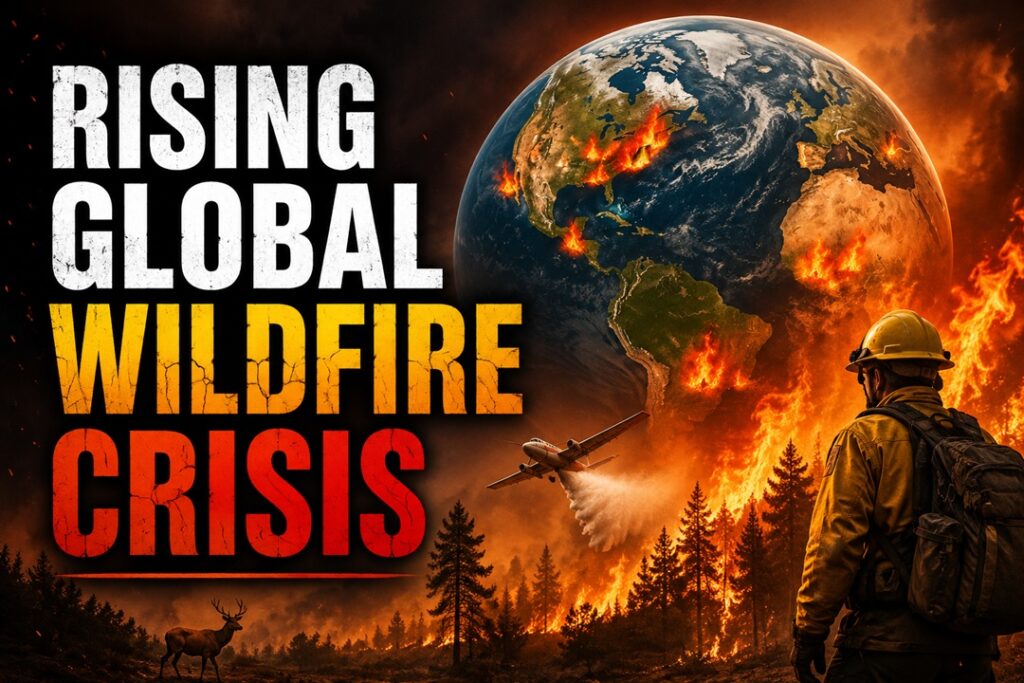
Recently, Southwestern Europe has been battling one of the most destructive wildfire outbreaks in decades, with prolonged heatwaves, drought, and strong winds accelerating the spread of fires. Similar incidents are also being reported across Canada, India, and other regions, highlighting the growing global challenge of forest fires.
Understanding Forest Fires
What is a Forest Fire?
A forest fire, commonly called a wildfire or vegetation fire, is an uncontrolled fire that spreads through forests, grasslands, shrublands, or other natural ecosystems. It consumes dry vegetation and expands depending on factors such as wind speed, terrain, humidity, and temperature.
Major Causes
- Human activities such as land clearing, unattended campfires, discarded cigarettes, and intentional burning.
- Climate-related factors including prolonged droughts, rising temperatures, and heatwaves.
- Natural causes like lightning strikes, though these account for a relatively small share of incidents.
Categories of Wildfires
Canopy (Crown) Fires
- Spread rapidly through the tops of trees.
- Considered the most destructive and difficult to control due to their intensity.
Surface Fires
- Burn fallen leaves, dry grass, twigs, and forest litter.
- Usually less severe and comparatively easier to extinguish.
Subsurface (Ground) Fires
- Burn beneath the surface in peat, humus, and organic soil.
- Progress slowly but can continue for long periods and are difficult to eliminate completely.
Major Wildfires in History
Peshtigo Fire (1871, United States)
- Burned nearly 1.2 million acres in Wisconsin.
- Caused an estimated 1,200–2,500 deaths, making it North America’s deadliest wildfire.
Great Fire of 1910 (United States)
- Swept across nearly 3 million acres in Idaho and Montana.
- Resulted in 87 fatalities, mostly firefighters, and reshaped U.S. wildfire management.
Black Dragon Fire (1987, China–Russia Border)
- Burned approximately 18 million acres along the Amur River basin.
- One of the largest recorded forest fires, causing 211 deaths.
Australian Black Summer Fires (2019–2020)
- Burned around 19 million hectares.
- Destroyed thousands of homes, claimed 33 lives, and affected nearly one billion animals.
Recent Global Wildfire Situation
France
- Massive fires continue to threaten the Bordeaux–Gironde region.
- More than 250,000 residents have been evacuated while firefighters battle expanding flames.
Spain
- Wildfires have severely affected Ávila, Guadalajara, and Castellón.
- Extreme heat and prolonged drought have made recent fire seasons among the country’s worst.
Canada
- Hundreds of active wildfires continue to burn across vast forested regions.
- Smoke has spread into the northern United States, causing significant air-quality concerns.
India’s Escalating Forest Fire Challenge (2026)
Current Situation
- India recorded 5,25,627 forest fire alerts in 2026, the second-highest annual count since 2012.
- Fire incidents during the first two months of the year were over 80% above the decade-long average.
Emerging Patterns
- Major fire outbreaks have been reported in Uttarakhand, Himachal Pradesh, Arunachal Pradesh, Central India, and the North-East.
- Fire seasons are beginning earlier and extending well beyond their traditional duration.
- Regions once considered relatively fire-resistant are increasingly experiencing wildfire events.
Key Drivers
Besides climate change, several human-induced factors are contributing:
- Inadequate forest management focused on plantations rather than ecosystem restoration.
- Expansion of chir pine, whose dry needles are highly combustible.
- Spread of invasive plant species and changing land-use practices.
- Agricultural burning, negligence, and intentional ignition.
- Weakening of traditional community-based forest governance, including Van Panchayats in Uttarakhand.
Experts emphasize that stronger community participation and traditional ecological knowledge can significantly improve wildfire prevention and management.
Why Are Wildfires Becoming More Intense?
Changing Climate
Increasing temperatures, prolonged droughts, and declining soil moisture create favorable conditions for ignition and rapid fire spread.
Fuel Build-Up
Accumulation of dead vegetation, dry leaves, shrubs, and fallen branches provides abundant combustible material.
Land-Use Transformation
Deforestation, poorly managed plantations, and agricultural expansion increase fire vulnerability.
Human Negligence
Uncontrolled agricultural burning, discarded cigarettes, faulty power lines, and unattended campfires remain major ignition sources.
Extreme Weather Events
Strong winds and lightning storms enable fires to spread quickly over vast areas.
Consequences of Forest Fires
Ecological Damage
- Destruction of wildlife habitats.
- Loss of biodiversity and ecosystem balance.
Soil and Water Impacts
- Removal of protective vegetation cover.
- Increased soil erosion, landslides, and sedimentation of water bodies.
Climate Effects
- Large-scale release of stored carbon dioxide, intensifying global warming.
Public Health Risks
- Smoke containing PM2.5 particles increases respiratory and cardiovascular illnesses.
Infrastructure and Economic Losses
- Destruction of homes, roads, utilities, and public infrastructure.
- Significant financial burden due to firefighting, rehabilitation, and disaster recovery.
Measures for Better Wildfire Management
Fuel Reduction
Regular removal of dry vegetation, dead wood, and combustible forest litter under safe weather conditions.
Fire Breaks
Develop cleared strips and natural barriers to prevent the spread of surface fires.
Biomass Utilization
Collect and utilize forest biomass through environmentally sustainable community initiatives.
Early Warning Systems
Use satellite monitoring, remote sensing, and moisture-based fire risk mapping for timely detection.
Surveillance and Rapid Response
Deploy drones, aerial patrols, watch towers, and mobile firefighting teams in vulnerable areas.
Emergency Coordination
Strengthen wildfire control centers for faster communication and emergency deployment.
Public Safety Regulations
Restrict open burning, fireworks, and campfires during high-risk fire seasons.
Defensible Zones
Maintain vegetation-free buffer areas around settlements and forest boundaries to reduce fire spread.
Source : The Hindu