
Quantum–AI Hybrid Technology for Personalized Cancer Vaccine Development
Context
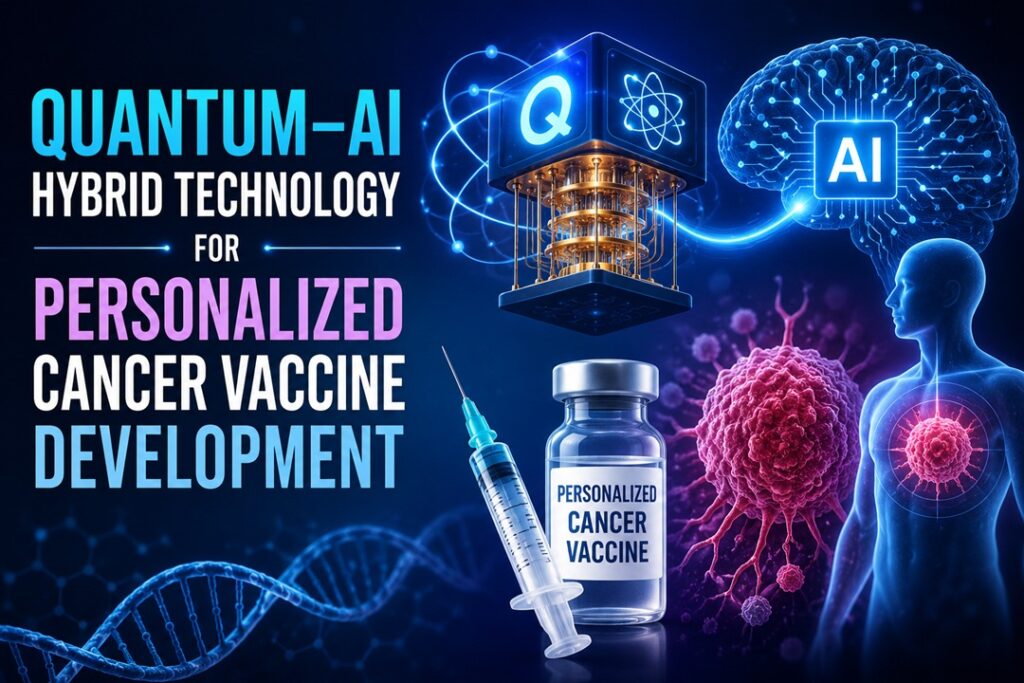
Researchers at the Technical University of Denmark (DTU) have demonstrated that integrating artificial intelligence (AI) with a photonic quantum computer can significantly improve the identification of immune peptides, paving the way for more effective personalized cancer vaccines.
Quantum–AI Hybrid System for Precision Cancer Immunotherapy
What is the Quantum–AI Hybrid Platform?
- It is an advanced computational framework that combines photonic quantum computing with generative AI to improve the discovery of immune peptides used in personalized cancer vaccines.
- Instead of relying solely on conventional randomization, the system employs quantum-generated probability patterns to guide AI toward more promising peptide candidates.
- The approach is particularly valuable for predicting peptides associated with rare Human Leukocyte Antigen (HLA) variants that lack sufficient biological data.
How Does the Hybrid Quantum Computing System Work?
Quantum Bits Instead of Classical Bits
- Classical computers process information using binary bits (0 or 1), whereas quantum computers use qubits, which can exist in multiple states simultaneously through quantum superposition.
Photonic Quantum Processing
- The system uses photons (particles of light) as qubits, enabling data encoding and computation through optical quantum circuits.
Quantum Interference
- Interactions between photons generate structured quantum probability distributions rather than ordinary random values, providing richer computational starting points.
Improved Search Across Complex Data
- These quantum-generated patterns help AI explore vast biological sequence spaces more efficiently, identifying potential vaccine peptides that conventional methods may overlook.
Applications in Personalized Cancer Vaccine Design
Efficient Peptide Discovery
- Immune peptides are short amino acid sequences with an enormous number of possible combinations.
- Quantum-assisted AI rapidly filters these possibilities to identify biologically relevant candidates.
Better Prediction for Rare HLA Variants
- Conventional AI models perform well for common HLA types but often struggle with uncommon genetic variants.
- Quantum-enhanced models improve prediction accuracy for these underrepresented populations.
Enhanced Peptide–HLA Interaction
- The platform designs peptides with stronger binding affinity to HLA molecules, improving their presentation to immune cells and strengthening immune recognition.
Faster Personalized Immunotherapy
- By identifying peptides linked to an individual patient’s tumor mutations, the system supports the rapid development of customized neoantigen-based cancer vaccines.
Challenges and Limitations
No Proven Quantum Supremacy Yet
- Current photonic quantum processors remain relatively small and can still be simulated by powerful classical computers.
Biological Validation Still Required
- Strong laboratory binding between peptides and HLA molecules does not necessarily ensure an effective immune response inside the human body.
Need for More Powerful Quantum Hardware
- Future benefits depend on scalable, fault-tolerant quantum computers and more sophisticated AI models.
Competition from Classical AI
- Continued improvements in classical machine learning algorithms may reduce the performance gap, making comparative evaluation essential.
Importance of the Research
Inclusive Precision Medicine
- Enhances vaccine development for patients carrying rare HLA genetic variants that are often underrepresented in existing datasets.
Experimental Confirmation
- Researchers synthesized and tested the predicted peptides, demonstrating strong laboratory binding performance across difficult HLA targets.
Hybrid Computing Architecture
- Provides a practical model for integrating Noisy Intermediate-Scale Quantum (NISQ) devices with conventional AI for solving complex biomedical problems.
Wider Biomedical Potential
- The same workflow could be adapted for designing vaccines against infectious diseases, developing therapies for autoimmune disorders, and discovering novel protein-based treatments.
Conclusion
The integration of photonic quantum computing with artificial intelligence marks an important step toward next-generation computational medicine. By leveraging quantum-generated probability distributions, researchers can improve peptide discovery, particularly for genetically diverse populations. Although larger and more capable quantum hardware is still required, this hybrid approach has the potential to accelerate personalized cancer vaccine development and expand the future applications of precision medicine.
Source : The Indian Express