
India’s Legal Information System and the Need for Digital Reform
Context
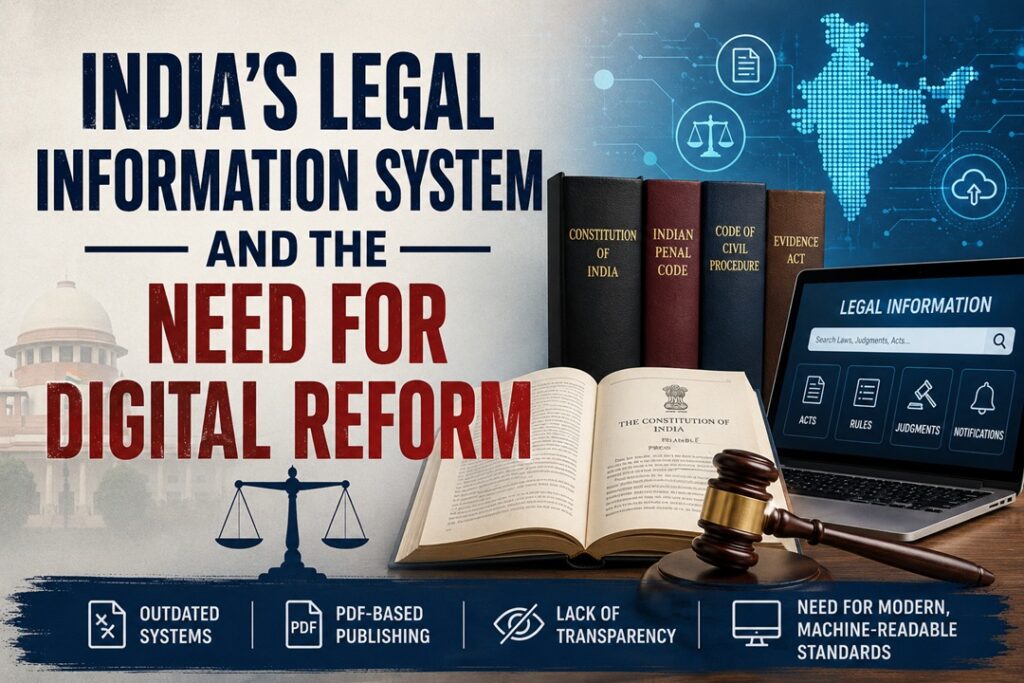
Concerns have grown over India’s fragmented legal information framework, where laws are primarily published in static PDF formats, making legal documents difficult to search, interpret, and track. Experts have highlighted the need for a modern, machine-readable legal publishing ecosystem to improve transparency, accessibility, and legal certainty.
What is a Legal Information Management System?
Meaning
A legal information management system is a structured digital framework through which governments publish, organise, update, and provide public access to laws, regulations, judicial decisions, and legal notifications.
Objective
It helps maintain authentic legal records, enables timely updates, and ensures citizens, courts, businesses, and policymakers can easily access applicable laws.
Major Elements
Primary Legislation
These include Constitutions, Acts, Bills, Ordinances, and statutory amendments enacted by legislatures, forming the backbone of the legal framework.
Judicial Decisions
Court judgments and legal precedents interpret statutory provisions and influence the application of law in future cases.
Reference Materials
These include legal commentaries, academic writings, law reports, manuals, and journals that assist in understanding and interpreting legal principles.
How do leading countries publish legal documents?
African Nations
Several African countries have adopted Akoma Ntoso, an international XML-based legal document standard.
They also use the open-source Indigo platform, which enables:
- Digital drafting and publication of legislation
- Automatic incorporation of amendments
- Version-wise comparison of laws
- Historical tracking of legal provisions
- Linking subordinate legislation with parent Acts
United States
The U.S. publishes legislation using the United States Legislative Markup (USLM) standard.
Key Highlights
- Bills and statutes are released in structured machine-readable formats.
- Multiple digital formats such as HTML and PDF are generated automatically.
- Archived editions of legal publications remain digitally accessible.
- Open standards encourage innovation by researchers, legal-tech firms, and civil society organisations.
United Kingdom
The UK publishes legislation through a central legal portal using Crown Legislation Markup Language (CLML), which supports structured and continuously updated legal documents.
What are the major shortcomings of India’s current legal publication framework?
Fragmented Legal Sources
Legal provisions are spread across multiple websites, gazette notifications, departmental portals, and publications, making it difficult to identify the latest applicable law.
Static Documentation
Heavy reliance on scanned documents and PDF files limits searchability, comparison, automation, and digital processing.
Amendment Tracking Issues
Frequent legal changes are not consolidated systematically, creating confusion over which provisions remain in force.
Weak Digital Infrastructure
India lacks an integrated legal database supported by structured metadata, open digital standards, and advanced multilingual search capabilities.
Limited Public Participation
Although consultation policies exist, many legislative proposals are introduced without extensive public engagement or transparent feedback mechanisms.
How does this affect citizens and businesses?
Low Legal Awareness
Scattered legal information and complicated amendments make it difficult for ordinary citizens to understand their legal obligations.
Rising Litigation
Ambiguities in applicable laws often lead to avoidable disputes, increasing court cases, delays, and litigation costs.
Regulatory Complexity
Businesses, particularly MSMEs, struggle with multiple compliance portals, changing regulations, and overlapping notifications, increasing compliance expenses.
Digital Inequality
People in rural and underserved regions face greater challenges because of language barriers, limited digital literacy, and poor access to legal assistance.
Increased Judicial Workload
Courts and legal professionals spend significant time identifying updated legal provisions instead of focusing on dispute resolution.
What initiatives has the Government undertaken?
India Code Portal
Provides online access to Central legislation, though comprehensive integration of subordinate legislation and historical versions remains limited.
e-Gazette Platform
Digitally publishes Acts, Rules, Notifications, and Ordinances while gradually improving online availability.
Digital India Programme
Promotes digital governance, paperless administration, and technology-driven public service delivery.
National e-Governance Plan (NeGP)
Strengthens electronic governance and improves citizen access to government services.
Right to Information Act, 2005
Enhances transparency by ensuring public access to government-held information.
Pre-Legislative Consultation Policy, 2014
Encourages publication of draft legislation and stakeholder consultations before enactment, though implementation remains uneven.
What reforms can strengthen India’s legal publishing ecosystem?
Digital-First Publishing
Replace static PDF-based publication with structured, machine-readable legal formats based on internationally accepted standards or an indigenous equivalent.
Integrated Legal Portal
Develop a single authenticated platform bringing together Central and State laws, Rules, Regulations, Notifications, Circulars, and subordinate legislation.
Automatic Version Control
Provide real-time consolidation of amendments with historical versions and date-wise legal timelines.
Multilingual Legal Access
Publish searchable legal texts in all Schedule VIII languages using Unicode-based digital formats.
AI-Powered Legal Services
Introduce intelligent search, automated summaries, amendment tracking, cross-referencing, and natural-language legal queries.
Participatory Lawmaking
Expand public consultation by publishing draft legislation in advance and making stakeholder responses publicly accessible.
Universal Accessibility
Design mobile-friendly legal platforms with disability-friendly features and simplified language summaries to ensure wider public access.
Source : The Hindu