
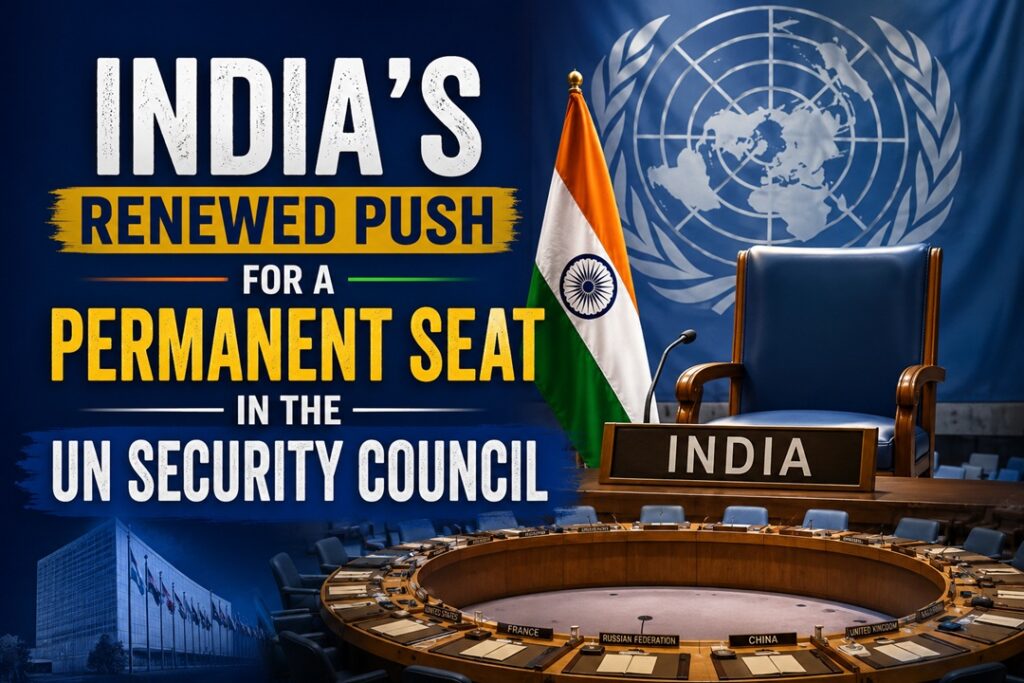
India’s Renewed Push for a Permanent Seat in the UN Security Council
Context
External Affairs Minister S. Jaishankar recently launched SHANTI (Securing Holistic Advancement through Norms, Trust and Integrity), India’s campaign for election as a non-permanent member of the UN Security Council (UNSC) for the 2028–2029 term.
The campaign also reiterates India’s long-standing aspiration for permanent membership of the UNSC and underlines the growing demand for comprehensive reforms to make the Council more representative of present-day global realities.
India’s Bid for Permanent Membership in the UNSC
About India’s Permanent Membership Campaign
What does it mean?
India’s pursuit of a permanent seat in the United Nations Security Council reflects its objective of securing a stronger and lasting role in global peace and security governance. While periodic non-permanent memberships provide opportunities to influence international discussions, permanent membership would enable India to participate continuously in critical decisions on global conflicts, sanctions, and peacekeeping with greater institutional authority.
Evolution of the United Nations Security Council
Formation of the UNSC (1945)
Following the Second World War, the UN Charter established the Security Council with five permanent members—the United States, the United Kingdom, France, the Soviet Union (now Russia), and China—each possessing veto powers.
Expansion of Elected Membership (1965)
The Council increased the number of elected non-permanent members from six to ten, expanding total membership to fifteen while leaving the permanent structure and veto system unchanged.
Creation of the G4 Alliance (2005)
India, Brazil, Germany, and Japan formed the G4 coalition to jointly advocate for permanent representation in a reformed Security Council, while also supporting greater African participation.
Concerns over Decision-making Deadlock
Repeated use of the veto by permanent members during international crises has often prevented timely action, strengthening calls for institutional reform and improved credibility.
Why India is Considered a Strong Candidate
Largest Population Representation
India represents the world’s largest population, giving voice to nearly one-fifth of humanity in international governance.
Rising Economic Influence
As one of the world’s fastest-growing major economies and among the largest globally, India plays an increasingly significant role in international economic affairs.
Distinguished Peacekeeping Record
India has contributed nearly 300,000 military personnel to around 50 UN peacekeeping operations since 1948, making it one of the organisation’s leading troop contributors.
Extensive Diplomatic Experience
Having served eight terms as a non-permanent UNSC member, India has consistently demonstrated its ability to build consensus and bridge diverse international viewpoints.
Leadership of the Global South
India actively champions the interests of developing countries while promoting inclusive principles such as Vasudhaiva Kutumbakam (One Earth, One Family, One Future).
Major Obstacles to India’s Permanent Membership
Difficult Constitutional Amendment Process
Any reform of the Security Council requires approval by two-thirds of the UN General Assembly and ratification by all five permanent members, making reforms extremely difficult.
China’s Opposition
China continues to oppose India’s permanent membership, largely due to regional strategic considerations and geopolitical competition.
Resistance from the Uniting for Consensus Group
Countries such as Italy and Pakistan, along with other members of the Uniting for Consensus (Coffee Club) group, oppose the expansion of permanent seats in the Security Council.
Reluctance of Existing Permanent Members
Current permanent members remain cautious about expanding permanent membership or extending veto privileges, fearing a reduction in their own influence.
Regional Representation Disputes
Differences among countries regarding which states should permanently represent Asia, Africa, and Latin America continue to delay consensus on reform.
The Way Ahead
Expanding International Support
India should use initiatives such as the SHANTI campaign and future non-permanent terms to strengthen diplomatic partnerships across the UN membership.
Advancing Formal Reform Negotiations
Encouraging text-based Intergovernmental Negotiations (IGN) can help transform broad discussions into concrete proposals for Security Council reform.
Strengthening Strategic Partnerships
India can continue enhancing cooperation through platforms such as the Quad, G20, BRICS, and the International Solar Alliance to expand its diplomatic influence globally.
Considering Transitional Reform Models
Supporting proposals that initially provide permanent membership without immediate veto rights may help build wider international acceptance.
Building Wider Coalitions
Closer coordination between the G4 countries and the African Union’s Ezulwini Consensus can improve prospects for securing the required General Assembly support.
Conclusion
India possesses the demographic strength, economic capacity, diplomatic experience, and peacekeeping credentials expected of a permanent UNSC member. However, institutional barriers and resistance from existing permanent members continue to delay meaningful reform. A more representative Security Council is essential for strengthening the legitimacy, effectiveness, and credibility of the United Nations in addressing contemporary global challenges.
Source : The Print